
SUPPLEMENTARY RECORD / 2014
The Missing Pieces
Ninety minutes of the town that was removed so the girl could be seen
David Lynch shot more than five hours for Fire Walk with Me and released two. What he removed was, overwhelmingly, Twin Peaks — Ed and Norma, the Double R, the sheriff's station, the Hornes, the ordinary business of a town — because the film had to stay on Laura Palmer and the town kept pulling focus off her. That footage was inaccessible for twenty-two years, and became the fandom's most-wanted object in Twin Peaks. In 2014 Lynch assembled it himself, in scene order, as a ninety-one-minute companion. It is supplementary and HELD: it is genuine production material handled by the author, and it is not the film. Its value is not that it explains anything — it mostly does not — but that it demonstrates, by subtraction, exactly what the 1992 cut was for.
STATUS / HOW THE ARCHIVE FILES IT
What This File Is
The Missing Pieces is not a director's cut, an extended edition, or an alternative version of the film. It is a sequence of discarded and extended scenes, running roughly in story order, with no attempt to reassemble them into a narrative. Scenes begin and end without context. Some run seconds.
Two facts give it more standing than an ordinary deleted-scenes reel, and both. It was assembled by Lynch himself, not by a distributor. And it was released as a component of Twin Peaks: The Entire Mystery, alongside the series and the film, rather than as a bonus disc.
Critical readingthe position here is nonetheless firm. Authorial assembly establishes provenance, not canon. Lynch cut this material deliberately, for reasons he stated plainly at the time — it was tangential and it slowed the progress of the main story — and a decision to make discarded footage available twenty-two years later is not a reversal of the decision to discard it.
The Missing Pieces therefore stands where this archive places Frost's dossiers and Scott Frost's autobiography: consistent with the record, valuable, occasionally decisive on small matters, and never controlling.
EXTENDED / THE OTHER TOWN
More of Deer Meadow
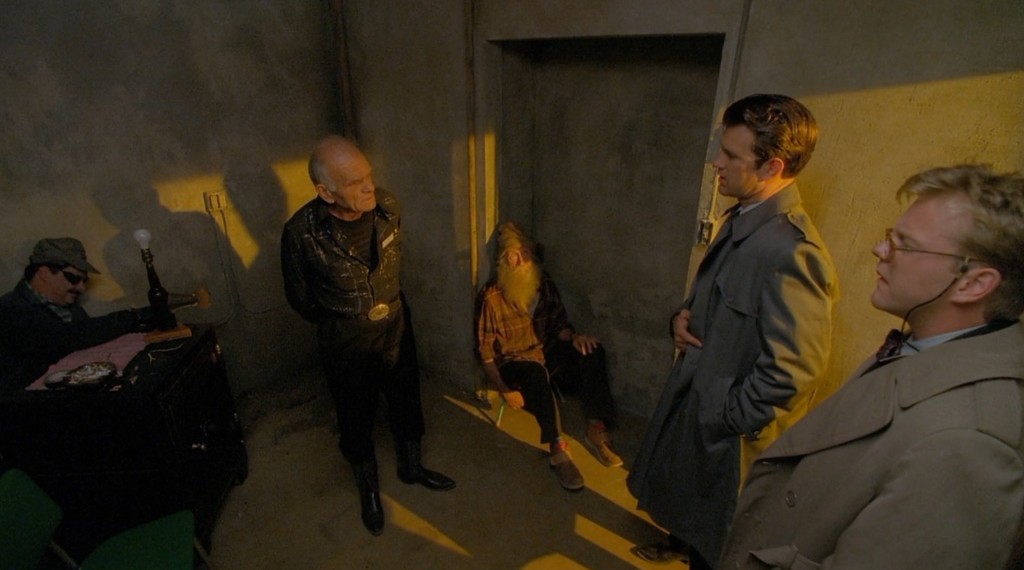
The Chester Desmond and Sam Stanley investigation runs considerably longer here. More of Hap's diner and its waitress; more of Sheriff Cable's obstruction and Desmond's handling of it; more of the two agents' working relationship, which the film compresses to a few exchanges.
Critical readingThis material is the least mysterious and among the most useful in the compilation, because it strengthens a reading the film already supports. The Deer Meadow prologue exists to show the same crime processed by a town that does not care, and the more time the footage spends on that indifference the sharper the comparison becomes.
It also gives Desmond weight. In the finished film he disappears roughly forty minutes in, having been competent and likeable but thinly drawn. With this material he is a fully realised agent — which makes his removal by the ring register as a loss rather than a transition.
DEER MEADOW / MOTIVE
What Teresa Worked Out
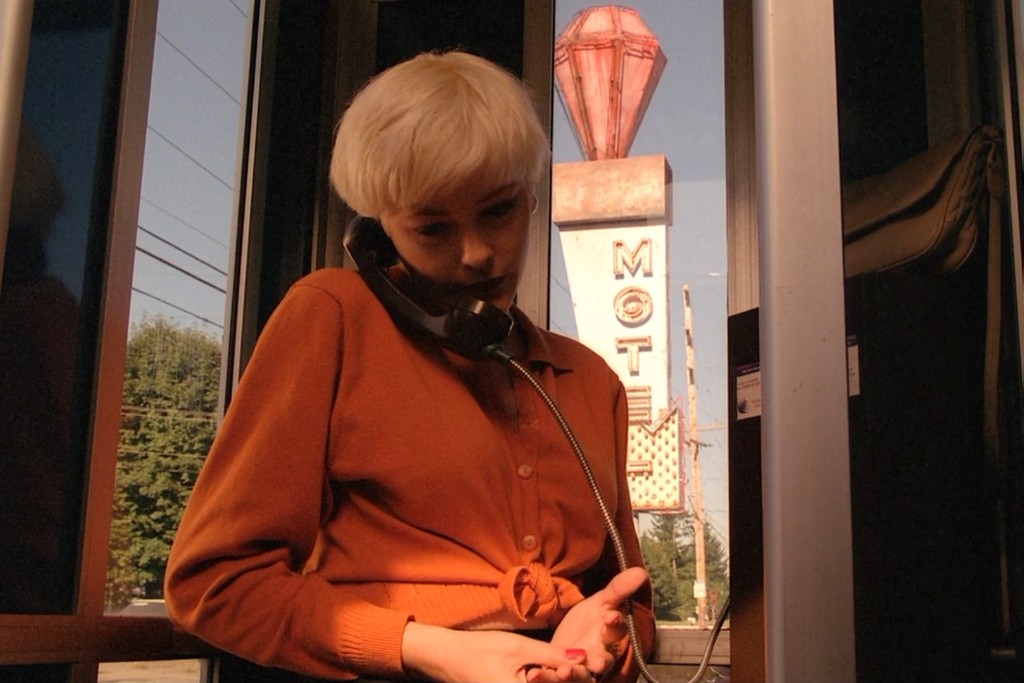
The compilation states, in plain dialogue, what the theatrical cut only lets the audience infer: Teresa Banks worked out that Leland Palmer was Laura's father — and tried to blackmail him with it.
Critical readingThis is the single most consequential thing in ninety minutes of discarded footage, and states the consequence without softening it.
The film's opening case has always been Twin Peaks's control sample: the same killer, the same ring, the same letter under the fingernail, a year earlier, in a town that did not care. What the theatrical cut leaves open is why Teresa Banks. The Lodge reading answers that BOB required a victim and found one. This scene answers something colder.
Teresa Banks was killed to keep her quiet. Not selected, not offered up, not required — silenced, by a man protecting a secret, for the oldest and most ordinary reason there is. The first murder in the Palmer case has a motive that would satisfy a homicide detective who had never heard of the Black Lodge.
Twin Peaks has always run two accounts of Leland Palmer in parallel — a man inhabited, and a man responsible — and refused to collapse them. This scene weights the second. Blackmail requires a man who understands his own exposure, calculates, and acts on his own behalf. It is not the behaviour of a vessel.
The material nonetheless stays HELD, and it does not settle the question. It is discarded footage; Lynch removed it; and the theatrical cut's refusal to supply a legible motive for Deer Meadow is itself a decision the film makes. The fact and the bracket belong together: on this evidence, the first killing was an act of self-preservation, and the film chose not to say so.
EXTENDED / PHILADELPHIA
Jeffries, at Length
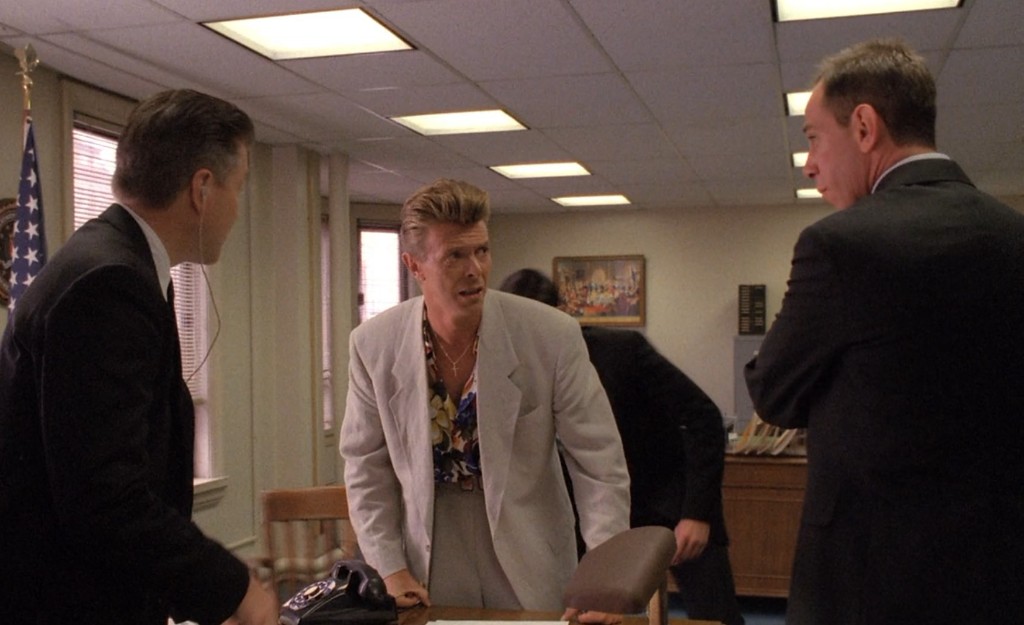
The Philadelphia sequence — a fragmentary burst in the film — runs longer and more legibly here. Phillip Jeffries gives Gordon Cole, Cooper and Albert Rosenfield more of his account of where he has been.
The core of it is a report of attendance: "I been to one of their meetings. It was above a convenience store." He describes finding something in Seattle, at Judy's, and then — there they were — and that they sat quietly for a long time.
He works out what the date is. Then he is gone.
Critical readingThe paradox is the most instructive thing in the compilation.
The extended Jeffries material is more comprehensible and less effective. In the film, Jeffries arrives, produces language that will not resolve, and is gone before the scene can be processed; the audience is left in the condition Cooper is left in. Given more time, the sequence begins to behave like exposition, and the terror leaks out of it.
This is the clearest available demonstration of what Lynch's edit was doing. He was not removing weak material. He was removing explanation, on the grounds that the Blue Rose category is defined by what cannot be explained — the same principle Lil's briefing states in the film's own text.
I been to one of their meetings is the vocabulary of a field agent filing a report: an attendance, a venue, a duration. He is not describing a vision. He is describing having been in a room, above a convenience store, with them, for hours, while they sat there. As Twin Peaks's most frightening formulation of the Lodge, precisely because it is administrative.
EXTENDED / THE PALM DELUXE
Buenos Aires
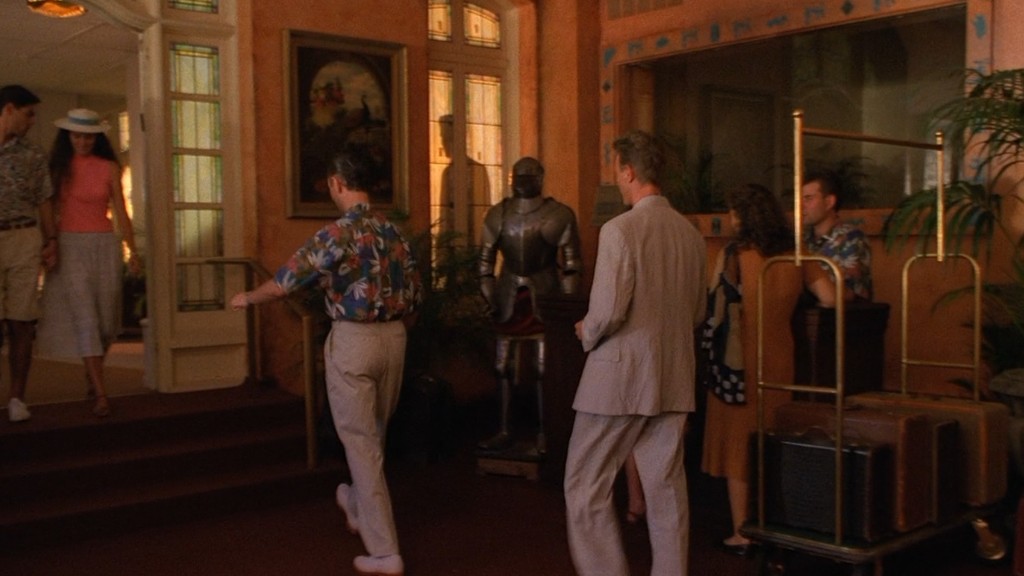
The compilation supplies what the film omits entirely: the other end of Jeffries' disappearance.
He arrives at the Palm Deluxe hotel in Buenos Aires with a suitcase. A harpist is playing in the lobby. He goes to the desk and asks after Judy — whether she is staying there, whether she is waiting. The clerk hands him a paper left for him by a young woman the staff can describe only as la señorita. A bellhop takes his bag; a couple is dancing a tango as they cross the lobby. He takes the lift up.
That is the last of him until the Philadelphia office.
After Philadelphia, he comes back — into a stairwell of the same hotel, disoriented, in distress, unable to make himself understood. A maid and a bellhop are there when it happens.
Critical readingThree findings hold. A fourth stays open.
Judy is a person he was trying to meet. Not an incantation, not a code word: a name he asks a hotel clerk about, at a desk, in the ordinary way a man asks after somebody he has arranged to see. And she is not there. She has left him a piece of paper instead. Twin Peaks's most withheld name enters the record as a missed appointment.
The disappearance is bracketed by hotel staff. A bellhop carries his bag up; a bellhop is standing there when he comes back. The Lodge does not take Jeffries out of a stone circle or a dream. It takes him out of a lift in a working hotel and returns him to a service stairwell, and the only witnesses are people on shift.
He cannot report. The film shows Jeffries producing language nobody can use; the compilation shows the same man, in the same week, checking in like a professional on an assignment. The distance between the two states is the whole of what happened to him, and it is never depicted — only the before and the after.
The dates stay OPEN. The film's editing places the Philadelphia appearance and the Buenos Aires return in 1988; the compilation and later material place them in 1989, and the staff who see him return are the staff from his 1987 stay. The discrepancy stands rather than being repaired, and a man who steps out of sequence is exactly the wrong subject on whom to enforce a calendar.
EXTENDED / THE MEETING
Above the Convenience Store
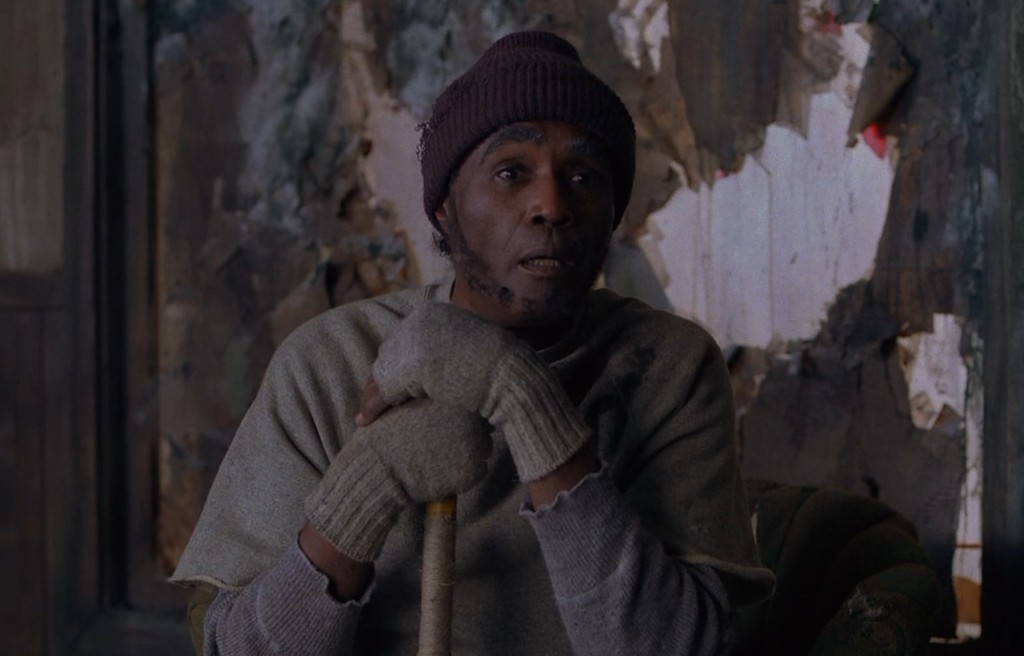
The meeting Jeffries reports attending runs longer here than in the film, and its population is legible.
In the foreground: the Man from Another Place and BOB. Behind them: the Jumping Man — a figure in a loud suit and a long-nosed plaster mask — the Electrician, Mrs. Tremond and her grandson, and two Woodsmen. The grandson is wearing a mask of the same kind as the Jumping Man's.
The furniture of the scene is specific and recurs across Twin Peaks: a green Formica table with chrome trim, the green ring, electricity, and the subject under discussion — garmonbozia. A utility pole numbered 6 appears, with the Arm's whooping cry over it.
Critical readingWhat the extended sequence establishes stands on its own; no cosmology is built on it.
It is a meeting. Not a rite and not a summoning. There are attendees, an agenda item, furniture and a venue, and Jeffries' own word for it is the one used here. Twin Peaks's supernatural does not convene in a grove; it convenes in a rented room over a shop, and the item on the table is the accounting for pain.
The Woodsmen, the Jumping Man and the Electrician are present in 1992 and go undeveloped for twenty-five years, until The Return puts Woodsmen in a New Mexico desert and a South Dakota jail. Continuity as a matter of fact and brackets everything The Return makes of it.
The numbered pole is filed and not interpreted. It recurs at the Palmer house, at Deer Meadow, and in The Return; no source in thirty years explains it. Mechanism OPEN.
And then there are the masks. The Tremond grandson wears one at the meeting and wears one when he hands Laura a picture on a doorstep. The boy who tells her that the man behind the mask is looking for the book with the pages torn out is a member of the meeting that is looking for it.
THE MOTEL ROOM / MIKE ALONE
Twelve Candles
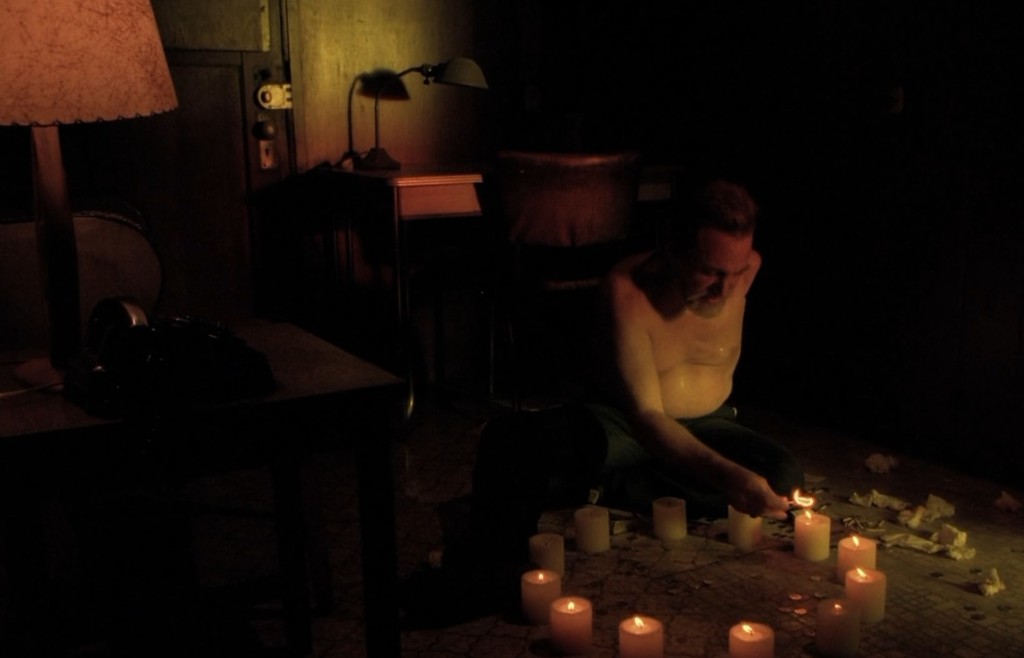
A motel room, near dawn. Philip Gerard is on the floor, shirtless, alone. Twelve candles are set out in a circle in front of him.
He works his way round them, and warbles the words: “Fire… walk… with… me.”
The sequence is reversed. He is not lighting the candles — the flames are being drawn off them — and he is not speaking so much as being played backwards, in the register Twin Peaks has otherwise reserved entirely for the red room.
Critical readingThis is the most significant Gerard material in the compilation, and states the finding in one line: this is the only scene in Twin Peaks that applies the Lodge's grammar to the ordinary world.
Reversed speech and reversed motion are, everywhere else in Twin Peaks, a marker of place. They tell the audience it is inside the Waiting Room. Here the technique is carried out of the red drapes and into a rented room with a telephone and a bedside lamp, and performed by a man the investigation has on file as a travelling shoe salesman. MIKE does not visit the Lodge. He is a piece of it, operating on a motel carpet, at his own initiative, before anyone is awake.
What he is saying does not soften. Fire walk with me is the invocation on the tattoo he cut his own arm off to be rid of. The one entity in this property that renounced BOB is alone in a motel at dawn, in a circle of candles, speaking the line backwards. The file has held throughout that MIKE's renunciation removed him from the production side of the Lodge's economy without removing him from it; this is that finding staged as an image.
The number and the shape are logged and not interpreted. Twelve, in a circle. Twin Peaks's other significant circle is the ring of sycamores at Glastonbury Grove, and its other significant twelve is a clock face. Neither reading is adopted. The mechanism stays OPEN.
What the scene is not. It is not staged as a summoning and nothing arrives. Whatever Gerard is doing, the compilation shows only the doing, and then moves on.
DOMESTIC / THE FAMILY AS IT LOOKED
The Palmer House on Ordinary Days
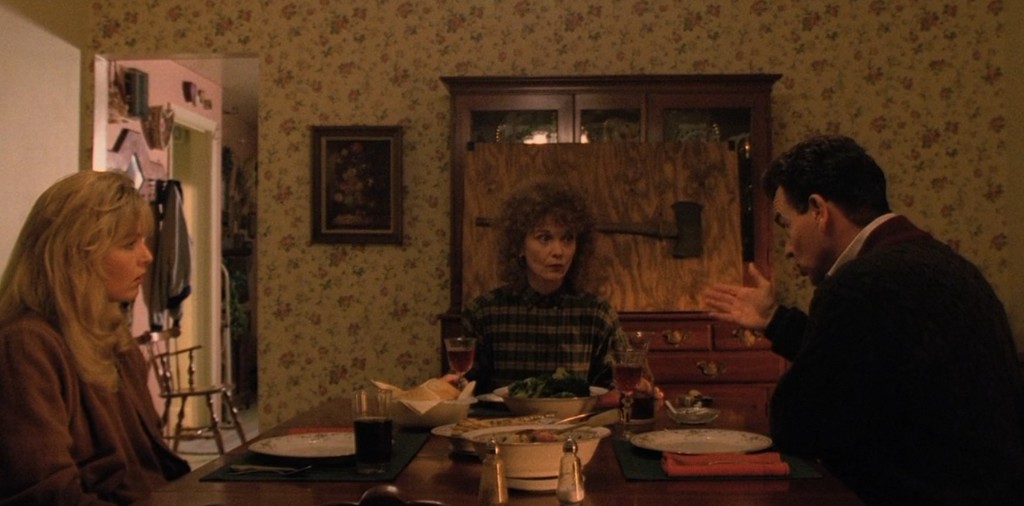
The compilation's most affecting material is the most ordinary. Leland teaches Laura and Sarah Norwegian phrases ahead of a business delegation, and the three of them practise together at the table, laughing. Laura and Sarah talk about honesty. There are breakfasts. There is a family.
On her last night there is another dinner, and Laura pushes asparagus around a plate while her parents talk. Later she goes out. Leland sees her leaving and lets her go.
Critical readingThese scenes are the compilation's genuine contribution to the record, and the reason is worth stating carefully.
The film, by necessity, shows the Palmer household almost entirely at its worst: the interrogation at dinner, the sedative, the bedroom. That is the correct emphasis for a two-hour film about a girl being destroyed. But it can leave an impression that the house was uniformly a torture chamber, which is not how these households work and not what the series showed either.
The Norwegian lesson is the corrective. It is warm, funny and completely sincere, and the man conducting it rapes his daughter. Both are true, in the same kitchen, in the same week. The record shows across thirty episode files that Twin Peaks concealed its central crime behind the ordinary — the town's compassion as camouflage, grief as costume — and this is the most direct evidence available of how that operated at the source. The abuse was not hidden instead of family life. It was hidden inside it.
The Norwegian detail is more than a joke. The delegation Leland is rehearsing for is the Ghostwood investment party — the same Norwegians whose departure the Pilot stages, on the morning the town learns Laura is dead. He is practising pleasantries for a business dinner that will be cancelled by the murder he is about to commit.
The last night stands without comment beyond one line. He watches his daughter go out into the dark, and does not stop her, and knows where the night ends.
THE HOUSE / AN OFFER
The Voice in the Fan
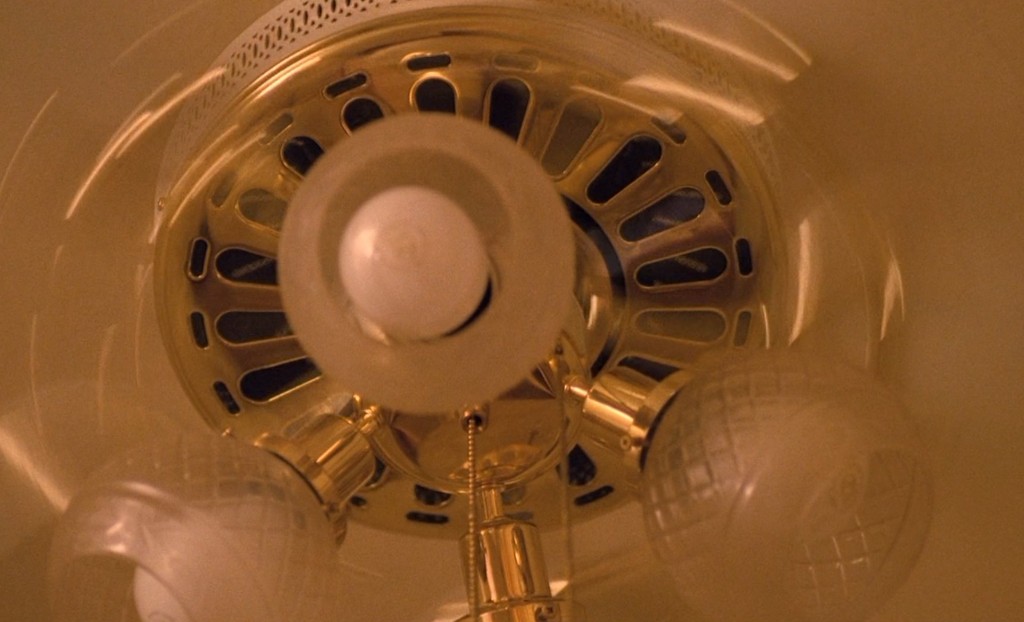
Laura hears BOB's voice coming from the ceiling fan on the landing. He wants to possess her — to taste through her mouth. She goes into something like a trance, and comes out of it only when Sarah interrupts her.
Elsewhere in the house, Sarah says that it is happening again.
Critical readingThe ceiling fan is Twin Peaks's most economical single image, and the film and the series both use it without ever explaining it. The fan turns at the top of the Palmer stairs before every assault in the record; it is the sound the house makes when it is about to happen. Here it speaks.
The content of the offer is significant and holds the mechanism OPEN. Taste through your mouth is a request for the use of a body's senses, not its labour — possession, in this property, is described by BOB himself as an appetite conducted through somebody else's nerves. If BOB requires Laura to be taken rather than simply used, then the film's ending — the ring, the refusal, the killing — has a shape: what she withholds is consent to be inhabited, and she is destroyed for withholding it. The archive has already declined to settle that reading in the film file and does not settle it here on the strength of a deleted scene.
Sarah's line is filed separately and is the more disturbing of the two. It is happening again is the Giant's sentence from "Lonely Souls" — spoken on a Roadhouse stage while Maddy Ferguson is killed — and here it is in Sarah Palmer's mouth, in her own house, before her daughter dies. She says it and does not construct from it what she knew. (See Glossary: The Ceiling Fan.)
23 FEBRUARY 1989 / THE BRIGGS HOUSE
The Basement
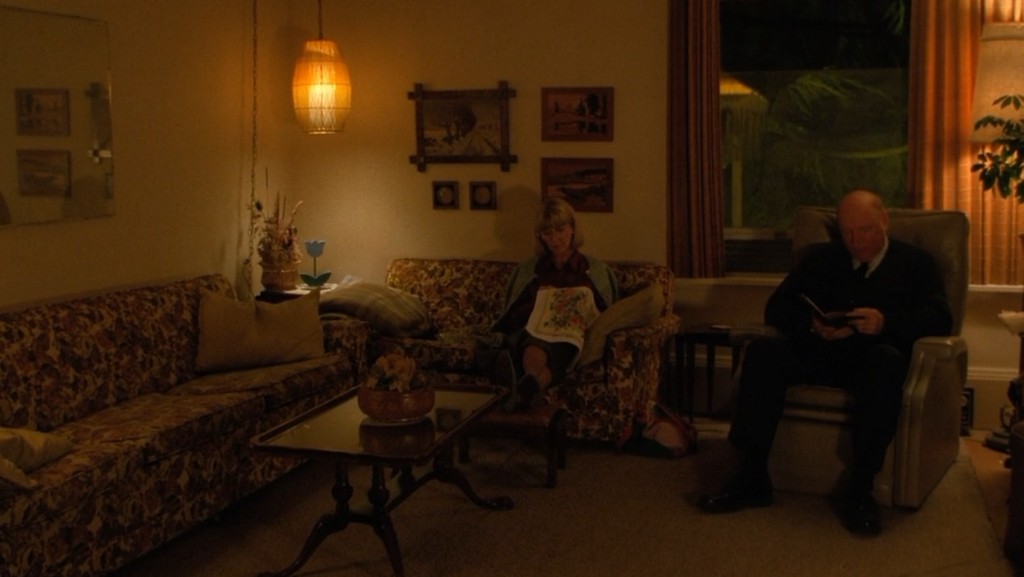
Laura's last full day. In the front room of the Briggs house, Major Garland Briggs is reading aloud to his wife Betty from the Book of Revelation.
Laura comes to the door. Betty lets her in and tells her that Bobby is downstairs. Laura goes down to the basement.
There, Bobby tells her what the buy in the woods actually was: the cocaine they collected — and killed the mule for — was baby laxative.
And there, in the basement, Laura and Bobby break up.
He shows her out. The door closes. He takes out a cigarette and starts to light it, and from the front room his father looks up and tells him to put it out.
Critical readingThis is the most complete scene the compilation restores, and files three findings from it.
The killing was for nothing. The broadcast series treats Bobby's shooting in the woods as plot and as guilt; the compilation makes it absurd. A man died over a bag of laxative, and the two teenagers who were there are standing in a basement working out that they were sold nothing. This is Twin Peaks's flattest statement about the Twin Peaks drug economy: the participants do not know what they are selling, and people die inside the confusion.
Laura ends it. The film gives Laura almost no scenes in which she closes something on her own terms; the last week is a sequence of things being done to her. Here, on the day before she dies, in a basement, she finishes a relationship. It stands alongside the ring in the train car as one of the two acts in this material that are entirely hers.
The house above them is reading Revelation. The placement stands, and nothing is built on it. Laura Palmer spends part of her last full day in a house where a father is reading the end of the world aloud to his wife while, one floor down, his son tells her about a corpse and a bag of laxative. Twin Peaks does not connect the two floors and neither does the file. It notes only that Garland Briggs is the one man in Twin Peaks who will later be shown to have been receiving transmissions, and that on this day he is reading scripture in his living room.
The cigarette is logged as the scene's exit and as the compilation in miniature. A boy who shot a man that week is scolded for smoking in the house. Twin Peaks has never once let the enormous and the domestic occupy separate rooms.
DISCREPANCY NOTE — the Leo debt is given as $5,000 in this material; the Leo Johnson file carries $10,000 from the broadcast series. Bobby separately brings Laura $10,000 in cash to hide.
THE ENSEMBLE / WHAT WAS REMOVED
The Town That Was Cut
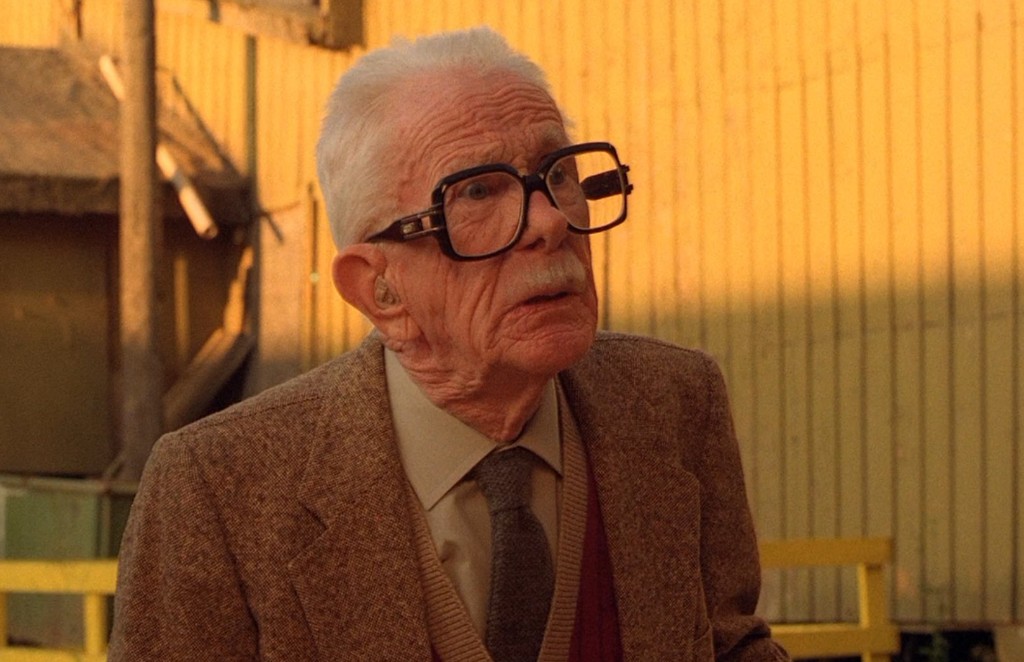
Most of Twin Peaks is in here, and the scenes are specific rather than atmospheric.
Pete Martell talks an aggrieved customer — Dell Mibbler — down over the dimensions of a piece of lumber. Big Ed and Nadine come into the Double R; Nadine sees Norma working and walks out; Ed comes back to apologise, and later he and Norma sit together and talk about what they are. Sheriff Truman, Andy and Hawk plan the arrest of a dealer. Andy, Truman and Lucy talk at the station. Dr. Jacoby is on the telephone.
Critical readingThese scenes account for a substantial share of the film's 1992 reception, and that removing them was correct.
An audience arriving from the series wanted the town. The town is what made Laura's death bearable to watch for thirty hours — the pie, the coffee, the deputies, the jokes. Lynch removed it, and what remained was a girl being raped by her father with no comic relief to cut to. The hostility at Cannes was, in part, an audience discovering that the thing it had enjoyed was the anaesthetic.
Seen in the compilation, the deleted town scenes are pleasant and entirely disposable. They are also, viewed against the film, quietly damning. Pete is arguing about lumber. Ed is apologising to Norma. The deputies are planning a small arrest. All of it is happening in the same week, eleven minutes from a house where a girl is running out of days, and none of it turns toward her. That is precisely the charge the film levels, and Lynch made it more forcefully by taking the reassurance away.
Dell Mibbler, arguing about the dimensions of a board, will be standing in the bank vault in "Beyond Life and Death" when the box explodes, beside the man who is here defusing his complaint. The compilation is full of people Twin Peaks has not finished with.
SEQUEL MATERIAL / THE WAITING ROOM
Cooper and the Little Man
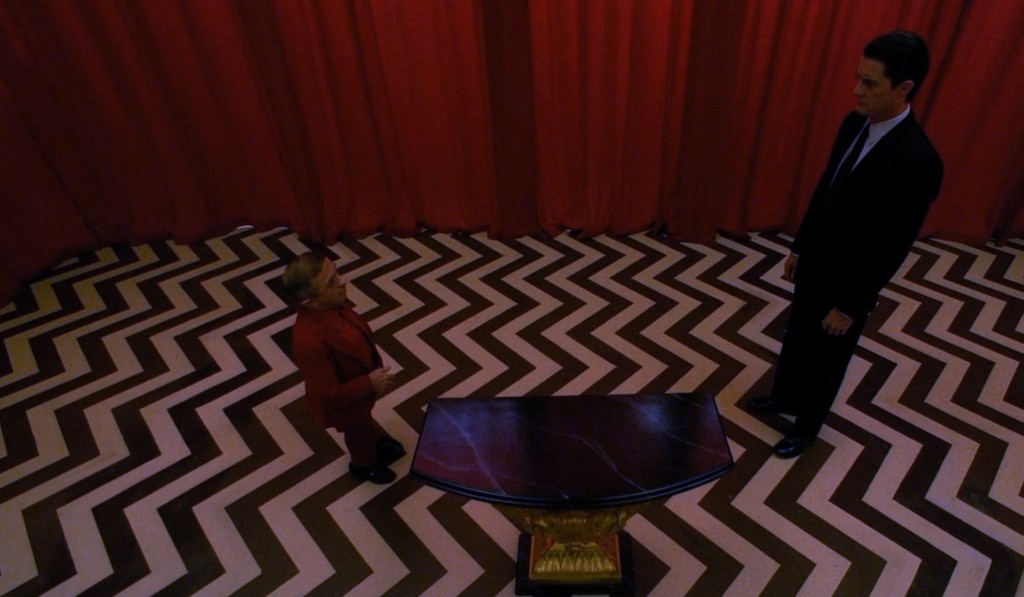
The compilation carries extended Red Room material that the film does not: Cooper and the Man from Another Place, in the room, talking.
The exchange is elliptical and its subject is time — how it unfolds, and what unfolding means in a room that does not keep it. Cooper is asking, in the manner the room permits, where he is and how he is to get out.
The green ring sits on the table in one of these scenes. In another, it does not.
Critical readingTwo findings hold. A third does not.
The room is not stable between takes. The ring is Twin Peaks's single most contested object — worn by Teresa Banks, reached for by Chester Desmond, thrown to Laura in the train car, taken off Annie's hand in a hospital bed — and across two versions of the same Red Room scene it is present and then absent. This is a matter of record rather than a puzzle. Whatever else the Waiting Room is, it does not hold its own furniture still.
Cooper is asking the wrong entity. The Man from Another Place is not a guide. He is the severed limb, the creditor, the party that turns up at the end of Fire Walk With Me to be paid. Cooper, in the room, is putting procedural questions — where am I, how do I leave — to something whose interest in his departure is at best commercial. The record shows since the Waiting Room scene in "Beyond Life and Death" that everything this entity tells Cooper is true and none of it helps him.
A third move is refused here, which would be to read these scenes as an answer to the finale. They are discarded footage from a film shot before the finale's consequences were written, and Twin Peaks's own account of Cooper's confinement is stated twenty-five years later, by a tree, in Part 2. This material is filed as HELD and is not used to complete anything.
PENDING — the archive does not yet carry the verbatim dialogue of these scenes. No transcript of the delivered sequence has been located that the file is willing to quote from, and after an earlier failure on this page the archive will not reconstruct Red Room dialogue from a screenplay or from summary. The lines will be entered when a trustworthy source supplies them.
CONTINUITY / AFTER THE FINALE
Annie's Hospital Room
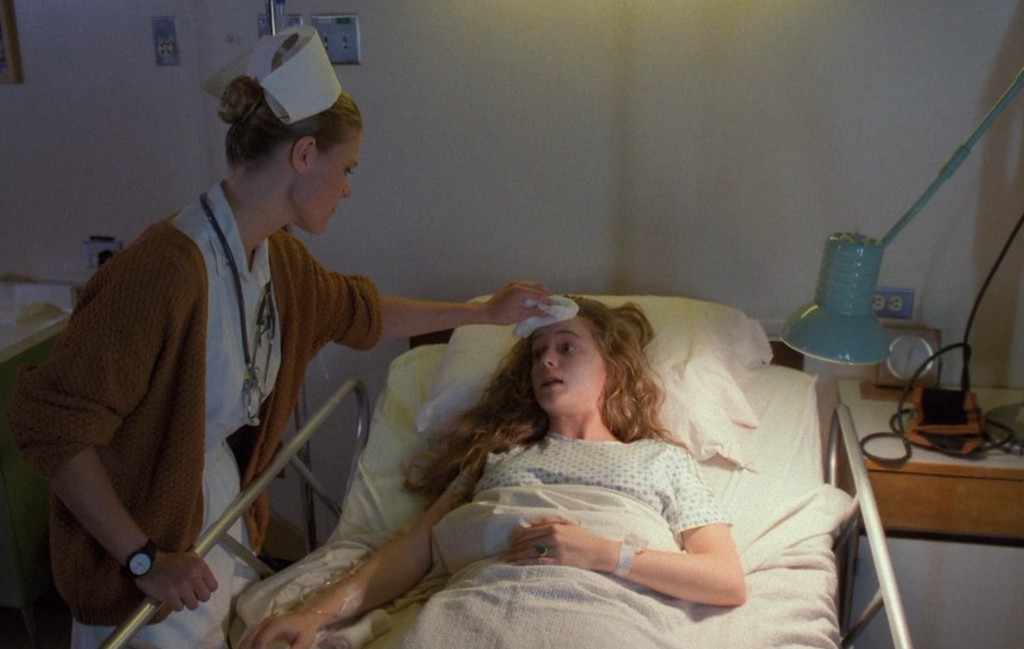
Annie Blackburn lies in a hospital bed after Glastonbury Grove. A nurse takes the green ring from her hand.
Critical readingThis is the compilation's most consequential single scene, because it is the only screen material of any kind that follows Annie past the last frame of "Beyond Life and Death." The broadcast series left her unconscious in the woods, and the final scene told the audience only that Truman said she would be all right — in a hotel room where the man asking after her was no longer himself.
The ring is the film's own object: worn by Teresa Banks, reached for by Chester Desmond, thrown to Laura in the train car. That it comes out of the Lodge on Annie's hand, and is then taken off it by a stranger, extends the chain past the point the record otherwise stops.
Annie's disposition stays HELD, and no outcome is constructed from it. Frost's The Final Dossier addresses her later, from a narrator at one remove, and that material is bracketed and filed separately. What this scene establishes is narrower and enough: Annie came back out, the ring came back out with her, and it did not stay still.
THE NIGHT ITSELF / A WITNESS IN THE DARK
She Heard It
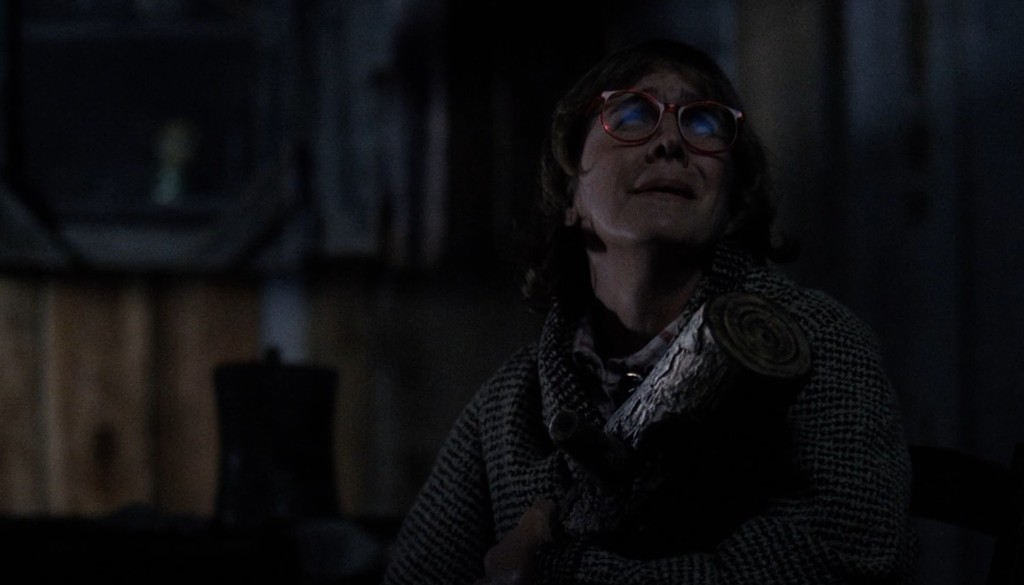
As Leland kills Laura in the train car, her screams carry through the woods — and Margaret Lanterman, holding her log, hears them.
Critical readingThis is the scene that quietly settles an argument the series ran for two seasons.
Margaret told the investigation in "Cooper's Dreams" what the log had registered that night: darkness, laughter, owls, two men, two girls, footsteps, screams far away, one voice. The town treated her as its eccentric for twenty years.
The compilation shows her receiving it. She is not channelling and she is not divining. She is within earshot. The one person in Twin Peaks nobody believed was, on the night in question, the only one listening — and the scene puts the audience beside her while it happens, with nothing to look at.
CONTINUITY / AFTER THE MIRROR
The Coda After the Mirror
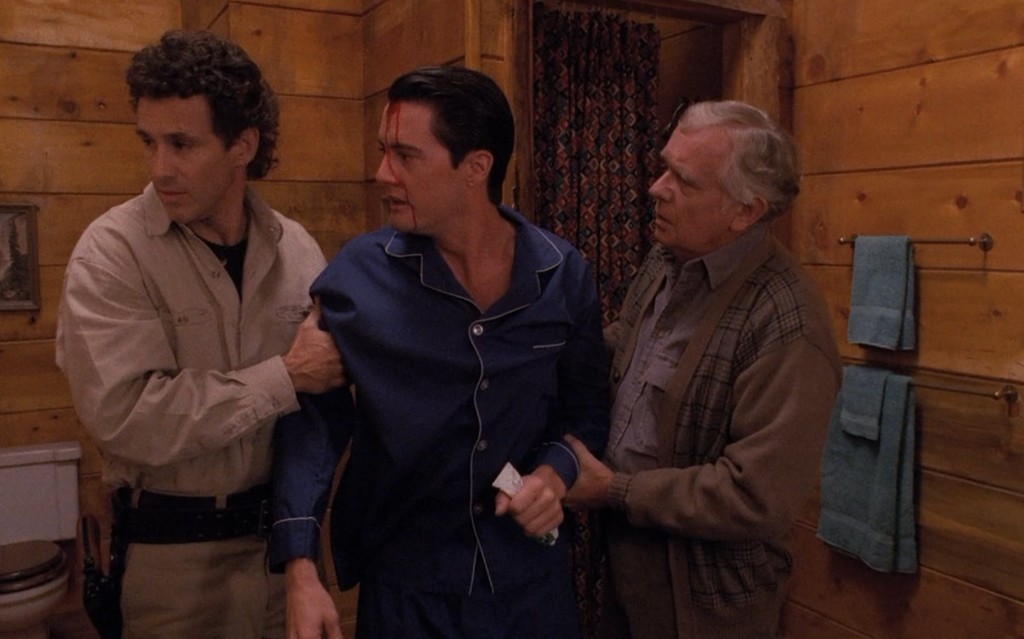
The compilation's final scene continues past the broadcast series' last image. Cooper's doppelgänger — head split, blood on his face — is attended by Sheriff Truman and Doc Hayward, who hear him injure himself. Told to go back to bed, he answers, cheerfully, that he has not brushed his teeth yet.
The credits then roll over a shot of creamed corn on a spoon, captioned garmonbozia (pain and sorrow).

This is the strangest object in the compilation and declines to treat it as a resolution.
The finale's last frame remains the correct end of the broadcast record: BOB in the glass, the repeated question, the laugh. What this scene supplies is a few seconds of what the following minute looked like — two men who have known Dale Cooper for two years standing in a corridor with something wearing him, hearing it make a joke about oral hygiene, and not knowing.
The horror is entirely in Truman and Hayward. They are behaving correctly. They are concerned about a head wound. The thing in front of him is performing normality just competently enough, and The long-running finding — that this town's decency is what conceals what is done inside it — receives one last demonstration in a deleted scene.
The credit image is the compilation's actual last word, and as the correct one. Fire Walk With Me ended on Laura's face; ninety minutes of everything Lynch removed from it ends on a spoonful of the substance her suffering was converted into. As the bluntest statement Twin Peaks ever makes about its own economy.
SUPPLEMENTARY LEDGER / WHAT THE FILE ADDS
What the File Adds
Deer Meadow extended
Fuller Desmond–Stanley investigation; more of the sheriff's obstruction and the town's indifference. Strengthens the film's opening argument.
Teresa Banks blackmailed Leland
She deduced that Leland was Laura's father and tried to use it. The first murder acquires an ordinary, human motive: silencing. Decisive on the possession question, and still HELD.
Jeffries, at length
"I been to one of their meetings. It was above a convenience store." Something found in Seattle, at Judy's. He works out the date and vanishes. More legible and less effective.
Buenos Aires: the Palm Deluxe
Jeffries checks in, asks the desk after Judy, is handed a paper left by a young woman, and goes up in the lift. He returns after Philadelphia into a stairwell, unable to speak, in front of a maid and a bellhop. Judy enters the record as a missed appointment.
The meeting above the store, populated
The Arm and BOB in front; the Jumping Man, the Electrician, Mrs. Tremond and her masked grandson, and two Woodsmen behind. Green Formica table, the ring, electricity, garmonbozia, a pole numbered 6. Mechanism OPEN.
MIKE’s candle circle
A motel room near dawn: Gerard shirtless on the floor with twelve candles in a circle, warbling “Fire… walk… with… me” in reverse while the flames are drawn off them. The Lodge’s technique performed outside the Lodge. Mechanism OPEN.
The Palmer family at ordinary strength
Norwegian lesson before the Ghostwood delegation; Laura and Sarah on honesty; the asparagus dinner on the last night; Leland watching his daughter go out and letting her.
BOB speaks from the ceiling fan
He wants to taste through her mouth. Laura goes into a trance; Sarah breaks it, and elsewhere says it is happening again. Bears on the possession/consent reading of the ring. Mechanism OPEN.
The Briggs house, 23 February 1989
Major Briggs reads Revelation aloud to Betty; Betty sends Laura down to the basement, where Bobby tells her the drugs they killed a man for were baby laxative, and where Laura ends the relationship. He is scolded for lighting a cigarette on the way out.
The ensemble town, restored
Pete and Dell Mibbler; Ed, Nadine and Norma at the Double R; Truman, Andy and Hawk planning an arrest; Lucy at the station. Pleasant, disposable, retrospectively damning.
Extended Red Room material
Cooper and the Man from Another Place in the Waiting Room, on the unfolding of time. The green ring is on the table in one version of the scene and absent in another. Verbatim dialogue not yet carried; see the pending note.
Annie Blackburn in hospital; the ring taken
The only screen material following Annie past the finale. A nurse takes the green ring from her hand. Disposition HELD; the chain continues.
Margaret Lanterman hears the screams
The log's testimony in S1 E5 was earwitness account, not divination. The town's least credited witness was the closest one.
Coda past the mirror
The doppelgänger with Truman and Doc Hayward, insisting on brushing his teeth. The compilation's last scene. Credits run over a spoonful of creamed corn, captioned garmonbozia (pain and sorrow).
ANALYSIS / SUBTRACTION AS METHOD
Why It Was Cut, and What It Proves
The overall judgement is that The Missing Pieces is the most useful supplementary object in Twin Peaks, and that its usefulness runs opposite to the way such objects usually work. Deleted scenes normally reveal what a film failed to include. This one reveals what a film succeeded in refusing.
Three refusals are legible across the ninety minutes.
REFUSING COMFORT
The town scenes are warm and would have made the film watchable in the way the series was watchable. Lynch removed the anaesthetic and released the operation.
REFUSING EXPLANATION
The longer Jeffries material makes the Blue Rose material more parseable and less frightening. Legibility was the thing being cut.
REFUSING THE SHOW
The Annie and doppelgänger scenes tie the film to the cliffhanger the audience wanted resolved. Keeping them would have made the film a sequel to the series. Cutting them made it a film about Laura.
For twenty-two years this material was the show's great absence — bootlegged stills, transcribed scripts, an object of collective longing. Its eventual release in 2014 came bundled with the box set that preceded The Return's announcement by four months, and the sequence without asserting a causal claim: the town came back into circulation, and then the town came back.
RECORD / HOW IT SURVIVED
Production Record
Lynch shot in excess of five hours of material for Fire Walk with Me and delivered roughly 134 minutes, stating that the removed scenes were too tangential to keep the main story moving and that the film had to stay on Laura Palmer.
The footage then sat for twenty-two years. The obstacle was not legal but practical and financial: restoring, editing, mixing and colour-grading the material to a releasable standard required an agreement between Lynch and the home-video rights holders that neither side moved on for two decades. The impasse ended when CBS Home Entertainment and Lynch agreed a comprehensive package combining both television seasons with the film — Twin Peaks: The Entire Mystery — with the assembled deleted material as a component.
Lynch edited the compilation himself. It premiered at the Vista Theatre in Los Angeles on July 16, 2014 and shipped with the box set on July 29. The Criterion Collection later included it with its release of the film.
Reviews treated it as what it is: a series of vignettes rather than a feature, valuable for its portrait of Laura's isolation and the town's inattention, and deliberately unwilling to resolve the Lodge questions or the fates left open by the finale.
Source trail
- Twin Peaks: The Missing Pieces (2014) — deleted and extended scenes from Fire Walk with Me, assembled and edited by David Lynch. Released within Twin Peaks: The Entire Mystery (CBS Home Entertainment, July 29, 2014); premiered July 16, 2014.
- Twin Peaks: Fire Walk with Me (1992) — the controlling record; see the film dossier.
- Lynch on Lynch (Chris Rodley, revised edition 2005) — Lynch on the volume of footage shot and the decision to focus the cut on Laura.
- Room to Dream (David Lynch and Kristine McKenna, 2018) — the film's production and its long aftermath.
- Mark Frost, The Final Dossier (2017) — later disposition of Annie Blackburn. Bracketed; filed HELD.
- Blue Rose Archive — Fire Walk with Me, S2 E22 dossier, S1 E6 dossier (the log's testimony), Laura Palmer file, Margaret Lanterman file, Phillip Jeffries file, Glossary: The Ceiling Fan.
- Published scene accounts of the Briggs house sequence (Major Briggs reading to Betty, Betty admitting Laura, the basement conversation, the break-up and the cigarette) and of the candle sequence — Lost in the Movies, Phillip Gerard (Twin Peaks Character Series #53), and corroborating scene descriptions — consulted July 2026 for the count of twelve, the reversal, and the spoken line.
- Verification — the release facts (premiere date and venue, box set, runtime, editor) and the scene inventory on this page were checked in July 2026 against Wikipedia (Twin Peaks: The Missing Pieces, Phillip Jeffries), the Twin Peaks Blog location study of the Palm Deluxe, and published reviews and scene accounts. Corrections made on audit: the compilation closes on the doppelgänger coda, not on the Log Lady; the nurse is recorded as taking the ring, not wearing it; Sheriff Truman is present in the coda alongside Doc Hayward. Dates for the Jeffries disappearance are left OPEN because sources conflict. Corrected on audit: Laura is admitted to the Briggs house by Betty Briggs, not by the Major, and the baby-laxative disclosure and the break-up both occur in the basement.