
SCREEN RECORD / SEASON 2 / EPISODE 1
May the Giant Be With You
A wounded agent, three unpaid clues, and a town that will not stop for either
Season 2 does not open a new binder. It opens on Cooper bleeding into the Great Northern carpet while every unfinished Season 1 machine — One Eyed Jacks, Leo’s body, Laura’s lookalike cousin, classified fathers, pregnancy gossip — keeps running. The Giant’s three clues arrive as gift and debt. What follows maps what the hour actually stages before later episodes cash the riddles in.
CLIFFHANGER / DURATION
Blood on the Floor
Season 1 ended with a gunshot in Cooper’s room; Season 2 begins by refusing to skip the cost. Cooper is down on the Great Northern carpet — conscious enough to suffer, not yet granted a clean recovery montage. Harry Truman, Doc Hayward, and eventually Albert turn the hotel room into a field hospital. The investigator has become the body. Hospitality architecture (hallway, phone, room service) has to decide whether it can still protect the man who arrived to protect the town.
Lynch holds the wound longer than network habit prefers. Comedy will return — Albert’s insults, Lucy’s logistics — but it enters a room that already contains blood. The premiere’s first lesson is ethical before it is mythological: Twin Peaks will not always cut from violence into puzzle.
VISITATION / THREE STATEMENTS
The Giant’s Three Clues
While Cooper lies wounded, a Giant appears — calm, enormous, oddly courteous, as if keeping an appointment rather than staging a haunting. He offers three statements and takes Cooper’s ring as collateral until the debt of understanding is paid:
- “There is a man in a smiling bag.” (Later payout, not this hour’s closed ID: Jacques Renault’s body in a morgue bag — the smile frozen on the face. Cooper will connect the phrase to that image; authorship of Jacques’s death is a separate file.)
- “The owls are not what they seem.” (Later adjacency: Major Briggs’s classified monitoring weather; the phrase will travel beyond folklore.)
- “Without chemicals, he points.” (Later payout: Philip Gerard / the one-armed man, off the drugs that suppress MIKE, pointing toward what Cooper needs to see.)
On first viewing these are riddles, not answers. The episode does not annotate them. It asks Cooper — and the audience — to keep them active while ordinary investigation continues. The ring as collateral is the hour’s quiet theology of method: supernatural help is not free information. Something is held back until attention catches up.
BUREAU / LOYALTY UNDER INSULT
Albert Returns
Albert Rosenfield returns with forensic contempt intact and, under pressure, unmistakable care for Cooper. He bullies the room, fights for medical control, and lets the insults remain the social form while urgency and protectiveness do the real work. Season 1 established Albert as abrasive instrument; this premiere lets the instrument reveal attachment without a sentimental conversion speech.
His presence also restates the institutional frame: Twin Peaks is still a federal murder investigation even while Giants, owls, and soap orbits compete for airtime. Ballistics and blood chemistry have not been retired by curtain rooms. When Cooper is stable enough to stand again, Albert’s return has already answered a quieter question — whether the Bureau still has a body in this town that will bleed for Cooper the way Cooper bleeds for the case.
THRESHOLD / HOSPITALITY
The Waiter Who Is Also the Giant
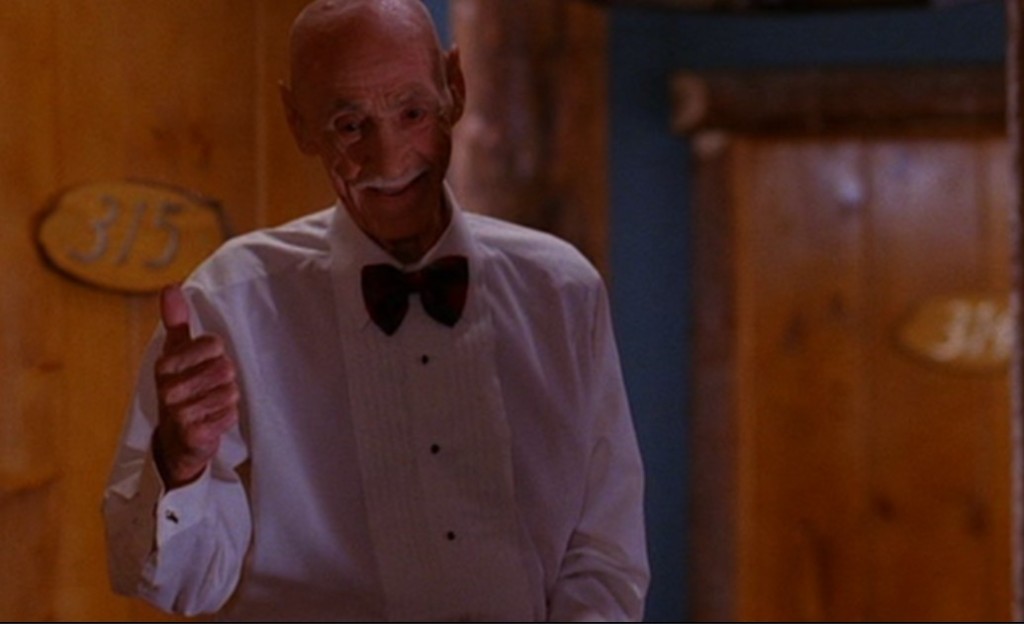
After the visitation, Cooper encounters an elderly room-service waiter who shares the Giant’s face — Carel Struycken in ordinary hotel clothes, pouring coffee as if the Lodge had taken a temp job at the Great Northern. The rhyme softens the supernatural into hospitality weather: Lodge adjacency dressed as service, not as a second special-effects reel.
The episode refuses to explain the rule. Is the waiter a mask, a rhyme, a joke the cosmos tells in Twin Peaks’s preferred register? The file can hold the doubling; it cannot close the ontology. What matters for method is that Cooper treats both encounters as real enough to act on — clue-bearing without becoming a sermon.
HORNE ECONOMY / CAPTIVITY
Audrey at One Eyed Jacks
Audrey’s Season 1 infiltration hardens into captivity and bargaining. Blackie O’Reilly runs the floor; Emory Battis’s presence tightens the link between the perfume counter’s recruitment pipeline and the casino upstairs. The premiere makes audible what Season 1 implied: Ben Horne is not merely a customer of One Eyed Jacks — he sits inside its ownership structure. Audrey learns the shape of her father’s secret economy from inside it.
Jean Renault’s orbit presses at the edges — trafficking, revenge, and cross-border violence waiting to claim the vacuum Leo’s coma creates. The murder case and the sex-and-drug case are no longer parallel hobbies; they share personnel, money, and rooms. Cooper’s wound does not pause Audrey’s danger.
PALMER HOUSE / DOUBLING
Maddy Arrives — Laura’s Face Returns
Madeleine Ferguson — Laura’s cousin from Missoula — arrives looking enough like Laura to restart the town’s nervous system. Donna and James fold her into their grief triangle; the Palmer house receives another body that wears the missing girl’s face. The premiere does not yet turn that resemblance into the living-room murder Arc 05 will later hold. Here the double is still social and erotic pressure: imitation as mourning, mourning as risk.
Leland’s grief continues in public registers — song, dance, performance that Season 1 already made dangerous. Sarah’s household remains a site where ordinary family roles cannot contain what Laura’s death opened. Maddy’s arrival is kindness that the deep file will later read as exposure.
AFTERMATH / DEBT
Leo in Coma · Shelly & Bobby
Leo Johnson survives Season 1’s violence as a coma patient — a body that still organizes Shelly’s fear and Bobby’s debt even while unconscious. Hospital rooms become the new roadside. Shelly’s path out of Leo’s marriage is not clean; Bobby’s courage remains mixed with self-interest. The drug economy that ran through Jacques, Leo, and the Canadian line does not end because one trucker cannot wake up.
Hank Jennings’s parole weather and the Renault machinery wait to exploit exactly this vacuum. The premiere plants the board; later hours move the pieces.
WITNESS / IMAGE
Ronette Names the Face
Ronette Pulaski — still the living path out of the train car — is shown images and reacts with terror to the face the investigation has been circling: BOB. The identification is somatic before it is verbal. She cannot yet deliver a clean courtroom narrative; she can deliver recognition. The hour treats that recognition as evidence of fear attached to a face, not as a finished metaphysics of inhabiting spirits.
Cooper’s dream vocabulary from Season 1 and Ronette’s waking terror begin to share an object. The file still lacks a mechanism. It has a pointed finger of flesh and a pointed finger of dream waiting to meet.
CLASSIFIED FATHER / MESSAGE
Briggs · Owls on the Wire
Major Garland Briggs enters the social frame as Bobby’s father and as a man whose work does not fit the mill-town résumé. Dinner-table warmth sits beside classified silence. Through his monitoring weather the phrase returns in a form Cooper can hear as confirmation rather than folklore: the owls are not what they seem. The Giant’s second clue and Briggs’s deep-space / deep-woods apparatus rhyme without becoming a PowerPoint.
For the Ledger, this is the first loud Screen handshake between Case 89’s Bureau plot and Listening Post Alpha’s orbit — still years before Mayday. For this episode alone, it is enough that Cooper learns the owl line is not only a riddle spoken over his bleeding body.
CIVIC SURREALISM / SOAP ENGINES
Lucy, Andy, Nadine
Lucy Brennan tells Andy she is pregnant — civic comedy with real stakes, timing jokes that will haunt the station for episodes. Nadine Hurley’s drape-cord suicide attempt fails into injury, eyepatch, and a personality fracture that Season 2 will milk as both gag and unease (high-school regression, later super-strength). Ed’s marriage becomes another haunted house.
These plots are easy to dismiss as “Season 2 soap.” The premiere’s structural point is sharper: Twin Peaks will run Lodge visitation and drape-cord farce in the same week because the town’s nervous system does not separate them. Evaluating later sprawl starts here — with Lynch still able to hold both temperatures in one feature-length open.
CASE LEDGER / WHAT ENTERS THE FILE
Clue Ledger
Cooper is the body
S1 shooter’s aftermath: Great Northern carpet, field medicine, recovery as plot rather than ellipsis.
Three clues + ring collateral
Smiling bag / owls / chemicals — held as active riddles; ring taken until understanding pays.
Albert reasserts Bureau force
Insults + loyalty; forensics still claim the case beside dream weather.
Waiter = Giant rhyme
Hospitality double; ontology OPEN.
One Eyed Jacks tightens
Audrey inside; Ben’s ownership audible; Renault pressure at the edge.
Maddy’s face enters
Laura’s cousin as living resemblance; Donna/James triangle reloads.
Ronette recognizes BOB
Image-terror as witness act; mechanism still OPEN.
Briggs confirms the owl line
Classified father; Giant’s second clue finds a wire.
Domestic engines start
Pregnancy reveal; Nadine’s drapes; Leo’s coma as unfinished debt.
DAVID LYNCH / OPENING THE SECOND SEASON
Lynch’s Season-Open Grammar
Like the Pilot, the premiere is long enough to refuse weekly compression. Lynch braids visitation with soap, Bureau procedure with hotel absurdity, classified quiet with pregnancy farce. The Giant is not a jump-scare; he is an appointment. The waiter joke is not a punchline that cancels the omen; it is Twin Peaks’s preferred way of telling the truth — sideways, through service industry faces.
Season 2 will later sprawl, soften, and sometimes lose the Pilot’s ethical focus. This opener still knows how to hold wound, joke, clue, and omen in one room. Judging later episodes against this premiere is fairer than judging them only against Season 1 nostalgia. The hour’s achievement is tonal permission: the show announces it will try to be many temperatures at once. Whether it can sustain that permission is the rest of the season’s problem.
PRODUCTION RECORD
Production Record
Broadcast September 30, 1990 on ABC as a feature-length Season 2 premiere. Continuous series numbering often lists it as Episode 8 (Pilot through S1 E7 as Episodes 1–7). Story by Mark Frost and David Lynch, teleplay by Frost alone; directed by Lynch — his return to the chair after Season 1’s later multi-director stretch. Carel Struycken plays both the Giant and the elderly waiter; the dual casting is the production’s clearest formal joke and its cleanest metaphysical rhyme.
The German broadcast title May the Giant Be With You later became the common English shorthand, the same home-video pattern that renamed several Season 1 hours. Contemporary U.S. listings often used generic episode numbering. Audience expectation in autumn 1990 was still sky-high; the premiere’s job was to reopen the wound and multiply the boards — murder, trafficking, family doubles, classified sky — before the season’s notorious middle stretch tested how many boards one show could carry.
Performance notes worth filing: Kyle MacLachlan plays pain without surrendering Cooper’s courtesy; Miguel Ferrer’s Albert finds the season’s first unmistakable note of love-under-insult; the One Eyed Jacks material extends the Horne economy Frost and Lynch had already wired into Season 1’s appetite plots.
Source trail
- Twin Peaks Season 2 Episode 1 (ABC, September 30, 1990) — primary screen record.
- Wikipedia — May the Giant Be With You: credits, runtime, broadcast notes (reference, not canon).
- Brad Dukes, Reflections: An Oral History of Twin Peaks (2014) — Season 2 launch testimony.
- Season 1 finale dossier — cliffhanger this hour inherits.
- Ledger · Arc 05 — later Lodge / Giant / Maddy path; do not back-date killer closure into this premiere.
- Ledger · Arc 04 — Case 89 physical grammar Ronette still carries.
- Dale Cooper · Albert · Briggs · Audrey
- Series guide · Season 2