The deep file meets the public crime: Teresa Banks in 1988, Laura’s last days, the February 24 opening, early federal evidence — then Doc’s Kauai leaf, Briggs’s Mayday, Preston’s seal. Same card rhythm. The killer is not closed on opening day.
The signed pattern begins one county west, before Twin Peaks knows Laura’s name as a case title.
00.1HELDScreen
Teresa Banks murdered — Deer Meadow, 1988
1988 · Fire Walk With Me
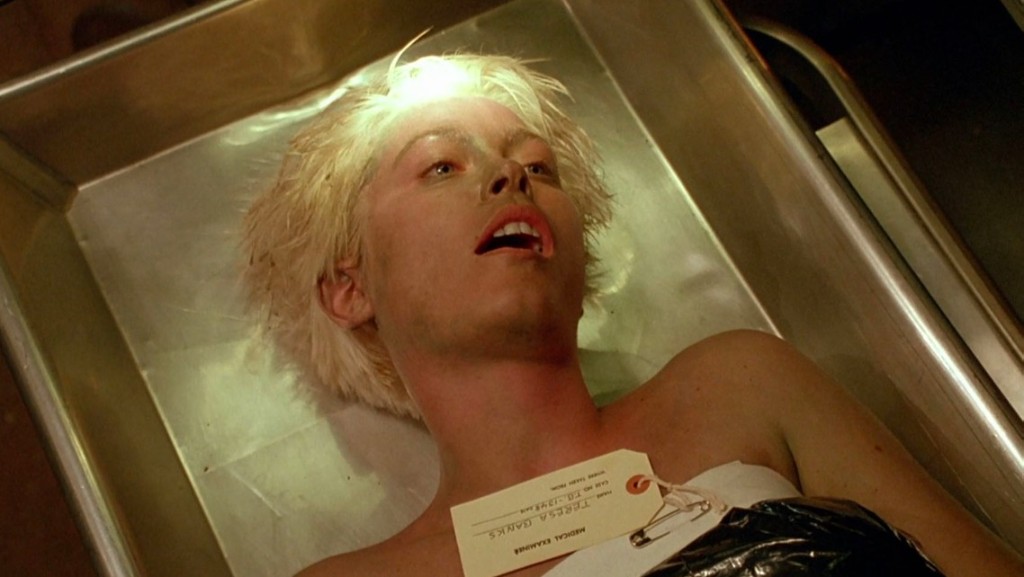
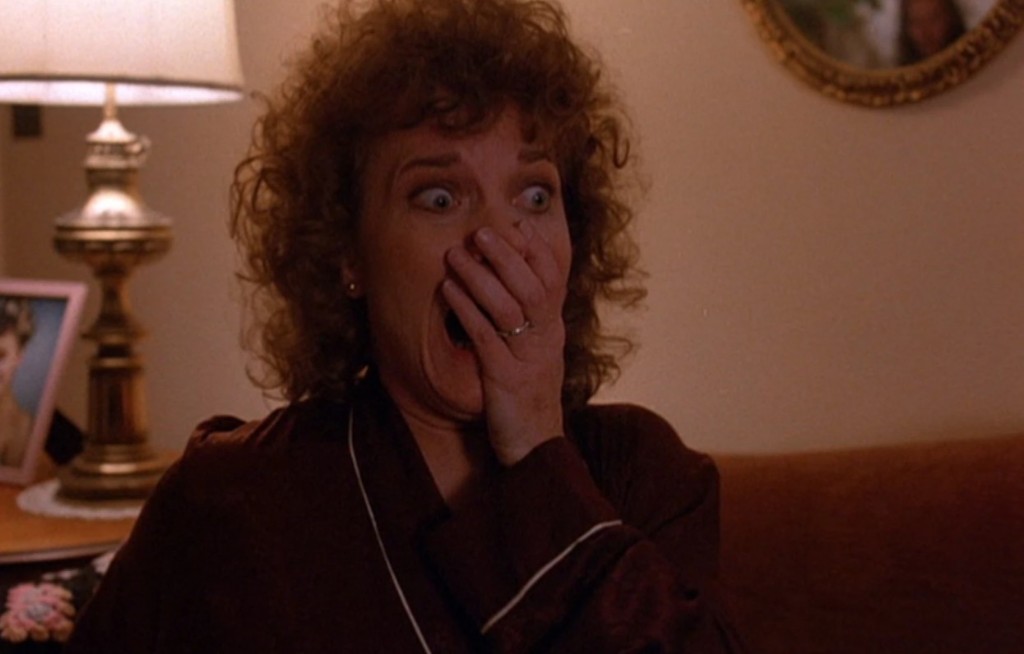
A year before Twin Peaks learns Laura’s name as a case title, Deer Meadow already has a body. Teresa Banks — transient, under-protected, easy for a sullen town to misfile — is murdered. The film opens on that county’s hostility and institutional friction, not as color, but as the first jurisdiction that will refuse to help the next one. Cooper will later speak her name on the Pilot as if the pattern were already sworn; this card is where that pattern begins in flesh.
Prior victim HELD on screen. Killer withheld here — the arc’s opening nodes keep Deer Meadow as signed absence, not as closed motive.
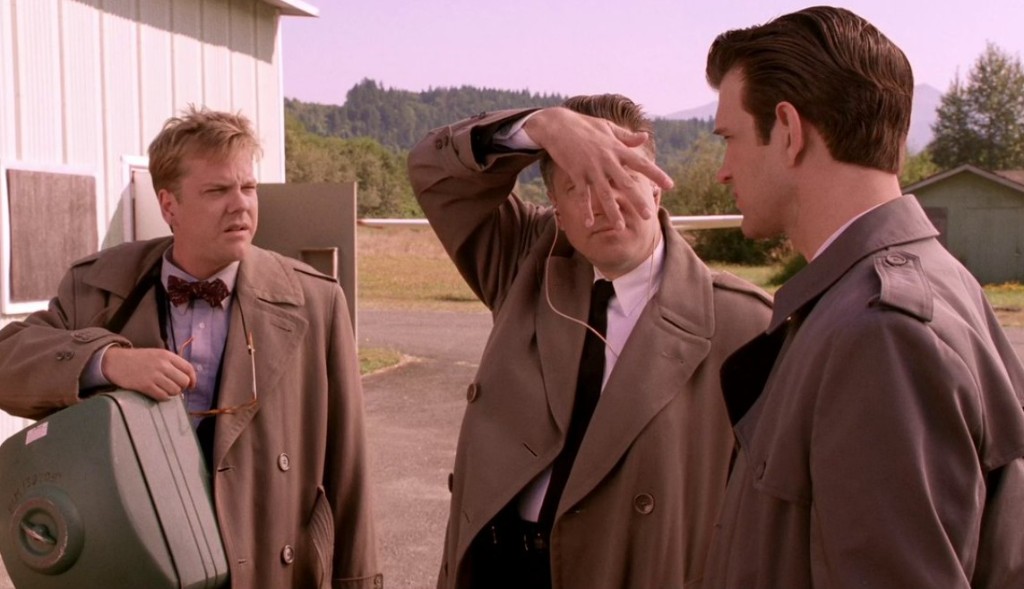
Gordon Cole — by then chief of the Philadelphia Bureau office — sends Special Agent Chet Desmond and forensic specialist Sam Stanley west. On screen they arrive into a town that wants them gone. In Frost, the Archivist underlines Deer Meadow as “sullen, sinking and hostile,” logging decline as civic weather — “everything Twin Peaks was not.” The dispatch is federal force applied to a place that answers with obstruction; the dossier keeps asking why Philadelphia owns an eastern-Washington murder at all.
Agents and dispatch HELD (Screen + Frost). Motive for Philadelphia’s hand remains the dossier’s open question — “You might well ask” — not answered inside this card.
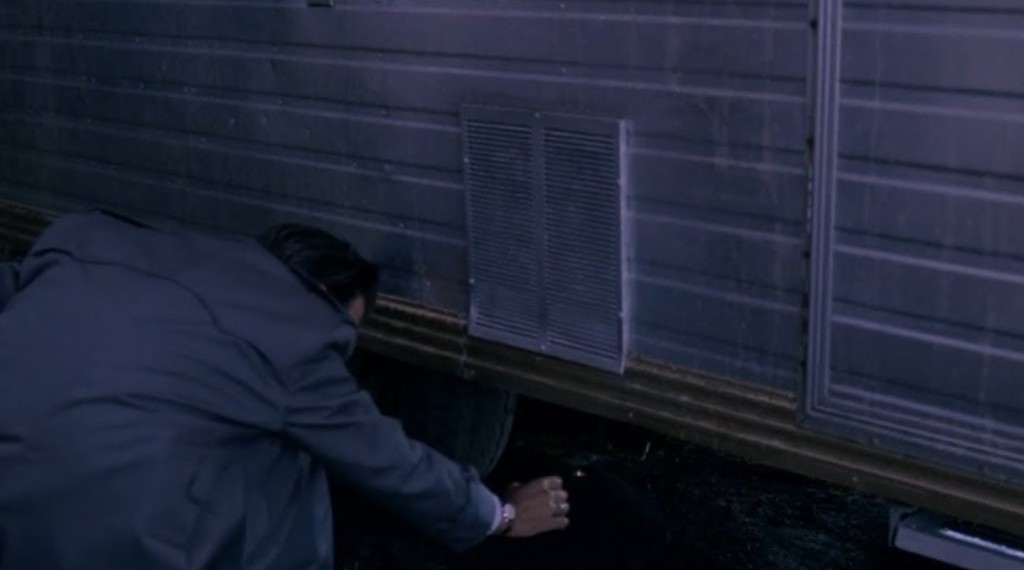
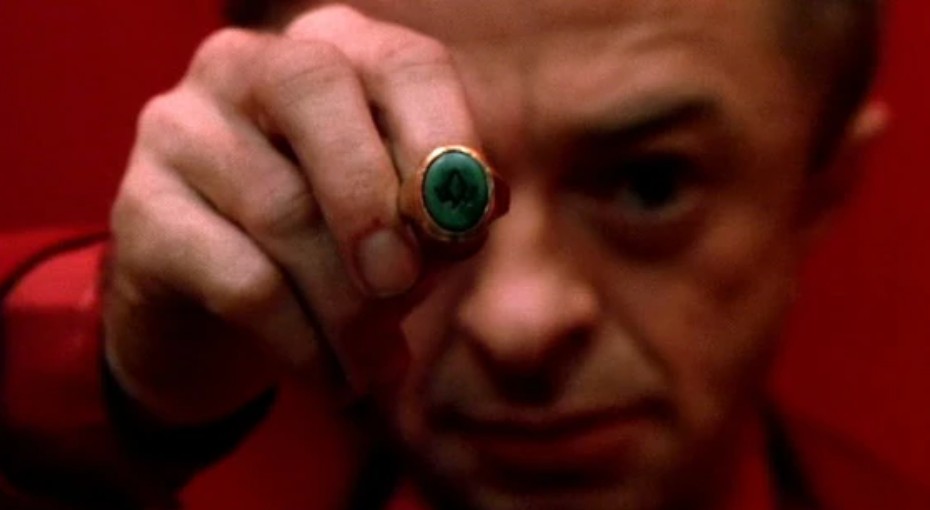
Desmond returns alone to the Fat Trout trailer park and works the space beneath Teresa Banks’s former trailer. In the dirt he finds a green ring bearing the Owl Cave sign — Formica weather on screen, although Frost’s dossier sometimes uses “jade” as narrative shorthand. The camera holds his hand reaching for it; it does not supply a transfer receipt, laboratory description, or ordinary evidence bag. The object enters the Deer Meadow file at the exact point normal custody fails.
After that contact, Desmond is absent. Cole sends Cooper west, but the screen provides no body, struggle, resignation, destination, or account from the missing agent. The ring’s presence is HELD; any rule that explains what it did to Desmond remains OPEN. When a green ring returns in Laura’s endgame at 01.2, the recurrence strengthens the signature without converting either disappearance or death into a solved Lodge mechanism.
Ring’s presence and Desmond’s contact HELD (Owl Cave / green Formica register). “Jade” is dossier voice, not a Screen mineral ID — do not collapse the two. Desmond’s whereabouts and the ring’s operation remain OPEN.
FWWM’s living center — before the Pilot’s corpse grammar.
01.1HELDScreen
Laura Palmer — final week on screen
Fire Walk With Me · days before 24 Feb 1989
The film turns from Teresa’s county to Laura alive — diary pages under candle light, cocaine as daily weather, One Eyed Jacks adjacency, James and Donna as partial confidants, the Palmer house as private crime scene where the ceiling fan already keeps time. BOB’s nights and the train-car gathering close the week like a storm front. This is not Pilot grammar (body, plastic, civic shock). It is the living subject the archive will later try to reconstruct from evidence bags and hometown myth. The week does not “explain” Laura; it refuses to let the town’s preferred girl be the only file copy — and it refuses to let Deer Meadow’s prior stay a separate county’s problem.
Week’s events HELD as Screen. Ring / BOB / “Fire walk with me” mechanism stays partly OPEN even after the film — see character and analysis leaves, not this card’s job to close.
In the train car, with flight and rescue collapsing around her, Laura takes — or accepts — the green, Owl Cave-marked form that entered the Deer Meadow file beneath the Fat Trout trailer at 00.3. She puts it on before she is killed. That visible action is the Screen hold: the ring reaches her hand, she wears it, and the murder proceeds. The film does not stop to issue rules for ownership, protection, possession, or passage, and the object is not reduced to a conventional murder weapon.
The archive may read refusal in the gesture: Laura making a last claim over the self BOB intends to occupy, at mortal cost. That reading fits the film’s insistence on agency under coercion, but it remains a LEAD, not a certified Lodge theorem. The file keeps action separate from explanation. Laura’s choice can be held without pretending the ring has one stable function, or that Desmond’s absence and Laura’s death prove the same outcome.
Laura taking and wearing the ring HELD; refusal, protection, and cost remain LEADs. Not a metaphysics certificate. Do not flatten “took the ring” into a finished theology.
Story date of the Pilot — the hour the town’s preferred Laura dies in public.
02.1HELDScreen
Laura Palmer — wrapped in plastic
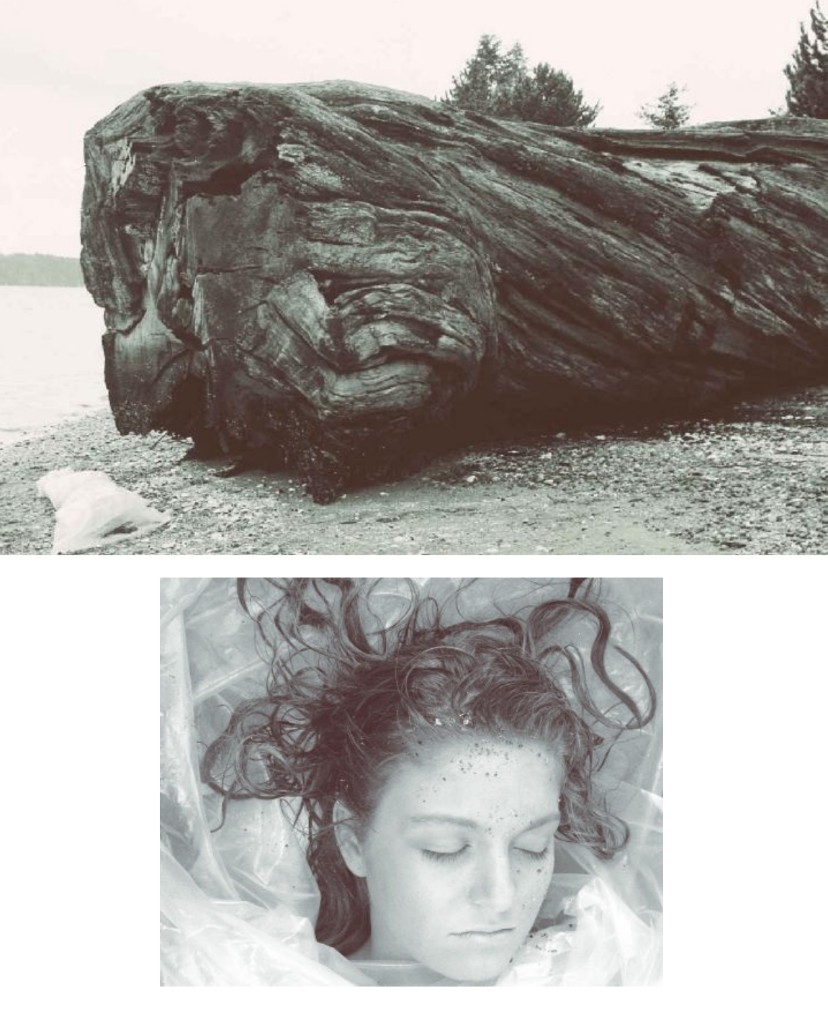
EXHIBIT · Wrapped in plastic.
24 February 1989 · Pilot
Pete Martell finds a human form at the water’s edge near the mill and calls the sheriff: dead, wrapped in plastic. Harry Truman’s department secures the shore; Andy Brennan photographs through shock, and Dr. Hayward opens enough of the wrapping to identify Laura Palmer. The homecoming portrait has not changed, but its civic use has: by morning the girl the town displayed as its preferred image has become a body, a location, and a police file. Plastic, water, and the driftwood margin are the first public grammar of Case 89.
The discovery establishes identity and condition at recovery, not authorship. Cooper has not yet arrived; Teresa’s signed pattern has not yet been matched; the train car and hidden compartments of Laura’s life remain outside this scene. The file therefore holds the body and the town’s recognition while refusing the hindsight available at 07.1. Opening-day grief is evidence of communal rupture, not proof of cause, motive, or killer.
Identity HELD. Cause and killer not established here. Do not import Season 2 closure — or Doc’s Kauai verdict — into this node. Later leaf: 07.1 · Jacoby.
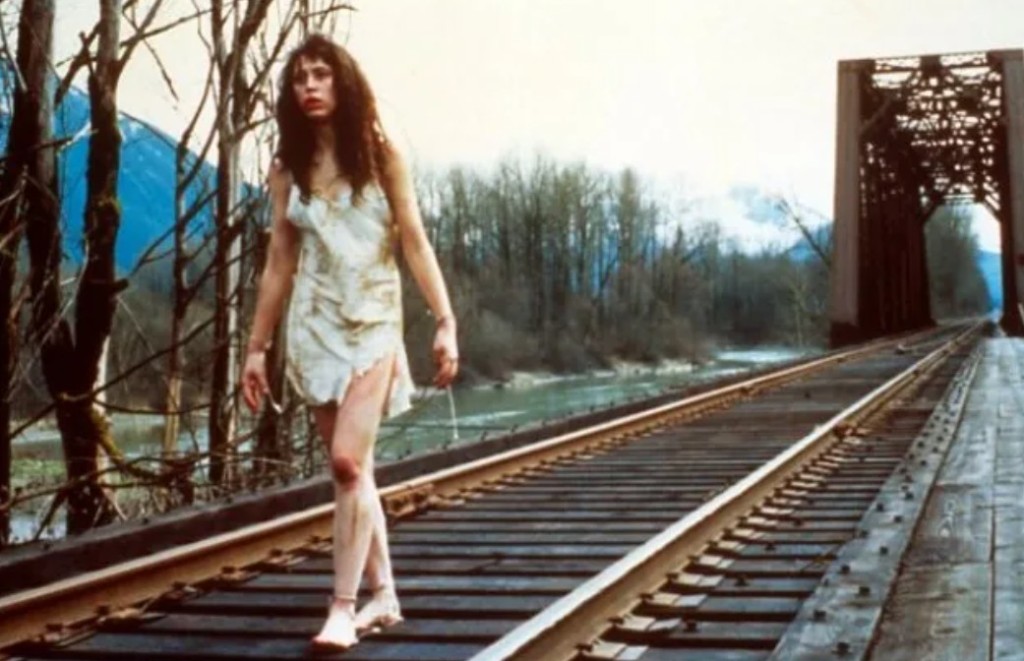
EXHIBIT · Ronette — rope still on the wrists; the living path out of the train car.
Same night / morning · Pilot
While Laura is recovered as shore evidence, Ronette Pulaski comes out of the same night alive. Bloodied and barely ambulatory, with rope still around her wrists, she crosses the railroad bridge at the state line and collapses into emergency custody. The body on the shore and the survivor on the tracks are not yet joined by a statement, but their injuries and later train-car locus place two young women inside one investigative field. Survival expands the case before anyone can ask Ronette to narrate it.
Her crossing supplies the interstate fact that brings federal jurisdiction and Cooper’s assignment at 03.1. It does not make her immediately available as a witness. Hospitalization and trauma block usable testimony; the Pilot will not turn survival into an effortless clue-delivery system. Presence is HELD, connection is a strong LEAD, and every account of the assailant, sequence, or escape remains OPEN at this hour.
Survival, state-line crossing, and physical condition HELD. Ronette remains OPEN as a testimony source; train-car connection is a strong LEAD until the evidence chain joins it. Do not force a full account from a witness still in shock.
Method, jurisdiction, and the Teresa signature return.
03.1HELDScreen
Dale Cooper assigned — Diane dictations begin
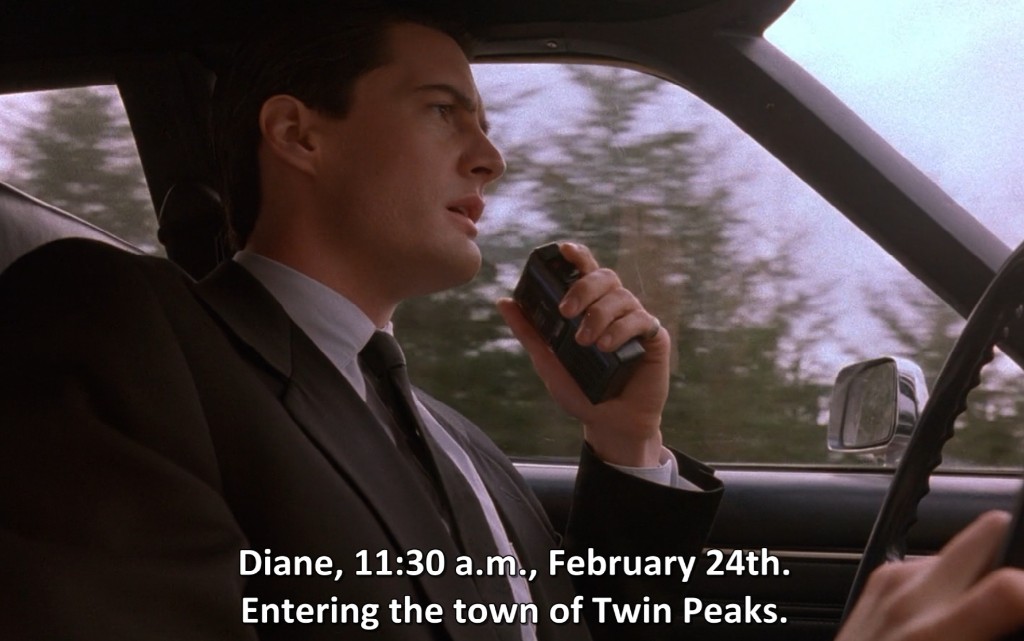
EXHIBIT · Diane.
Pilot · FBI Special Agent
Cooper enters Twin Peaks already dictating to Diane. Time, mileage, road conditions, Douglas firs, lodging, coffee, and food share the tape with the assignment; observation is continuous rather than switched on only over a body. The recorder makes a running Bureau ledger from details another agent might discard. Pleasure does not soften his seriousness. It demonstrates the same alertness that will notice a miniature letter under a nail and a motorcycle caught in a frame of home video.
Ronette’s state-line crossing at 02.2 supplies jurisdiction. On arrival Cooper works with Sheriff Truman instead of treating local knowledge as an obstacle, while refusing the town’s uncomplicated account of Laura. He brings the prior Teresa Banks file into view, separates affection for the victim from claims about her life, and starts a partnership built on reciprocal evidence. Assignment, method, and cooperation are HELD; neither the tape nor federal authority arrives with the solution.
Assignment, partnership, and method HELD. Solution not claimed. Diane remains address and instrument — not yet a closed biography.
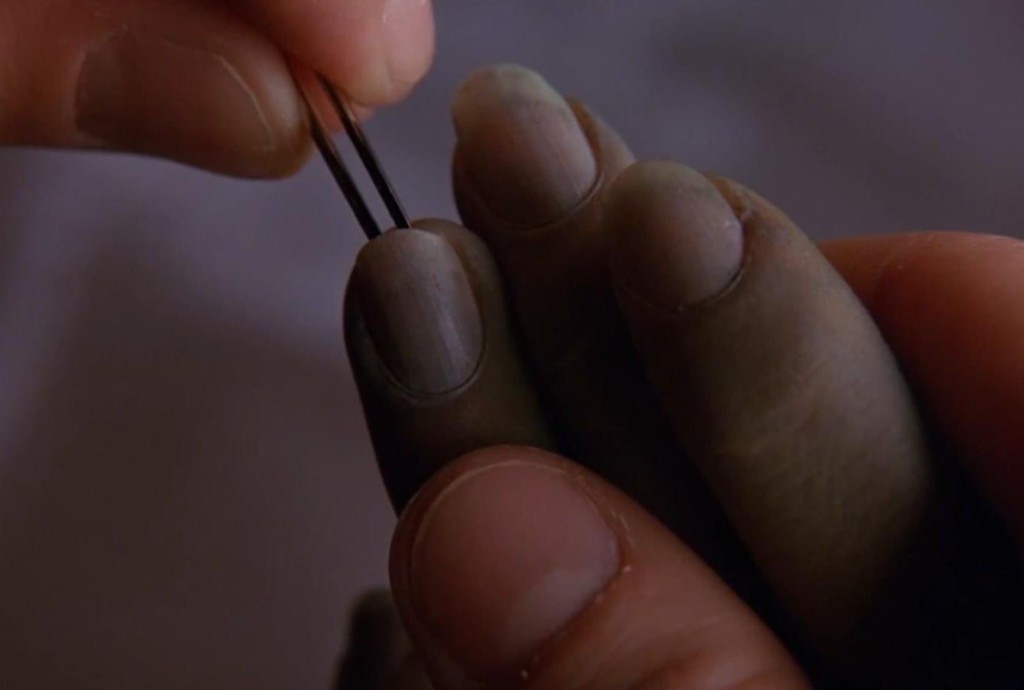
During the controlled examination of Laura’s body, Cooper lifts a tiny paper R from beneath her ring fingernail. He does not treat it as stray debris. On screen he names the prior comparison: Teresa Banks carried a T beneath a fingernail. Deer Meadow therefore re-enters Case 89 through a deliberately concealed mark, not through later mythology or audience hindsight. The match is small enough to miss and specific enough to move the investigation beyond a single local homicide.
What the file holds is recurrence: two victims, two paper letters, parallel placement. It does not yet hold the alphabet’s purpose, the author’s identity, a complete victim count, or a motive for making investigators discover the sequence. The R is a signed-pattern LEAD, not a confession. It connects Laura upstream to 00.1 while leaving every profile built from that connection provisional.
Signed pattern LEAD. Not yet a closed motive, complete serial profile, or named author. Keep Teresa’s card upstream; do not let R rewrite 00 into a finished theory or import Season 2 closure into this Pilot hour.
Objects and scenes that survive the first day’s shock.
04.1LEADScreen
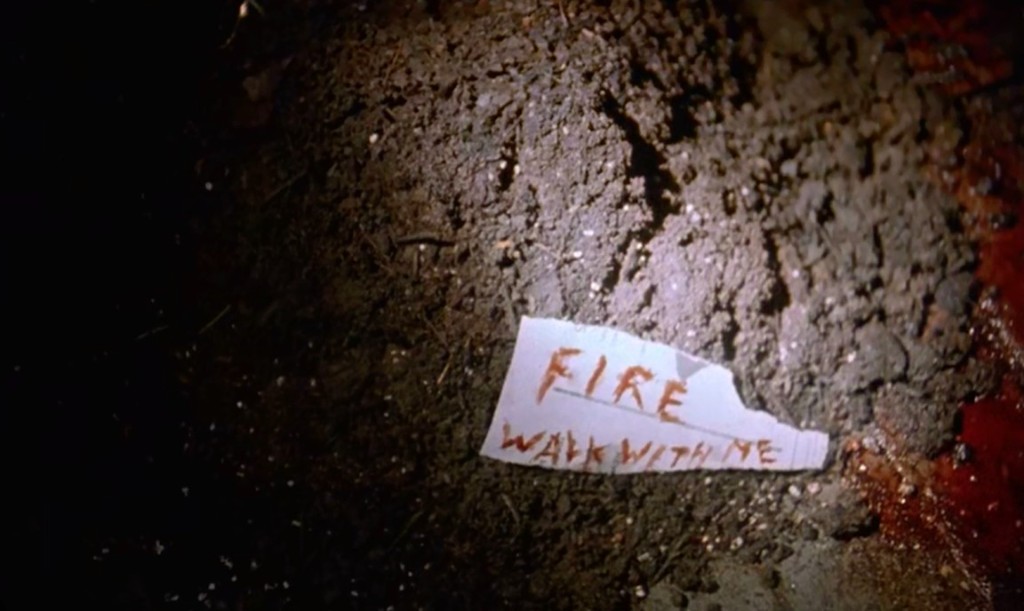
Train car — “FIRE WALK WITH ME”
EXHIBIT · Fire walk with me.
Pilot · crime scene
The abandoned rail car gives the investigation a physical locus the shoreline could not. Its inventory holds blood, a hammer, cloth, one half of a heart necklace, and paper bearing FIRE WALK WITH ME in blood. These objects place preparation, restraint, violence, and language inside one confined scene. Ronette’s rope-marked survival at 02.2 and Laura’s recovery at 02.1 now have a shared evidentiary center even before a witness can supply sequence.
The phrase matters because it was left at the crime, not because the Pilot defines it. On opening day it is authored language attached to violence: possible signature, address, instruction, or ritual caption. Lodge doctrine comes later and cannot be back-filled as if officers found a manual beside the hammer. The fingernail letters remain their own pattern at 03.2; the necklace’s removal from custody becomes the separate contamination at 05.1.
Scene and phrase on record as LEAD. Inside the Pilot the words are evidence of language at the crime — not yet a defined Lodge manual. Necklace’s later burial splits to 05.1.
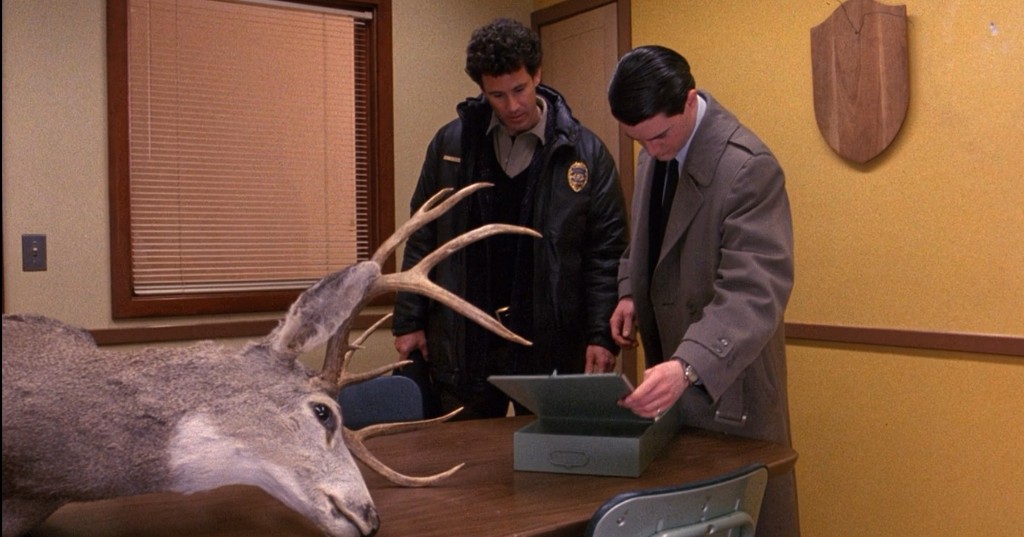
A key recovered in the opening investigation gives Cooper and Truman access to Laura’s safe-deposit box. Under the station’s odd weather — a deer head resting on the table while official procedure continues around it — they inventory more than ten thousand dollars in cash and a marked issue of Flesh World. The magazine carries the link to Ronette Pulaski; the money establishes a private economy concealed from family, school, and the civic portrait. A familiar teenager’s life becomes compartments that must be investigated rather than morally summarized.
The box proves possession and association, not the source of the cash, the terms of Laura’s contact, or whether exploitation, coercion, agency, and concealment operated in what proportions. Cocaine residue and the key belong to the upstream evidence trail; the vault is where those leads open onto money and a second victim. The file holds exhibits that break the “golden girl” simplification while refusing to replace it with an equally false finished biography.
Association LEAD — expands Case 89 beyond single-victim piety. Full map of Laura’s nights is not certified by this box alone.
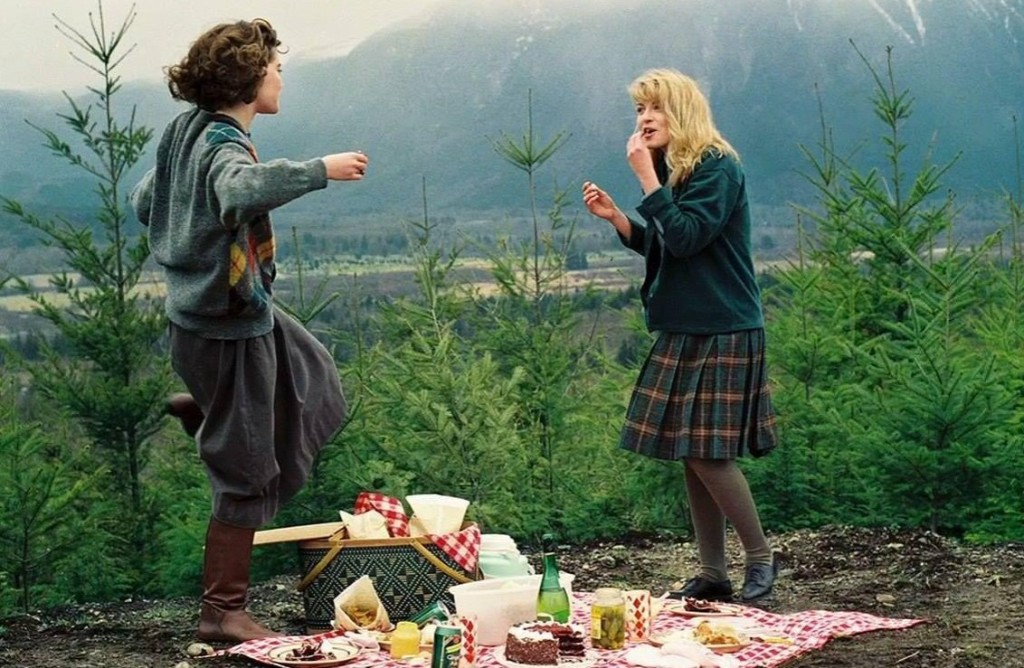
The Palmer home video preserves Laura and Donna at a ridge picnic: motion, laughter, and an apparently ordinary memory the investigators can stop, enlarge, and replay. Cooper notices that the image contains more than its maker intended. A motorcycle is reflected in Laura’s eye, placing a rider at the gathering outside the family’s first account. The frame does not speak, but it retains a witness detail that memory, loyalty, or fear has withheld. Laura’s photographed surface becomes evidence without yielding her thoughts.
Opening day can hold only the optical fact and the direction it points: James Hurley and the motorcycle require scrutiny. The reflection does not establish what James knew, when he last saw Laura, why he stayed outside the first telling, or whether concealment makes him violent. The tape is a delayed charge, not an instant confession. Episode 1 will spend the lead against denial; this card keeps the evidentiary distinction between presence in an image and guilt in a crime.
Reflection LEAD on opening day — not yet a confession. Follows into Episode 1’s pressure on James. Do not treat picnic weather as proof of innocence or guilt beyond presence.
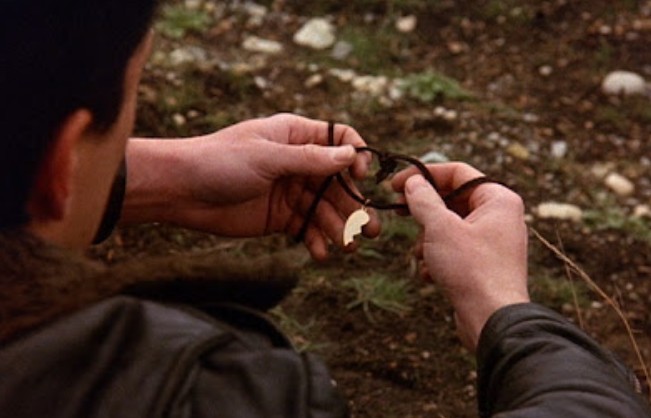
James holds the half-heart that matches the piece found in the train car. Rather than surrender it, he and Donna take it into the woods and bury it. Their reasons register as grief, fear, loyalty, and the knowledge that James concealed his relationship with Laura; none of those motives restores custody. An object capable of linking Laura’s last hidden relationships to the crime scene is deliberately removed from police view by people who may later be questioned about both.
The file therefore separates existence from usability. Necklace, match, possession, and burial are HELD on screen, but provenance after concealment is compromised and the object is not yet a Bureau-clean exhibit. James and Donna do not create the murder, yet they manufacture an additional mystery inside it. Sarah’s impossible view of the buried object at 06.1 deepens the breach without repairing the chain.
CONTAMINATED — fact of burial HELD; object not yet a Bureau-clean exhibit. Sarah’s vision of the gloved hand follows in 06.1 without naming whose hand.
The U.S. Broadcast Pilot ends not on a laboratory result but on Sarah Palmer’s perception: a gloved hand unearthing the half-heart James and Donna buried at 05.1. Sarah was not present in the woods and has not been told where the object lies. The image joins the Palmer house to a concealed site through no ordinary witness route. What the investigators cannot yet know enters the episode anyway, carried by a grieving mother whose sight does not fit an evidence form.
That fracture is the hold. It does not identify the hand, establish when the digging occurs, prove Sarah understands what she sees, or certify a complete psychic system. No officer receives the vision as testimony and no badge bags the image. The file records threshold evidence as OPEN: an impossible connection with precise content, strong enough to disturb procedure and too incomplete to name an actor, mechanism, or Lodge rule.
Vision recorded OPEN. Hand not identified inside the Pilot. Do not import later names into this node. Necklace contamination remains upstream at 05.1.
Princeville, 19 March 1989 — dossier leaf after opening-day discipline. Margaret’s “dark age” gets a name. Calendar then: WSMA 26 Mar → Mayday 28 Mar.
07.1HELDFrost dossier
Laura Palmer, final case notes — 19 Mar 1989
EXHIBIT · Laura Palmer.
Dr. Lawrence Jacoby · Princeville, Kauai · Hanalei Bay
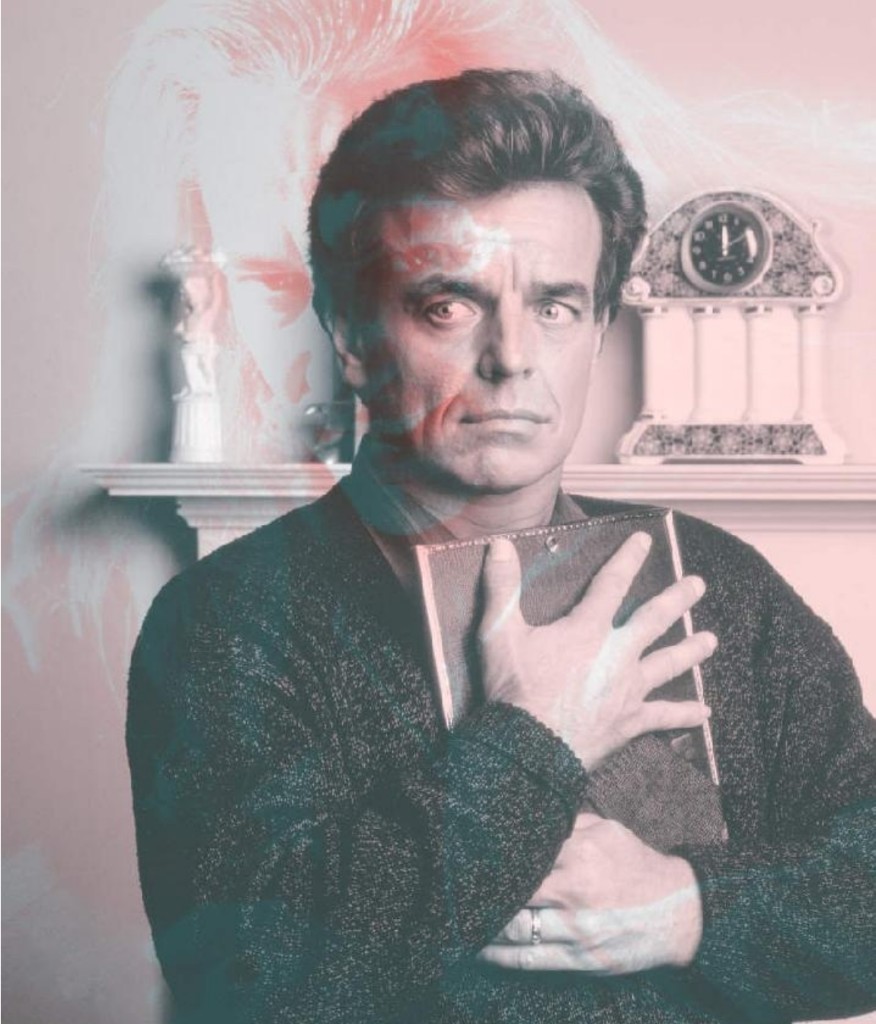
What can you say about an eighteen-year-old girl who died? Mother’s ashes in the bay; Robert’s cremains waiting for a calmer trade wind. The facts, as Jacoby writes them: father Leland Palmer, 45 — Seattle money, UW Law Review, Horne Corp counsel — killed Laura, homecoming queen, golden girl. Then Laura’s first cousin Madeleine Ferguson of Missoula, Montana (mother’s side) — an innocent who came to help after Laura’s death. Laura, in more than one way, danced with the devil and paid. Leland also smothered Jacques Renault, who had harmed his daughter — an act Jacoby inadvertently witnessed as a cardiac patient, sedated in a nearby bed. After arrest, confronted with crimes he first claimed not to remember, Leland took his own life.
HELD as Doc’s Kauai dossier leaf for Leland / Madeleine / Jacques — do not back-date into 02 Opening day. Age slip: “eighteen-year-old” is dossier wording; screen birthdate 22 Jul 1971 makes Laura 17 on 24 Feb 1989 — Frost/Jacoby error, not HELD age. Board answer: 07.3.
Dr. Lawrence Jacoby · Princeville · after the facts
Life is but a dream from which we seem able to only rarely awaken. Whatever it means is beyond words. Words lose their meaning when you look at them too long. “God.” “Science.” “Meaning.” Everything melts into silence. The trades have eased. The whitecaps are gone and there’s sunlight on the water. I’m going to go bury my brother now.
The Kauai leaf closes on Robert’s ashes and Hanalei calm — silence after the names Leland / Madeleine / Jacques. Civic paper will answer within a week (07.3); Mayday two days after that. Doc’s metaphysics is not Bureau proof; it is the doctor’s last breath before the Board takes the license.
HELD as Doc’s last Kauai breath — Robert’s ashes, Hanalei calm, silence after the names. Leland’s plate follows that sentence: grief, ring, framed daughter — the man the facts named, not Feb 24 civic mourning.
26 March 1989 · Washington State Medical Association · Tumwater
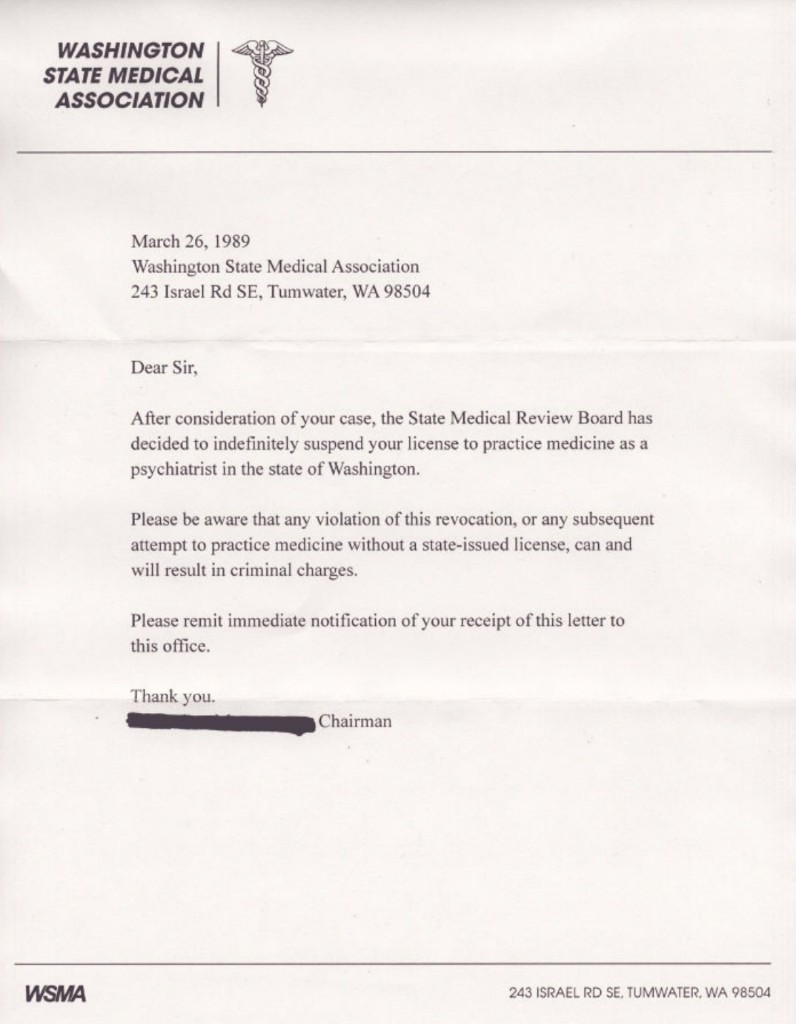
One week after the dated Kauai leaf, the Washington State Medical Association answers in institutional paper. The 26 March notice places Dr. Lawrence Jacoby under indefinite suspension from the practice of psychiatry in Washington. Whatever private calm closes 07.2, the public record resumes with sanction: named doctor, professional jurisdiction, effective consequence. The file can hold the action and date without inventing a fuller hearing transcript than the reproduced notice supplies.
The Chairman’s name is blacked out on the plate as received. That absence belongs to the artifact; it is not a failed image load or an archivist’s discretionary concealment. Adjacency invites the reader to connect Laura’s treatment, Jacoby’s conduct, and the Board’s response, but the notice alone does not certify every cause assigned to the suspension. It establishes the Board’s answer. Two days later Briggs’s parallel file ends in 08.3.
EXHIBIT · WSMA · 26 Mar 1989.
HELD as dossier facsimile. Two days before Briggs’s Mayday (28 Mar) — civic paper after Kauai silence, not Feb 24 procedure.
While Case 89 runs in town, Briggs’s deep file climbs toward 28 March — after Kauai’s names, before Preston seals the binder.
08.1HELDFrost dossier
Cooper in the zone — LPA goes hot
Secret History · Briggs on Cooper’s arrival
In Briggs’s account, Agent Cooper’s arrival is not confined to the Laura Palmer homicide. Cooper enters territory already watched by Listening Post Alpha and carries connections to the secret allies surrounding Colonel Douglas Milford’s work. Briggs records that the arrival raises the ante: instrumentation spikes, unusual readings accumulate, and “strange phenomena” register while the federal investigation begins in town. Cooper is inside the monitored zone before either man possesses a settled explanation for what is responding.
The dossier therefore runs two files beside one another. On the civic track, Cooper earns jurisdiction through Ronette and builds evidence with Truman at 03.1. On the deep track, Briggs reads telemetry, inherited warnings, and activity around the woods. The concurrence is HELD as Briggs’s Frost-tagged account; causation remains unproved. LPA weather cannot replace a letter under a nail, and Pilot evidence cannot by itself explain why the post went hot.
HELD as Briggs’s first-person Frost account of the Case 89 period Arc 04 maps on screen. Not a substitute for Pilot evidence nodes (02–06).
Briggs shares the intercepted message that has put Cooper’s name inside LPA’s field, and the two men camp in Ghostwood. The recoverable sequence then breaks ordinary field-report grammar: white light, Briggs gone, and a return that does not supply a conventional route or elapsed experience. Briggs later records paralysis, a dark-robed figure, speech or language he cannot ordinarily parse, and the impression of a vast “leviathan.” What comes back is memory under pressure, not a clean instrument printout.
He also describes a later, “downloaded” certainty about how he must proceed. Tammy Preston can compare the camping trip and disappearance with Cooper’s notes, so the shared event is stronger than Briggs’s ontology for it. The file holds trip, light, absence, and return while leaving abduction, Lodge passage, vision, and other explanations OPEN. Subjective certainty becomes operational evidence only because Briggs acts on it toward the Mayday line at 08.3.
Event OPEN as ontology (abduction / Lodge / other). Trip and disappearance HELD as occurring in the record. Leads into the Mayday line.
At 12:05 PM on 28 March, Briggs makes the last entry preserved under his own hand: “He just left. Something’s wrong.” This Secret History leaf does not name the visitor. It states that the message still holds the answer, but Briggs has misinterpreted it; protocols are in place, he must act quickly, and he is heading to Listening Post Alpha alone. A later Tammy reconstruction identifies the visitor as Cooper’s Double. That identification belongs downstream, not inside the quoted line.
Then the ledger resolves into distress: Mayday. The timestamp, wording, and decision to move toward LPA are HELD as the Secret History terminus; what waits at the post is not shown in this binder. Calendar matters: Jacoby writes from Kauai on 19 March, WSMA acts on 26 March, and Briggs closes on the 28th. Later reconstruction can follow at Arc 05, but this card keeps his fate after the typed warning OPEN and hands the unresolved file to 09.1.
* M * A * Y * D * A * Y *
Timestamp, warning, misread message, protocols, and LPA departure HELD as Secret History. Visitor identity and Briggs’s fate remain OPEN in this leaf; Tammy’s later Double reconstruction is separately labeled at Arc 05 · 05.13 Major Briggs. Binder seal: 09 Preston.
Last leaf of The Secret History of Twin Peaks — after Mayday, after the compiled file.
09.1HELDFrost dossier
Special Agent Tamara Preston — waiting for the right moment
EXHIBIT · SPECIAL AGENT TAMARA PRESTON.
Close of The Secret History of Twin Peaks · TP to the Director’s office
I don’t know what happened to either Major Briggs or Agent Cooper at this point. There are files on Briggs, at both the FBI and Air Force, and on Cooper, at the FBI, that are designated many levels above top secret. Out of my reach. I’ve taken my analysis as far as I can. My instructions are clear: I’m to turn over the dossier with my findings to the Director’s office and wait for their response. Deadlines are pressing. I’m guessing that if, and only if, they find my work to date acceptable they will have me begin breaking down the other data, which I have not yet seen. The rest is out of my hands. I’m still listed on the duty roster as “on assignment” but, as far as I can determine, have been removed from active service until that decision is reached. As Director Cole once told me, that time he took me out for coffee, a big part of this job—and, for that matter, life itself—is waiting for the right moment.
HELD as the book’s terminal leaf — after Briggs’s 08.3 Mayday. Briggs/Cooper fates stay above her clearance. Continues in screen / Final Dossier / Arc 05 — not closed inside this binder.
Twin Peaks: Fire Walk With Me (David Lynch, 1992) — Teresa Banks investigation; Desmond/Stanley; Laura’s final week; ring.
Twin Peaks Pilot / “Northwest Passage” (ABC, 1990) — story date 24 February 1989; body; Ronette; Cooper; R/T pattern; train car; safe-deposit; picnic video; necklace burial; Sarah vision (U.S. Cut).
The Secret History of Twin Peaks (Mark Frost, 2016) — PDF ~pp. 304–312 (Teresa / Cole; Jacoby Kauai final case notes; TP list); ~327–333 (Cooper in the zone; camping; Mayday 28 March 1989); closing leaf — Special Agent Tamara Preston sign-off / FBI seal.