Douglas Milford leaves the young town of Arc 01 and walks into the century’s secret machinery — war, Roswell, Project Sign, local anomalies — until Listening Post Alpha and the Blue Rose file take over his work. Same reading rhythm as Arc 01: cards in order, dossier depth where the file needs it.
From Depression drift to Pacific quartermaster — incomplete records, a Guam trapdoor, then White Sands adjacency and Roswell.
00.1HELDFrost dossier
Pearl Harbor +1 — enlistment, 1941
8 December 1941 · San Francisco
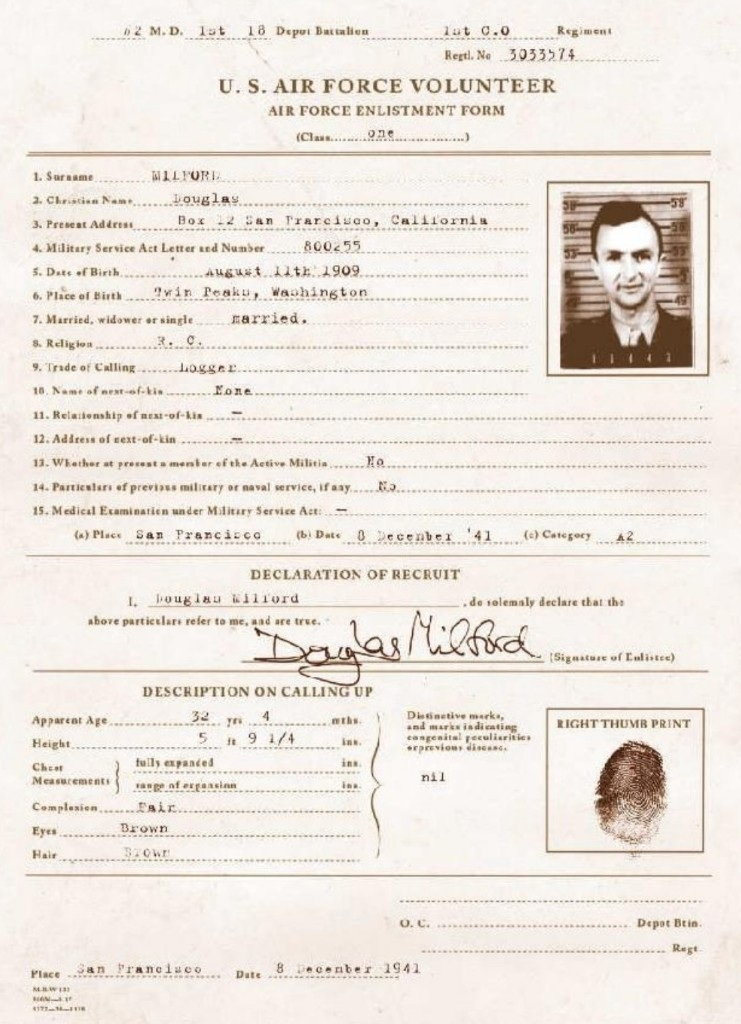
Arc 01 left Douglas as the town drunk of Prohibition Twin Peaks, then a rail-rider after the crash of ’29 — rootless through the 1930s. Little is heard until San Francisco: the day after Pearl Harbor he signs a Volunteer Air Force enlistment form. The facsimile fills in the man the ledger had only sketched — born Twin Peaks, 11 August 1909; Box 12, San Francisco; trade listed as logger; religion R.C.; next-of-kin left blank; medical category A2, same day. He marks himself married (Pauline Cuyo still hangs in the earlier diary weather). Height chart photo, right thumbprint, signature. The war years put him in a quartermaster’s brigade of the Army Air Corps, island-hopping the Pacific as the Allies push Japan back.
Exhibit · enlistment form, 8 Dec 1941. Douglas Milford — Twin Peaks birth, SF address, logger, married, next-of-kin none — the paper gate from Arc 01’s drifter into the century’s machine.
Enlistment date, form particulars, theatre, and quartermaster track HELD. The Archivist still flags wartime records after this gate as “frustratingly incomplete” — already the pattern that will follow him into every later file.
November 1944 · Guam · then vanished from Pacific ranks
Now-Sergeant Douglas Milford, serving in the quartermaster track that carried him across the Pacific, is brought up on serious charges on Guam: black-market trafficking in stolen Army property, principally liquor and cigarettes. The dossier does not show a completed court-martial. It opens a side door instead. An unnamed channel offers Milford the chance to “volunteer” for a special detachment stateside; he accepts, the charges are dismissed, his sergeant’s rank is stripped away, and he disappears from the Pacific rolls. The next paper catches him in 1945 as a buck private at Alamogordo / White Sands. That sequence establishes demotion and transfer, not motive. Punitive reassignment, a coerced bargain, and deliberate recruitment into compartmented work all fit the gap; the file names no recruiter, unit, or duty. Guam is the trapdoor: a supply sergeant goes in, and a reduced private in atomic-test country comes out.
TP confirms the charges were dismissed — though he was demoted — and that he was transferred to the base named next. The “volunteer” framing and the missing middle of the paper trail stay the open seam. Next card: White Sands / Roswell PX.
1945 · Alamogordo / White Sands Proving Ground · July 1947 · Roswell AAF
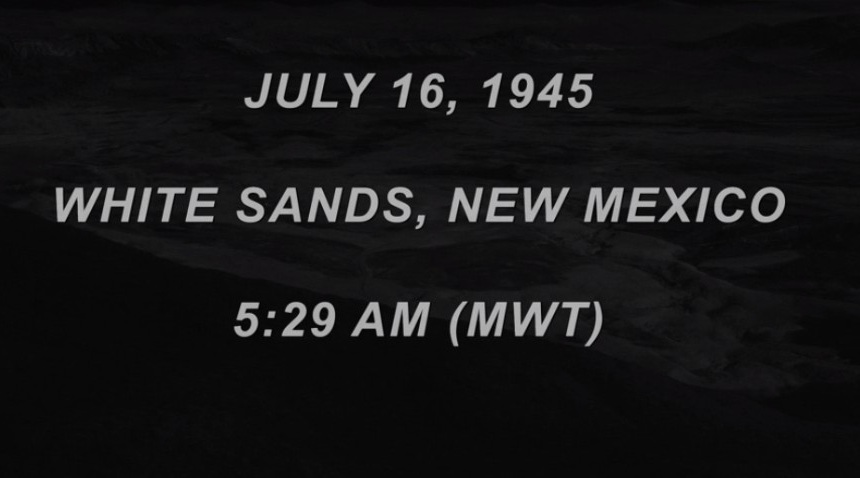
After the Pacific vanish he next turns up as a buck private at Alamogordo, New Mexico — what the dossier casually calls White Sands country, 1945. What the “special detachment” did is unclear. One theory rises above the others: an unacknowledged unit assigned hazardous duties around the Manhattan Project, bearing possible radiation exposure. If so, Douglas survives intact. By July 1947 he is at the Army air base in nearby Roswell — records say corporal, Army Air Forces, working the PX — though questions remain about what he was actually doing there.
Exhibit · White Sands country, 1945 orbit. Alamogordo range — first A-bomb test country; the trapdoor base after Guam, before the Roswell PX.
Presence at Alamogordo / White Sands and Roswell PX HELD as dossier chronology. Period name: White Sands Proving Ground (1945); “Missile Range” is the later (1958+) designation — Frost/dossier shorthand, noted here as anachronistic wording. Manhattan-hazard unit theory is LEAD. Roswell adjacency sets the next section.
Northwest skies first; Roswell second; Project Sign as the new machine — and Milford already inside it.
01.1HELDFrost dossier
Kenneth Arnold — Cascades, 24 June 1947
Sighting 24 June 1947 · Pendleton / press 25 June · Cascade Range · less than two weeks before Roswell
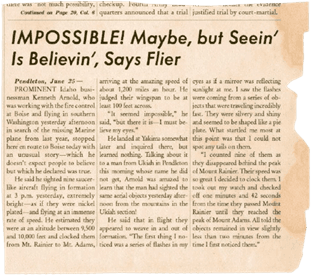
December 1946: a U.S. Marines transport vanishes in heavy weather on Mt. Rainier. Military and civilian pilots keep searching — and for a $5,000 finder’s fee. One of them is Kenneth Arnold, prominent Idaho businessman out of Boise, flying southern Washington on fire-control / search work. On the afternoon of June 24 he sights nine saucer-like aircraft in formation — extremely bright, as if nickel-plated — between about 9,500 and 10,000 feet. He clocks them from Mt. Rainier to Mt. Adams at roughly 1,200 mph; wingspan he judges at least a hundred feet. First cue: flashes in the eyes like a mirror throwing sunlight. Silvery, pie-plate shapes, no tails, weaving in and out of formation. They stay in view slightly less than two minutes; he times Rainier-to-Adams at one minute forty-two seconds. “It seemed impossible,” he says, “but there it is—I must believe my eyes.” He lands at Yakima knowing nothing; next morning in Pendleton a man from Ukiah says he saw the same objects from the mountains the afternoon before.
Exhibit · Pendleton clip, 25 June 1947 (day-after wire). “Impossible! Maybe, but Seein’ Is Believin’, Says Flier” — Arnold’s nine nickel-bright craft, Rainier to Adams, ~1,200 mph; sighting itself is 24 June.
The story hits the wires; national and international headlines follow. Army Intelligence investigates — and, for the first time on this trail, FBI personnel too. In a later CBS radio interview with Edward R. Murrow, Arnold explains the historic misquote: he said they flew like a saucer skipped across water, not that they looked like saucers. The phrase “flying saucer” sticks anyway. He leans toward extraterrestrial origin if the objects are not American science or Army Air Forces.
Public incident and the Pendleton facsimile held. What the objects were remains OPEN. The July 12 Boise interview (Hotel Owyhee) that puts Douglas Milford on the investigator line comes after Roswell — see 01.2–01.3.
5–8 July 1947 · Roswell Field · INT-F-000399 · Ref. 221-912
On base as Cpl. Douglas James Milford, Army Air Forces, working the PX register. The July 8 interview form (interviewer redacted) catches him in informal custody — he asks for coffee because “what they’re serving in the brig is like cat piss,” jokes that he’s married but “wouldn’t say I’m a fanatic about it.” His account of the early morning of July 5: pre-dawn scuttlebutt of a top-secret test craft — or something stranger — down in the desert after a thunderstorm; radar had been tracking strange bogeys for days. MPs and an unnamed Major shut the cantina. Curiosity wins. He borrows a Willis from the motor pool, tails a northwest convoy ~35 miles to a sheep ranch, slips in off-road.
From a rise he sees a debris field two–three hundred yards across, a shallow trench as long as a football field, generators, bright unconventional metal, MPs setting a perimeter. Farther on: personnel in gas masks around an intact craft gone nose-up into an embankment — flying-wing shape, “like an old Curtiss.” Through field glasses he watches a crane try to lift it onto a flatbed. Things on the ground go into bags and onto stretchers, then into waiting ambulances — he will not name what they were. A black car with motorcycle escort arrives; a ramrod-straight man checks the craft, then the ambulances. Back at the PX Milford realizes the face on the wall: General Nathan F. Twining, Air Materiel Command. Twining peeks in an ambulance, barks orders; the vehicles leave fast, no siren. Then MPs pour over the hill — Milford takes a knock to the head and wakes cuffed in a paddy wagon. He asks to speak to the lieutenant’s superior: this isn’t the first time I’ve seen something like this.
Transcript substance HELD (TP verifies authenticity). Presence at the site, Twining named in-frame, and informal custody held as dossier claim — not as certified ET recovery. The Archivist hears Pearl Lakes (or older woods weather) in that last line; TP also notes Pauline Cuyo behind the marriage shrug. What the bags and stretchers carried stays OPEN. Facsimile pages archived off-page; the ledger keeps the deciphered file, not four more newsprint plates.
12–14 July 1947 · Boise → Seattle · September 1947 · Project Sign
Days after Roswell, Milford is already north. A July 12 memorandum at Hotel Owyhee, Boise, interviews Kenneth Arnold about the Cascades sighting. Signatories: Frederic Nathan, Special Agent FBI — and Douglas Milford, S/A CIC 4th AF (Continental Air Command / CIC personnel who will feed Project Sign). The Archivist surmises immediate recruitment after Roswell and a July 8 Air Force Intelligence order that saucer reports be investigated by more qualified observers — a description Milford now appears to fit. Twining helps compile Roswell data into Project Sign — Frost dates that machine to September 1947 as the first of three Air Force UFO task forces. Sign’s early work includes walking back Roswell’s first releases into a “top-secret air balloon,” silencing witnesses by intimidation or bribes. Doug Milford is “right in the middle of it.”
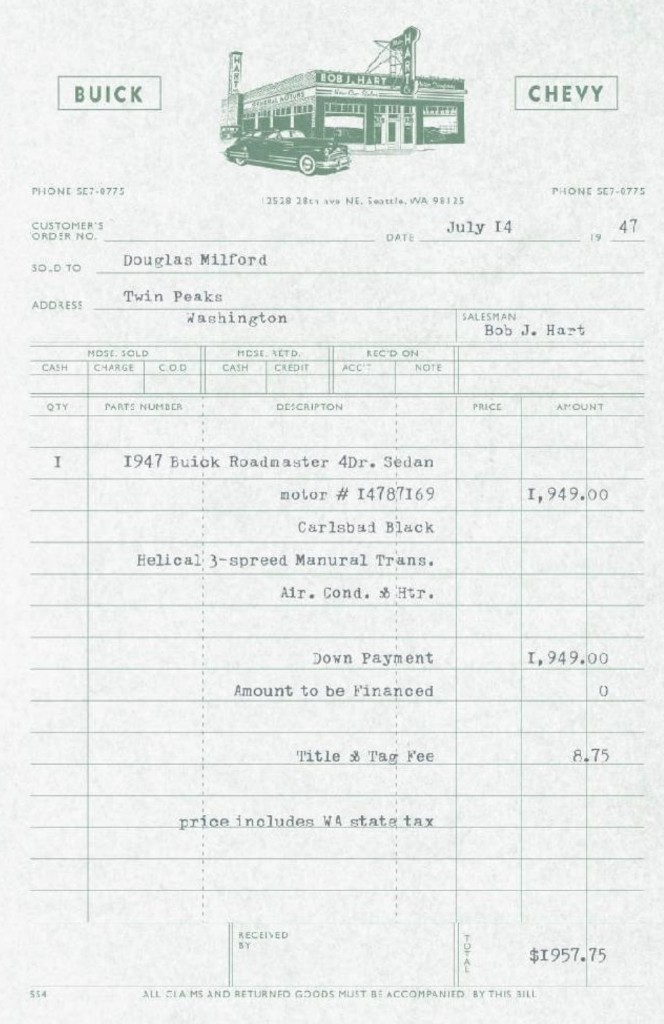
Two days after Boise he is in the Seattle area. The dossier holds a Bob J. Hart dealership bill of sale, 14 July 1947: one 1947 Buick Roadmaster 4-door sedan, Carlsbad Black, paid in full — down payment equals the $1,949 price, nothing financed; title & tag $8.75; total $1,957.75 including WA tax. Sold to Douglas Milford, address Twin Peaks, Washington. Cash for a new black Roadmaster days after Roswell custody raises the Archivist’s question — what was he doing here, and where did the money come from? — as he turns toward Maury Island weather and, soon, home.
Exhibit · bill of sale, 14 July 1947. Bob J. Hart, Seattle — 1947 Buick Roadmaster, Carlsbad Black, cash to Douglas Milford / Twin Peaks. The paper trail that puts him back in Washington after Boise.
Sign’s existence and Twining’s role HELD (TP). Milford on the July 12 Arnold interview line HELD. Frost’s “September 1947” Sign start is dossier dating — real-world Sign is usually late Dec 1947 → Grudge Feb 1949 (see 04.1). Receipt particulars HELD; cash source OPEN/LEAD. Balloon debunking as SOP is institutional method, not proof of Roswell.
Maury Island first in the telling of method — though the Sound encounter (21 June) sits a few days before Arnold. Filed here because this is where Milford’s silhouette hardens after Roswell recruitment.
02.1CONTAMINATEDFrost dossier
Maury Island — Dahl, slag, Corn Flakes box
21 June 1947 · Puget Sound · a few days before Arnold
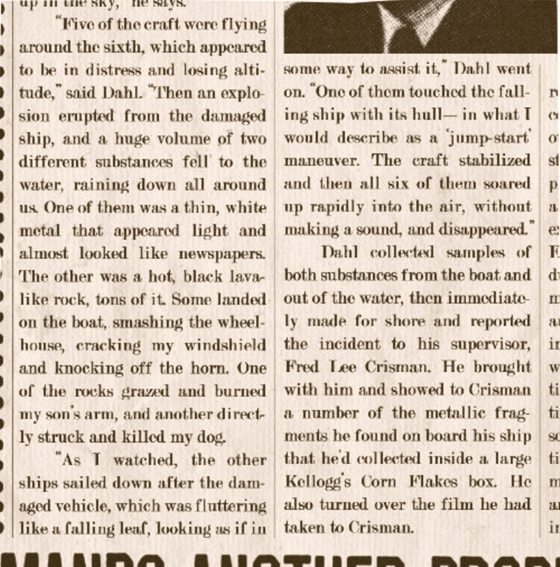
The Archivist says this is where the 1947 sky story can be said to begin — and where Douglas Milford’s role starts to harden. Licensed marine scavenger Harold Dahl, his sixteen-year-old son Charles, and their dog are pulling orphan logs near Maury Island around 11 a.m. Six round craft appear overhead — metallic gold or silver, silent, ~200 feet across, a ring of porthole windows. Five circle a sixth that seems in distress and losing altitude. An explosion; two rains fall: thin white metal light as newspaper, and hot black lava-like rock by the ton. Rock smashes the wheelhouse, cracks the windshield, knocks off the horn; one burns Charles’s arm; another kills the dog. The damaged ship flutters “like a falling leaf”; another craft touches it in what Dahl calls a jump-start; all six climb silent and vanish.
Exhibit · Dahl’s Maury Island account. Six craft; white metal and black slag; son burned, dog killed; fragments to Fred Crisman in a Kellogg’s Corn Flakes box — plus the film.
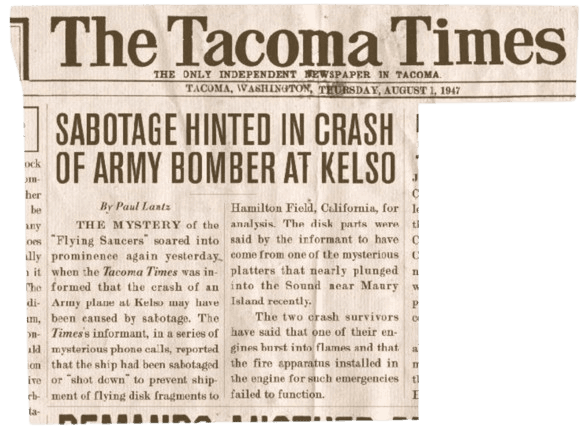
Dahl beaches, gathers both substances, reports to his supervisor Fred Lee Crisman, and shows him metallic fragments collected in a large Kellogg’s Corn Flakes box — film handed over too. Crisman feeds the Tacoma Times (Paul Lantz, 22 June; TP verifies) and wires Ray Palmer at Amazing Stories. Son Charles treated for second-degree burns that afternoon. The case pulls Kenneth Arnold to Tacoma in late July (Palmer’s $200 assignment); Arnold brings United Airlines pilot Emil J. Smith — who had his own nine-disk sighting on a Boise–Seattle DC-3 on July 5 — and contacts investigators Milford & Nathan from the Boise interview. Captains Davidson and Lieutenant Brown fly up from Hamilton Field, take the Corn Flakes box for “safekeeping,” and lift off from McChord in a B-25 toward California. Within half an hour the left engine burns; two others parachute; Davidson and Brown die near Kelso. TP: first official casualties of the brand-new U.S. Air Force (service birth day). Cause of fire: undetermined. A chemistry pass on a third batch of samples (via Ted Morello / College of Puget Sound) later flags unusual metal — titanium talk enters the paper. Milford flickers through Roswell and Maury “like a shadow… by design.”
Exhibit · Tacoma Times, 1 Aug 1947. Paul Lantz — “Sabotage Hinted in Crash of Army Bomber at Kelso.” Anonymous calls: ship sabotaged or shot down to stop Maury Island disk fragments reaching Hamilton Field.
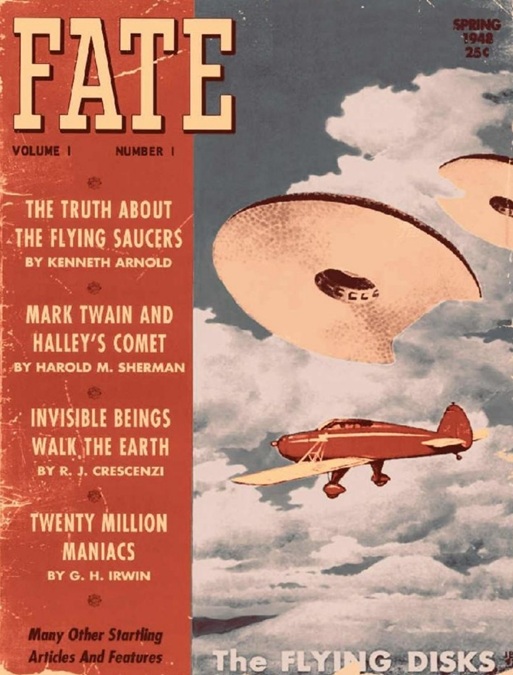
Arnold’s own write-up of the Tacoma hotel trail later opens the premiere issue of Palmer’s new pulp, Fate (Spring 1948) — “The Truth About the Flying Saucers” on the cover beside painted disks over a lone prop plane.
Exhibit · Fate Vol. I No. I, Spring 1948. Premiere issue — Arnold’s “The Truth About the Flying Saucers”; the Maury/Tacoma story enters pulp print under Palmer’s new masthead.
CONTAMINATED as clean proof of craft — hoax claims, intimidation, and agency fog sit in the same pages. Held as the Northwest pattern that teaches Sign’s double edge: investigate, collect, silence. Lantz’s Kelso page and the Fate cover are the public afterlife of that fog, not a clearing of it.
Amazing Stories · “Mystery of the Cave” · then July–Aug 1947 Tacoma
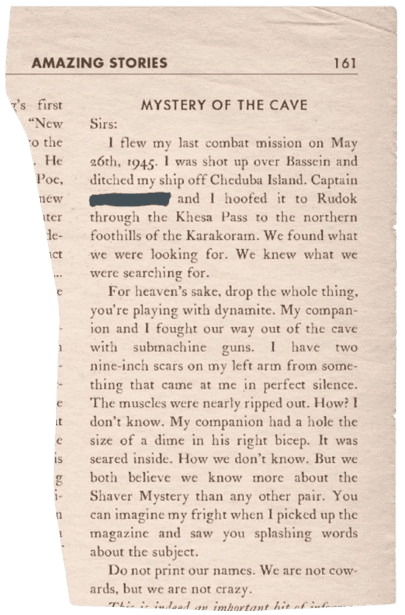
Before Maury, Crisman had already written Palmer. The dossier keeps a torn Amazing Stories page — “Mystery of the Cave” — a letter begging the magazine to drop the Shaver/Lemurian subject: last combat May 26, 1945; ditched off Cheduba; a companion’s name redacted; a cave in the Karakoram foothills; submachine guns; nine-inch silent scars; a dime-sized seared hole in the companion’s arm; “we both believe we know more about the Shaver Mystery than any other pair.” Do not print our names. TP can verify Crisman’s OSS / Far East combat record; at Maury time he is still Air Force Reserve, salvage man, and VA. The letter is how Crisman and Palmer meet — the pipeline that later moves Dahl’s slag toward Chicago pulp and, fatefully, toward Arnold, Emil Smith, and investigators Milford & Nathan.
Exhibit · Amazing Stories, “Mystery of the Cave.” Crisman’s wartime cave letter to Palmer — redacted companion, silent wounds, Shaver weather — the acquaintance that opens the Maury pipeline.
After Arnold’s Tacoma hotel meetings, Harold Dahl is visited by a man in a black suit — no credentials, “government” flavor — who drives him to a coffee shop in a brand-new black Buick sedan. The message: shut up, or harm to him and his; if asked later, say he made it up. Charles goes missing from the house that same stretch. Anonymous calls to the Tacoma Times and UPI claim the B-25 was sabotaged; warn Arnold and Smith they could be next. Palmer, in Chicago, later claims a black-suited agent visited after Crisman mailed him a cigar box of slag — then the locked cabinet is burgled and the box vanishes; TP wonders aloud whether Milford made it to Chicago. The Archivist reads the silhouette: by July 1947 Milford works for someone — most likely emerging Sign — that both investigates and suppresses. At worst, sabotage and even murder. The trail “leads, inevitably, back to his hometown of Twin Peaks.”
Crisman–Palmer letter and Maury intimidation sequence HELD as dossier narrative (TP on Crisman’s war record; B-25 facts verified). Do not convert the black-Buick man into named Milford without the file forcing it — the car rhymes with Milford’s own July 14 cash Roadmaster, which is LEAD, not proof. Chicago burglary stays OPEN. Worst-case sabotage/murder language stays Archivist heat, not certified homicide. Alternate Archivist theory (Hanford waste dump as Maury slag) is noted as competing frame — not adopted as held fact here.
1947 → 1975 · Alaska · Korea · Garrison · Dealey Plaza rumor
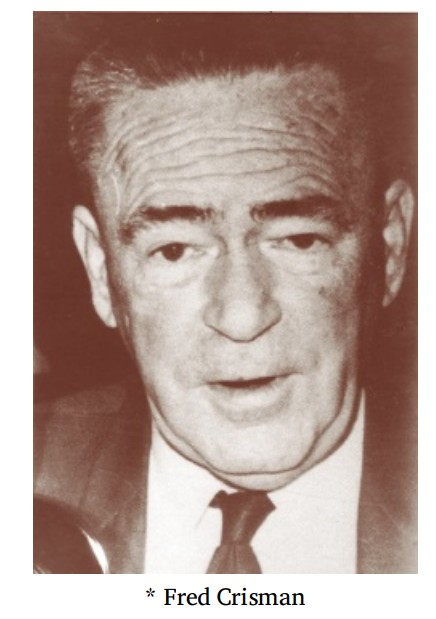
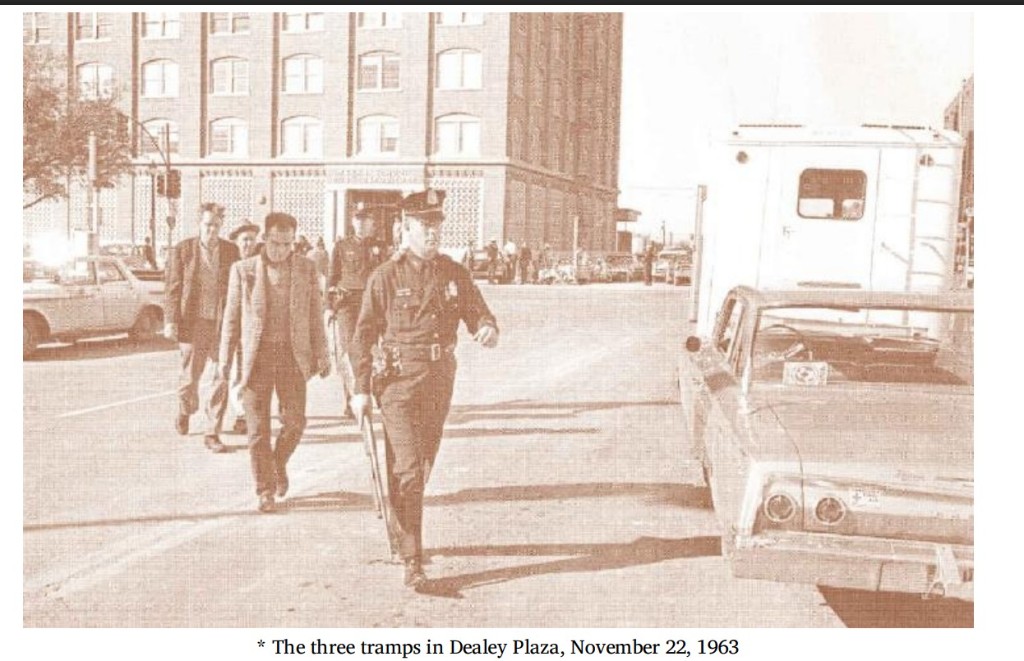
After Maury, the dossier keeps chasing Crisman past the Sound. Reserve commission revoked (8 Sept 1947) after a murky Alaska stretch; a second Amazing Stories cave letter (companion “Dick,” ray-gun death); a 1950 Fate letter denying hoax and tying the B-25 deaths to proof. Recalled for Korea as a fighter pilot; later teacher, speechwriter, Puyallup radio as “Jon Gold.” Archivist rumors of CIA deep-cover / black-bag go-between stay unconfirmed. Garrison’s New Orleans orbit brushes him; 1977 House JFK hearings revive a claim he was one of the Dealey Plaza “three tramps” (22 Nov 1963) — photo resemblance argued, Rainier OR colleagues offer an alibi. Dies 1975, Seattle VA, kidney failure; autopsy ordered, reasons unexplained. Exhibits parked here so the Maury silhouette has a face and a coda — full Crisman essay can thicken later without blocking Local.
Exhibit · Fred Crisman. Maury Island supervisor / OSS & Reserve orbit — the face the Archivist keeps in the machine of mid-century fog.Exhibit · Dealey Plaza, 22 Nov 1963. “The three tramps” — later hearings float Crisman as the shortest; photographic rhyme is LEAD, not held identity.
CONTAMINATED as solved conspiracy. Useful as Crisman continuity after Maury; do not promote tramp-as-Crisman or CIA handler claims to held fact.
Home woods again — dogfight, Incident #18, the Gazette’s “happy ending,” then Margaret Coulson’s plates.
03.1HELDFrost dossier
Mysteries vs. Secrets — Cold War scale
Twin Peaks Sightings, Disappearances and Abductions · Project Sign
The Archivist restates the Arc 01 rule at national voltage: mysteries enliven; secret-hoarding concentrates power. UFO policy becomes the battlefield where that polarity is enacted. Twin Peaks sits under Fairchild AFB weather — Strategic Air Command, B-29s, rumored silos — less than half an hour by jet. Early September 1947 puts local paper ink and Sign file numbers on the same map. What follows is not Lodge cosmology yet. It is home ground under the new machine.
Held as reading doctrine for Local, Grudge, and Blue Rose. The town is no longer only Arc 01’s young biweekly myth — it is a Sign case neighborhood.
4 September 1947 · Twin Peaks paper · Fairchild “weather balloon”
Local ink covers a “dogfight” sighting — Sign’s Incident #17. A Phantom pilot, Lt. Dan Luhrman, pursues a bright object north of his patrol: it holds distance at full power, drops to ~500 feet, shrugs off turns, then climbs vertical until his plane stalls at 14,000 feet. Fairchild’s information officer feeds the standby line: derelict weather balloon. Major Milford travels home as family friend, not in uniform authority, to interview the sole civilian eyewitness named in the paper — Einer Jennings, schoolmate of Milford’s father, father of Emil Jennings. After hearing the bar-embellished version, Milford gently cautions him about mysterious visitors who shadowed Dahl, Arnold, et al. — Arnold’s near-miss with airplane sabotage. Einer turns pale; the mission, Milford reports, is accomplished. Town already half-writes Einer off as drunk; the balloon story finishes the job.
Dogfight file + Fairchild balloon SOP HELD as dossier narrative (TP verifies the leaf). Aircraft anachronism: F-4 Phantom II first flew in 1958 — a 1947 “Phantom pilot” is Frost continuity fog, not a HELD Air Force fact; keep the story, do not promote the airframe. Milford’s silencing visit HELD as his field method: investigate, caution, quiet the town.
Incident #18 — Pearl Lakes, three children, Owl Cave
8 September 1947 · Ghostwood / Pearl Lakes · field report to Lt. Col. Garrett · Wright-Patterson
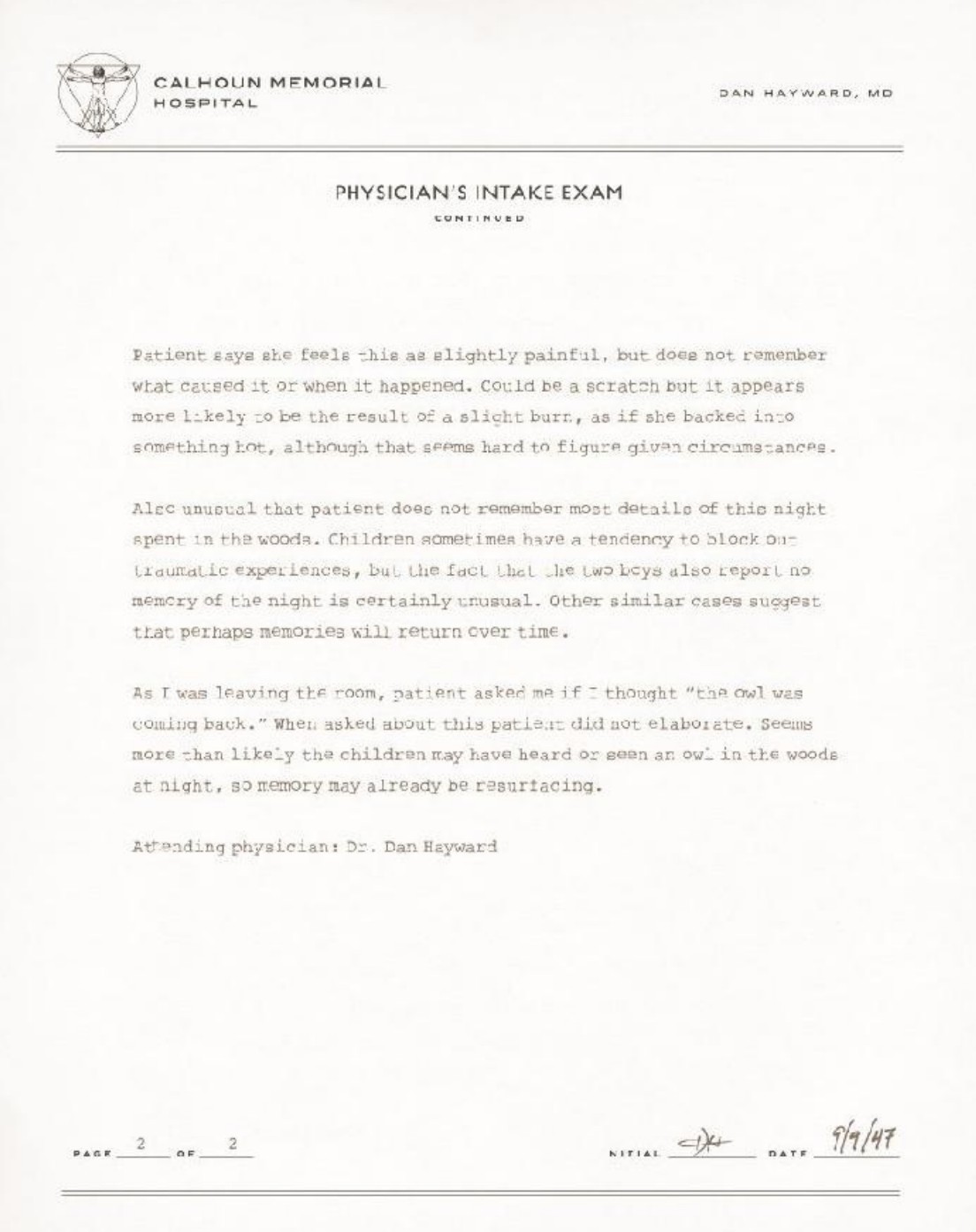
Same trip, next beat. After Jennings, Milford walks the sighting ground on September 8 — no physical evidence — when a mental image of a place miles away seizes him: Pearl Lakes in Ghostwood National Forest, Boy Scout country from twenty years earlier, a strange experience long suppressed. He feels he has no choice. Hiking the plateau above Pearl Lake, a clear fall afternoon turns black as night. A pulsating electric hum; movement in the trees; a cluster of red / white / green lights swaying overhead, issuing from a dark round shape maybe a hundred feet around, hovering ~25 feet above a clearing below the tree line. Aviators’ shades. Then three children — two boys, one girl, maybe seven or eight — backs to him, looking up. Lights merge into a single blinding white beam; the hum screams; he covers his ears. Suddenly daylight again. Craft gone. Children gone. No trace, no physical evidence. Minox shots of the clearing he knows from childhood — and nearby, the old Indian dwelling with wall drawings his pals called Owl Cave. Extreme dread; he flees to the car. He later enters the account as Incident #18 field report to Lt. Col. Garrett (Project Sign / MJ-12 letterhead) — the same dossier text deciphered here without reprinting the facsimile plates.
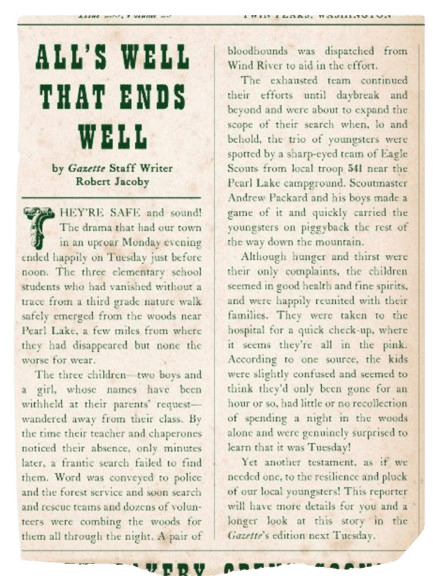
The Archivist calls this the first officially recorded abduction-pattern close encounter in Sign’s opening list — beyond the other seventeen entries. The town paper then prints the civic ending: Twin Peaks Gazette, Issue 7 Vol. 20 — Robert Jacoby, “All’s Well That Ends Well.” Three elementary students (two boys, one girl; names withheld) vanish from a third-grade nature walk Monday evening; bloodhounds from Wind River, search and rescue, volunteers through the night. Tuesday near noon, Eagle Scouts from Troop 541 — Scoutmaster Andrew Packard — spot them near the Pearl Lake campground and piggyback them down. Hospital: in the pink; only hunger and thirst. The children seem to think they were gone an hour or so, recall little of a night in the woods, and are surprised it is Tuesday. Later Archivist note identifies two of the boys as Carl Rodd and Alan Traherne, third-grade classmates of Margaret Coulson at Warren G. Harding Elementary — all three graduate Twin Peaks High in 1958. Reception of Milford’s report at Wright-Patterson, and whether he showed photographs, go unrecorded.
Exhibit · Gazette, “All’s Well That Ends Well” (Robert Jacoby). Three children found near Pearl Lake by Troop 541 / Scoutmaster Andrew Packard — time slip in the kids’ heads; names withheld in print.
Incident #18 report substance HELD (TP: authentic document). Gazette “happy ending” HELD as press artifact — civic fog over the same Pearl Lake locus as Milford’s beam. Abduction reading is Archivist frame / LEAD — not certified ET. Owl Cave rhyme with Arc 01 scout lore HELD as place continuity; Packard as scoutmaster is a bitter-sweet echo of Arc 01’s camping Gazette. Margaret / Rodd / Traherne identity trail is later Archivist ascertainment — keep as named lead. MJ-12 letterhead on the form is contaminated chrome (see Grudge); do not promote the header to held conspiracy. Facsimile pages not displayed — text only.
Sept 1947 medical trail · Warren G. Harding Elementary · later Lanterman
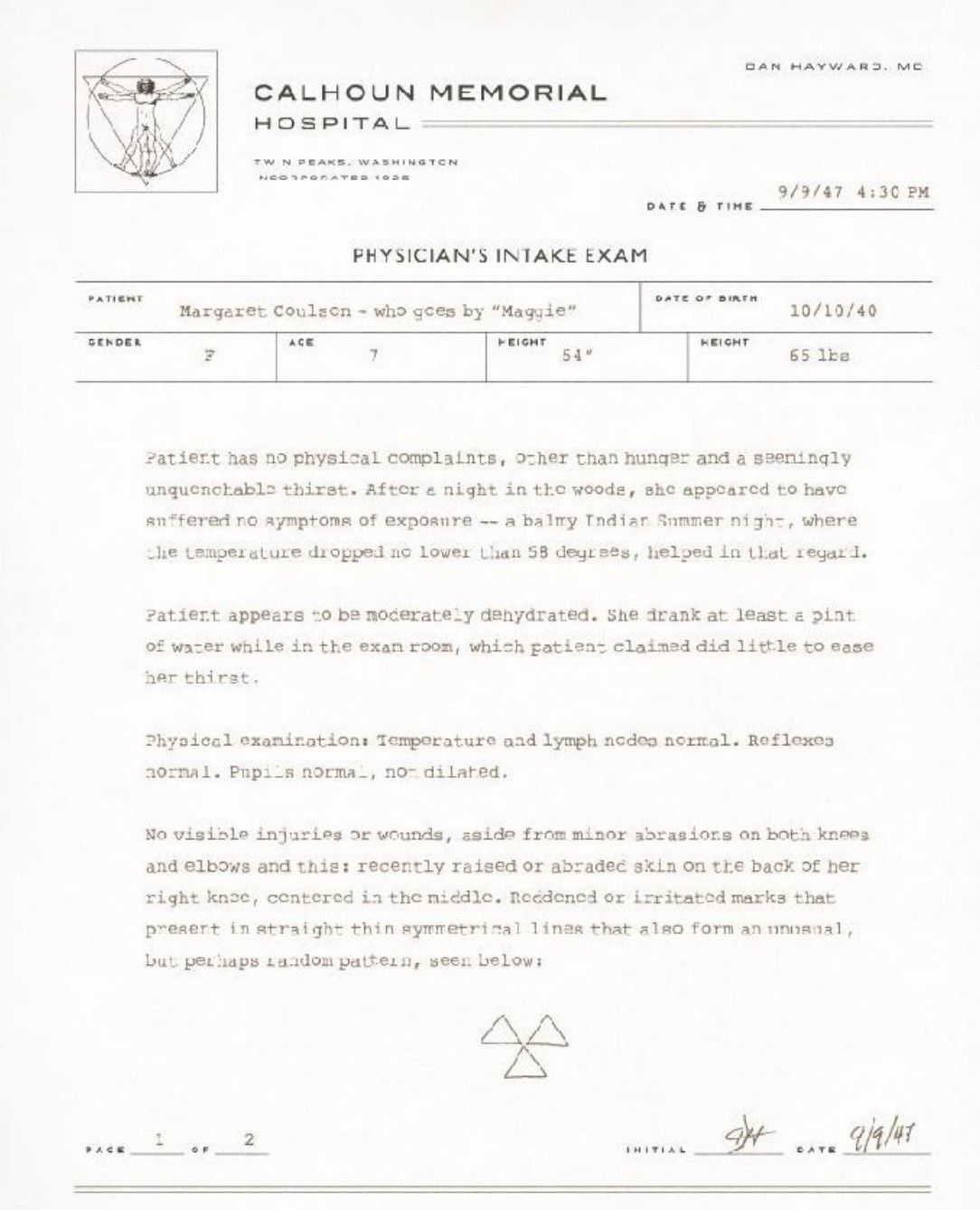
The boys’ medical evaluations go missing from the recovered file; Margaret’s does not vanish entirely. The dossier keeps facsimile plates of young Margaret Coulson — third-grade classmate of Carl Rodd and Alan Traherne at Warren G. Harding — after the Pearl Lake night. Exam weather sits with Dr. Hayward (father of the Will Hayward who will later treat the town in Cooper’s notes): the children are “in the pink” in Jacoby’s paper, yet the Archivist’s plates imply a marking Margaret receives — later echoed when Carl Rodd is photographed in Coast Guard years with a similar mark behind the right knee. Time slip in the kids’ heads (an hour, not a night) sits beside Owl Cave dread in Milford’s report. TP’s later margin: Maggie Coulson is the likely seed of Margaret Lanterman, the Log Lady — overnight woods weather as one possible root of the log’s vocation, not a diagnosis.
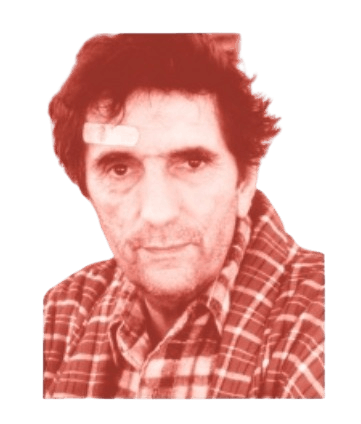
Exhibit · Margaret Coulson plate. One of the three in Milford’s clearing — dossier face for the girl the Gazette left unnamed.Exhibit · companion Margaret plate. Medical / file weather after Pearl Lake — the trail the boys’ missing evals leave open beside her.Exhibit · Carl Rodd. One of the three — later Coast Guard boatswain’s mate; the Archivist notes a marking like Margaret’s behind the right knee. Fat Trout years still ahead.
Identity of the girl as Margaret Coulson is Archivist LEAD (classmates named; TP links to Lanterman). Marking / medical substance held as dossier claim, not Screen canon. Rodd’s portrait held as dossier face for the boy who later manages Fat Trout; Traherne’s LA / PTSD trail waits for a later arc-03-local-families pass.
Sign’s ET finding is erased. Grudge debunks for show. Major Milford’s first Grudge case drags Crowley, Thelema, and Jack Parsons into the same weather as Roswell.
04.1HELDFrost dossier
“Estimate of the Situation” — destroyed
Late 1947 · after Milford’s Twin Peaks / Sign report · Vandenberg rejects the Estimate · Frost’s Sign→Grudge hinge
After Milford files his Twin Peaks incident report to Project Sign, Sign’s finding — UFOs “most likely of extraterrestrial origin” — climbs the Air Force ladder until General Hoyt Vandenberg rejects it, orders copies destroyed, and — in the dossier’s telling — shuts Sign down. Successor: Project Grudge. Debunking becomes the order of the day. The Archivist’s chapter title for what follows is The Coming of What? — because the first case Grudge hands Major Milford will not stay inside balloon weather.
Rejection/destruction of the Estimate HELD as dossier claim (TP: no known surviving copies). Real-world record differs: Project Sign is conventionally dated from late Dec 1947 and transitions to Grudge in Feb 1949 — Estimate rejection and “Sign closes overnight” are not one certified historical instant. Keep Frost’s hinge as dossier sequence; do not sell it as NARA timeline.
Behind public Project Grudge, the Archivist places a second, alleged machine: at President Truman’s direction, General Twining supposedly helps organize twelve scientists, senior officers, and government officials into an insider panel most often called Majestic 12. In this telling, the group holds extraordinary clearance and helps force the Air Force turn from Sign’s extraterrestrial estimate toward Grudge’s organized debunking. Every hinge in that paragraph remains allegation. Official acknowledgment is absent, the name has accumulated decades of pop-cultural chrome, and TP cannot verify that any MJ-12-like “star chamber” existed at all — it “may be as mythical as a unicorn.” She leaves one narrow aperture: the Archivist might be writing from firsthand knowledge. Later Milford journals whisper about shadowy “Wise Men,” but resemblance is not chain of custody and a drifting nickname is not proof of one continuous panel. Keep the secrecy pattern; do not let it rename the paper trail.
OPEN / do not promote MJ-12 to held fact. Secrecy-as-method is LEAD; the unicorn warning stays on the card.
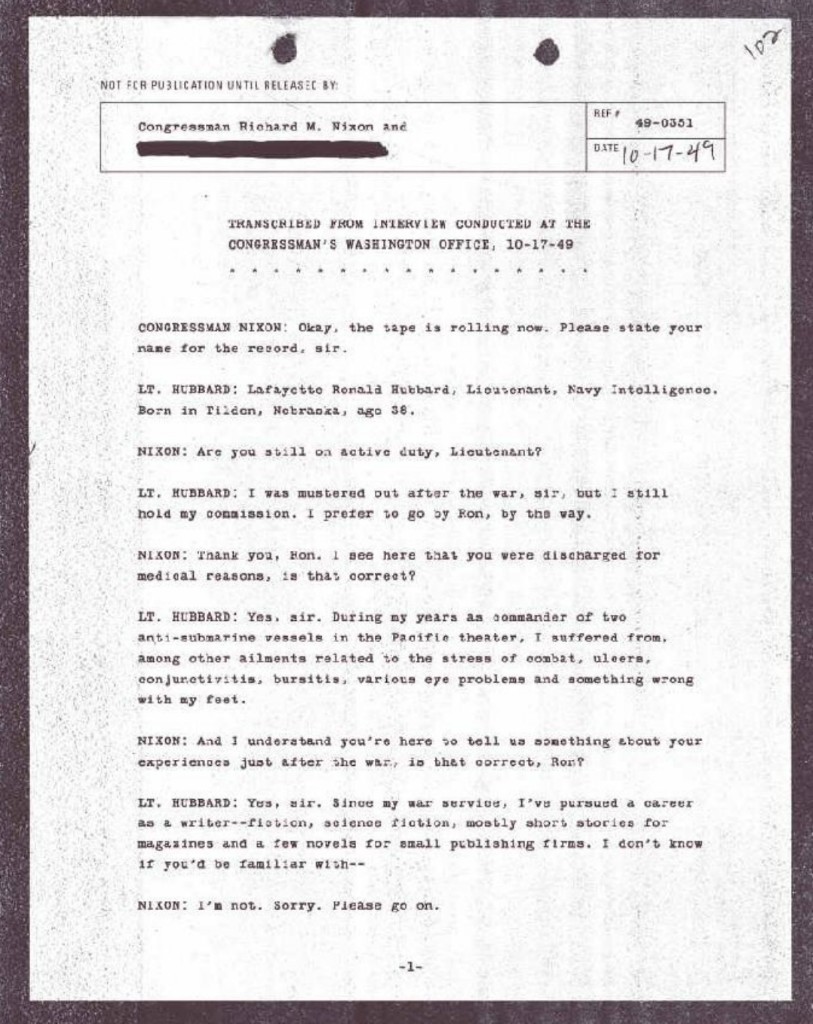
House of Representatives · PERSONAL & CONFIDENTIAL · interview 17 Oct 1949 · REF 49-0351
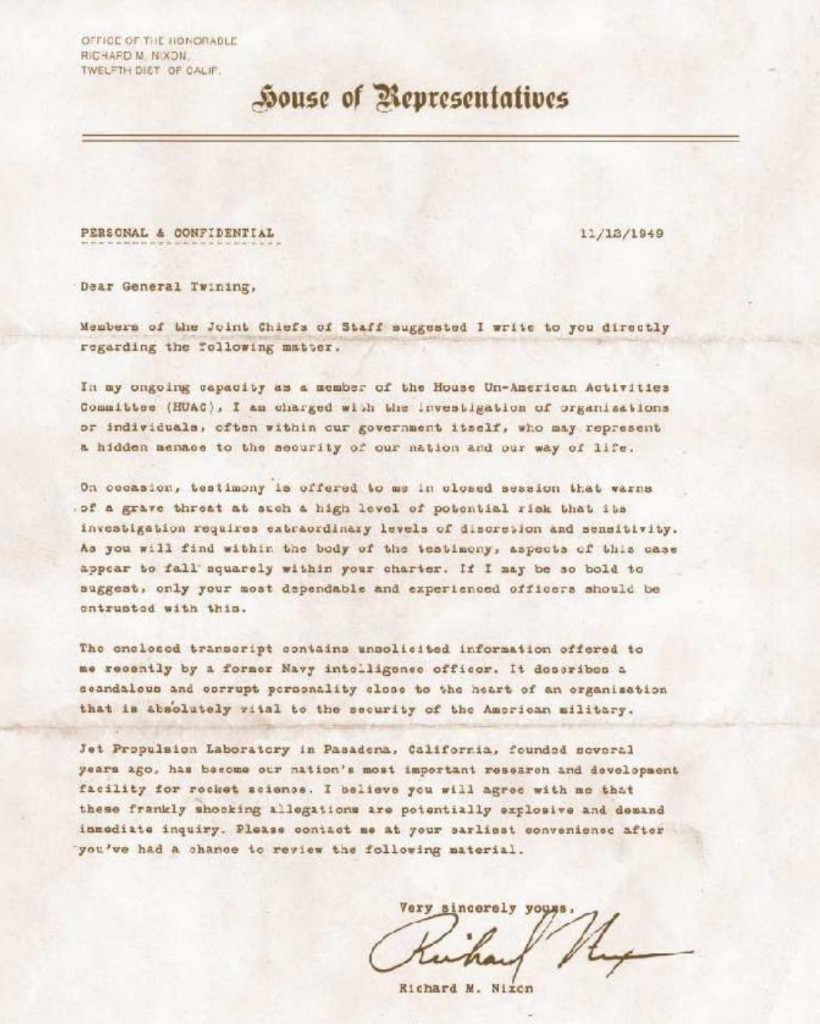
The chapter opens on paper: Congressman Richard M. Nixon writes PERSONAL & CONFIDENTIAL to General Twining (11/13/1949). Joint Chiefs steered him; as HUAC he flags closed-session testimony that needs only Twining’s most dependable officers. Enclosed: a tip about a “scandalous and corrupt personality” at Jet Propulsion Laboratory — “potentially explosive.”
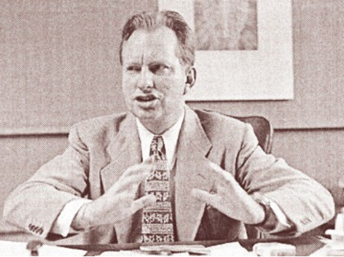
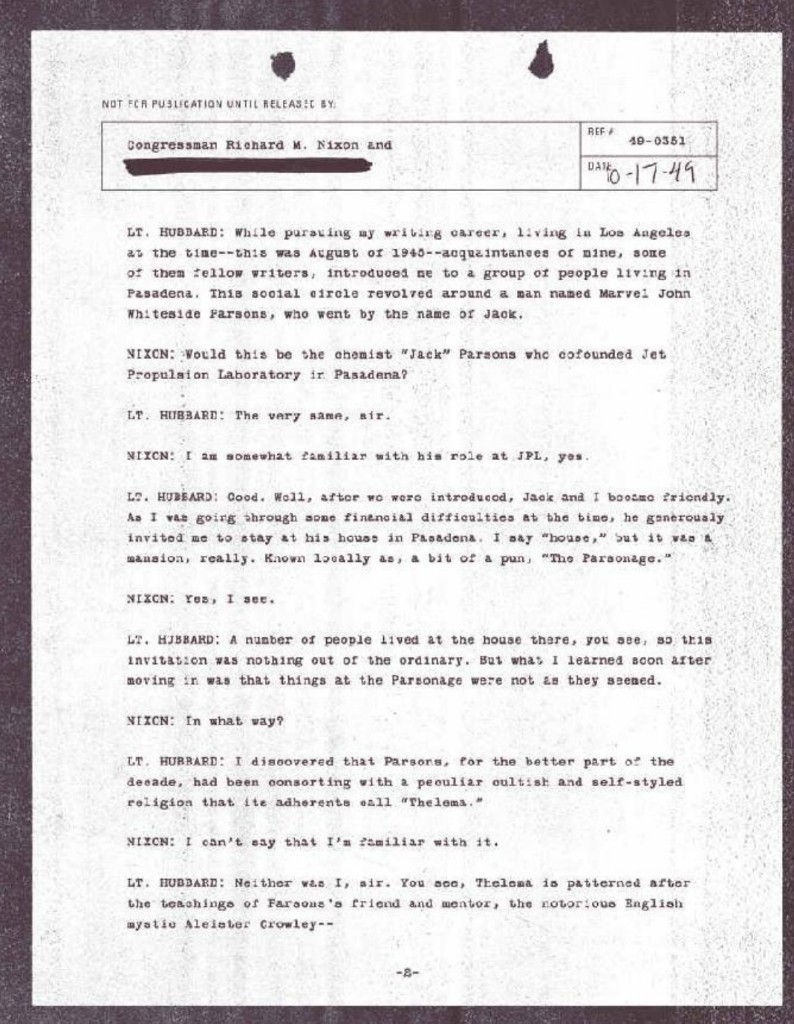
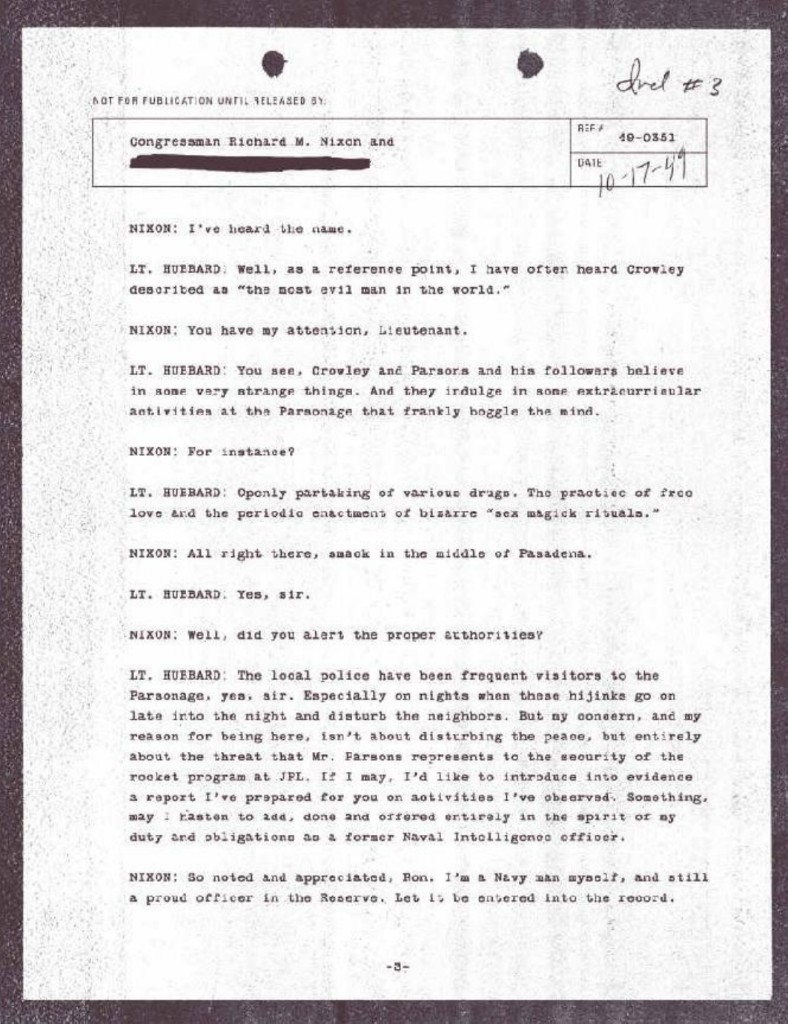
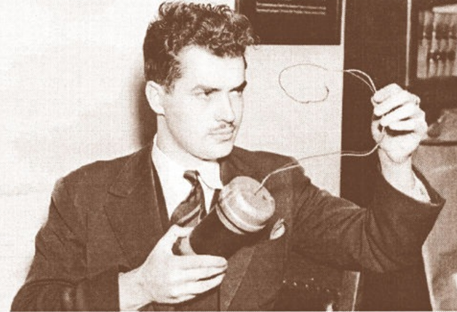
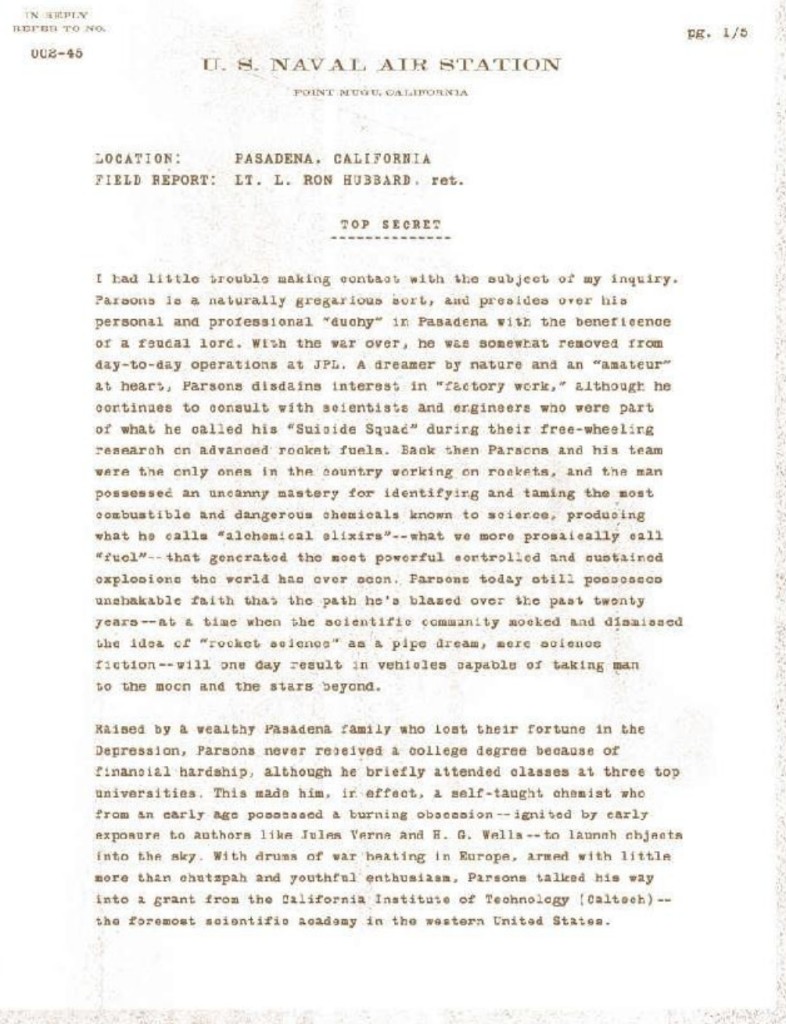
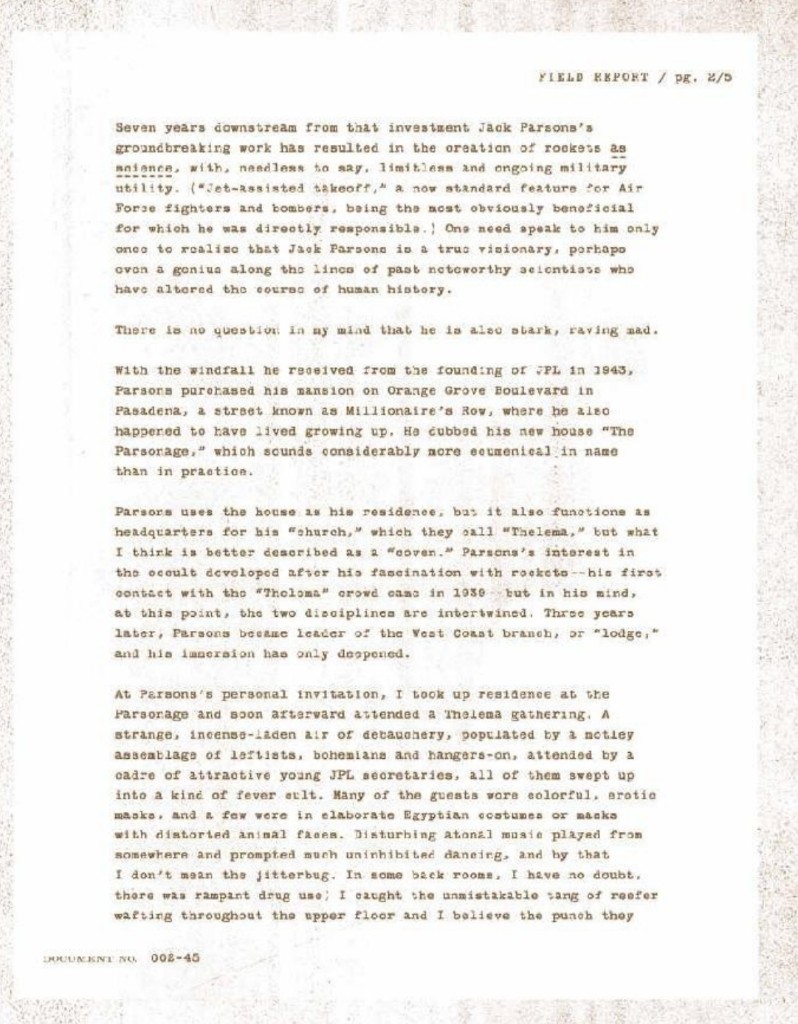
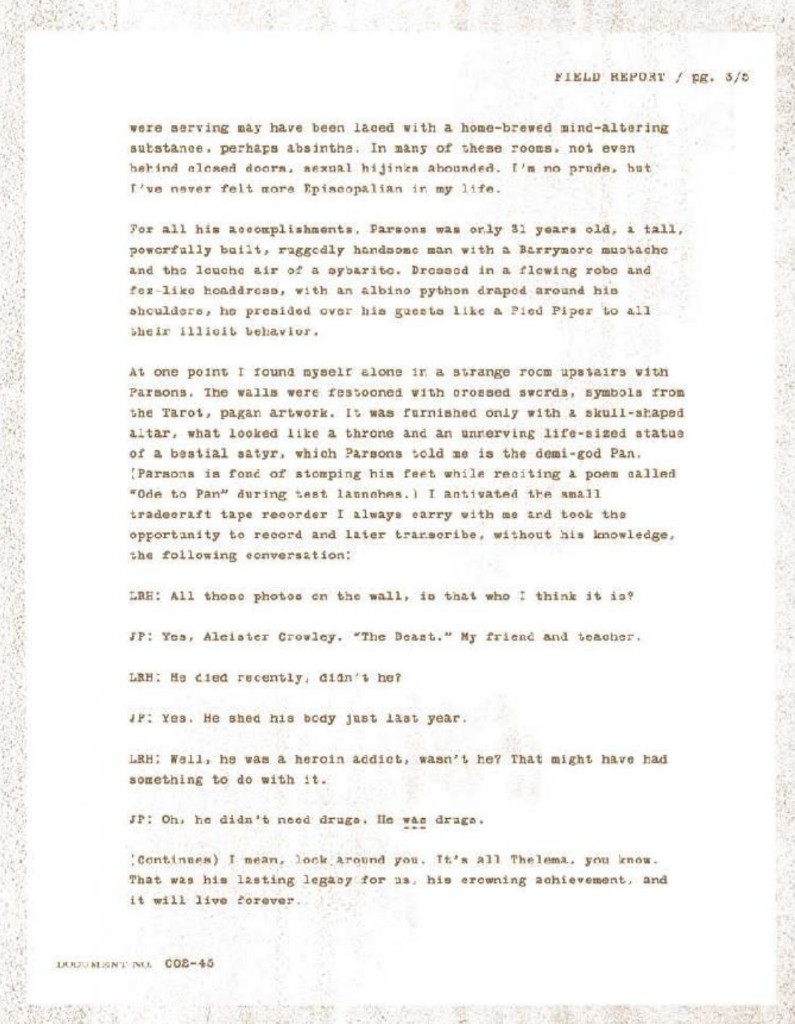
The enclosed voice is on tape from Nixon’s Washington office, 17 Oct 1949 (REF 49-0351). Lafayette Ronald Hubbard — Lieutenant, Navy Intelligence (mustered out, still holds commission; prefers “Ron”) — sells himself as Pacific ASW commander wrecked by ulcers and combat stress, now a pulp science-fiction writer. He places himself at the Pasadena mansion locals call the Parsonage from August 1945, guest of Marvel John Whiteside “Jack” Parsons, JPL cofounder. What he “discovered”: a decade of Thelema under mentor Aleister Crowley — “the most evil man in the world”; drugs; free love; “sex magick” rituals that bring the Pasadena police when the neighbors complain. His pitch is not the noise ordinance. It is that Parsons is a security threat to the rocket program — and he has a prepared five-page Point Mugu “field report” (see 04.4), offered “entirely in the spirit of… former Naval Intelligence.” Nixon, Navy Reserve himself, enters it into the record.
That tip puts Major Milford on Parsons. The Archivist’s margin is colder: Hubbard’s delay in talking smells like the con that cleaned Parsons out — money, Betty, a Miami yacht — before the congressman’s tape ever rolled. When Parsons’s clearance comes up for renewal, Grudge sends Milford to Pasadena under journalist cover. Three years of this case will shift the polar axis of the whole UFO file.
HELD as Nixon–Twining leaf + Hubbard interview plates (partial set in hand). Hubbard’s self-portrait CONTAMINATED as motive; Parsons/Crowley/Thelema substance is what the tip claims, not what the file yet proves. TP verifies Parsons’s JPL role; Hubbard’s later “undercover intel” story stays Archivist-rejected.
EXHIBIT · Nixon → Twining · 13 Nov 1949 — the cover letter that ships the Hubbard tip to Twining.EXHIBIT · L. Ron Hubbard, circa 1948 — the voice on the October tape.
Pasadena · Arroyo Seco · Thelema · Dec 1949 field report
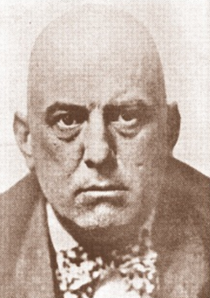
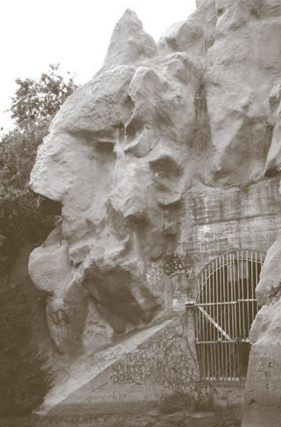
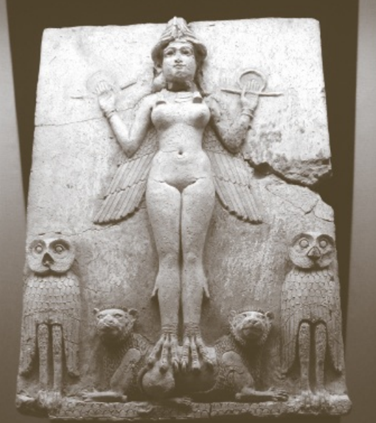
In a Manhattan Beach coffee shop Parsons talks rockets and magic in the same breath: Crowley rituals Hubbard helped him attempt in the desert — Jornada del Muerto, near White Sands / Roswell weather — “messengers of the gods,” grays, Nordics from the Dog Star. The Working of Babalon: calling forth an Elemental. A former Suicide Squad colleague walks Milford to the Devil’s Gate dam in the Arroyo Seco — rock face like a devil; Tongva name Hell Gate, a portal to the underworld. TP’s margin: Crowley wrote Parsons that Hell Gate was one of seven planetary gateways to hell and told him to “make use of it.” Off-record: Parsons and Hubbard tried to summon Babalon, Mother of Abominations; a second desert gate aimed at Crowley’s Moonchild. Cross-check of the cat-sitting weekend puts the Working just before the Roswell incident Milford personally half-witnessed. At the dam Milford feels the same animal fear he knew above the Pearl Lakes.
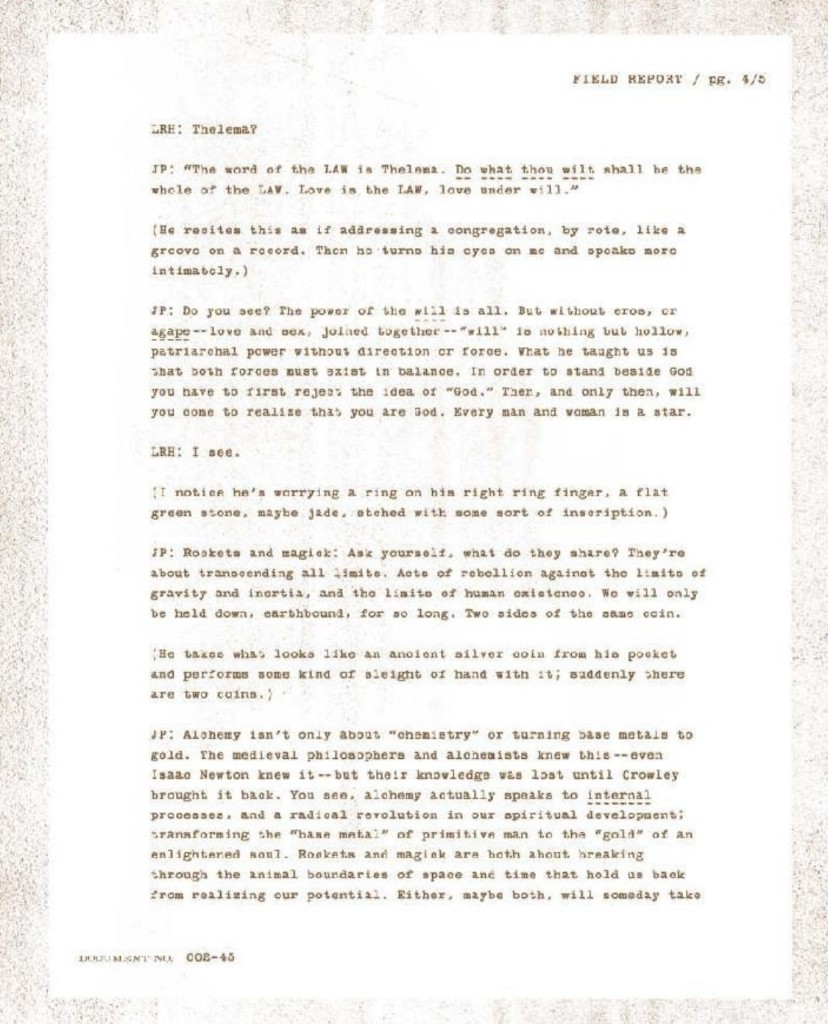
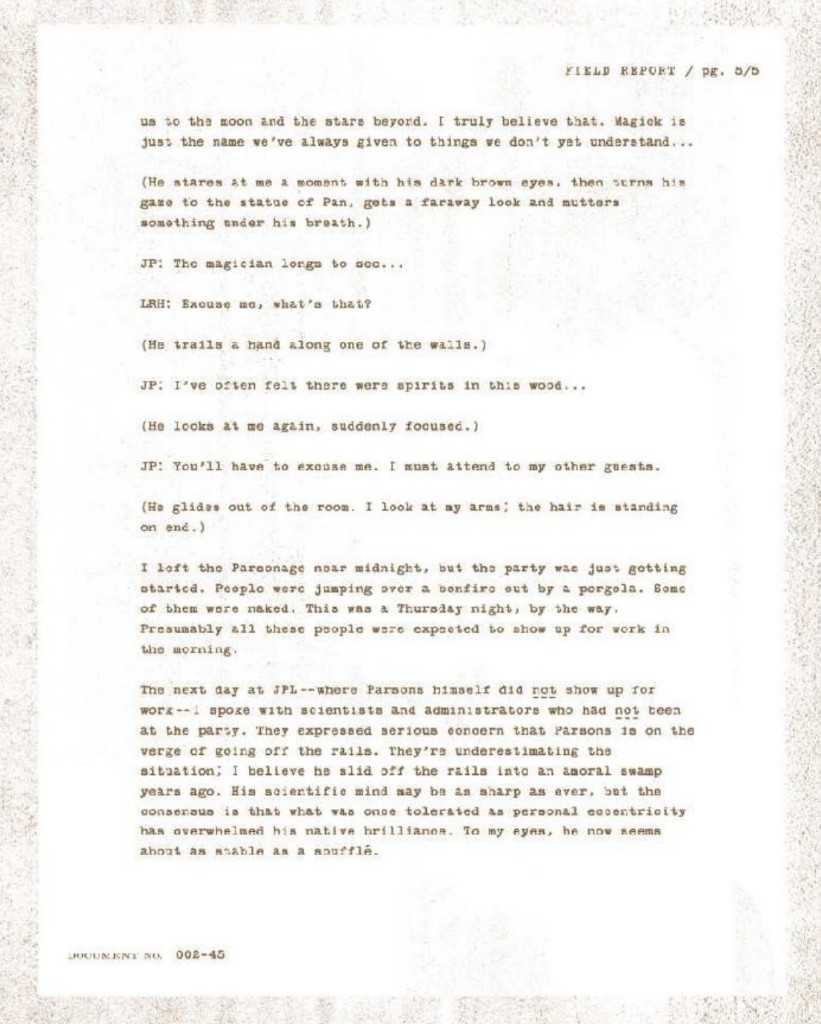
Beside Parsons’s face the dossier keeps the five-page paper Hubbard waved at Nixon: a Point Mugu / Pasadena TOP SECRET “field report” in Hubbard’s own voice — Contact easy; Parsons a feudal dreamer of the Suicide Squad, self-taught chemist of “alchemical elixirs,” sure his fuels will put man on the moon; also “stark, raving mad.” The Parsonage on Millionaire’s Row as Thelema “coven” since ’39; lodge nights of masks, Egyptian faces, reefer, laced punch, sex in open rooms; Parsons at thirty-one in robe and fez with an albino python, Pan’s statue upstairs, secret tape of Crowley as “The Beast” who “was drugs,” Thelema’s LAW, rockets and magick as one rebellion against gravity and God. Thursday bonfire, naked guests; Friday at JPL the sober men say he is going off the rails. Read it as Hubbard’s exhibit, not as clean intel — the same man the Archivist will later call a Cub-Scout-making liar when Dianetics invents the undercover legend.
The Archivist cuts that later respectability to size: after Dianetics (1950) Hubbard claimed he had only infiltrated Parsons’s “sex cult” as military undercover — “utterly without foundation.” Intel wanted him discharged in 1945; Thelema’s tenets bleed into the religion he builds. Same stretch: the week after the Working, a woman waits at Parsons’s door — Technicolor redhead Milford will see again behind a Buick wheel. TP names her Marjorie Cameron, second wife — the Elemental the ritual was meant to call.
Places, names, Crowley’s Hell Gate letter, and Milford’s Pearl Lakes rhyme are HELD as dossier. Roswell-from-the-Working stays LEAD / Archivist heat. Hubbard field report HELD as facsimile and CONTAMINATED as authorship/motive. Undercover claim HELD as rejected. Crowley, Parsons, field pages, Devil’s Gate, Babalon, Cameron plates HELD.
EXHIBIT · Crowley, date unknown — Thelema; Hell Gate counsel to Parsons.EXHIBIT · Jack Parsons at JPL, circa 1942 — rocket chemist; Babalon Working.
EXHIBIT · The Devil’s Gate, Arroyo Seco, Pasadena — Hell Gate; where Parsons worked the “explosive sciences.”EXHIBIT · “The Whore of Babylon,” Sumerian bas relief — dossier plate for Babalon / Mother of Abominations.
EXHIBIT · Marjorie Cameron — Parsons’s second wife; at the door after the Working; Scarlet Woman weather of the Babalon file.
Clearance denied — 1952 revisit — fire in the carriage house
Milford field reports · Dec 1949 · June 1952 · Parsons’s death
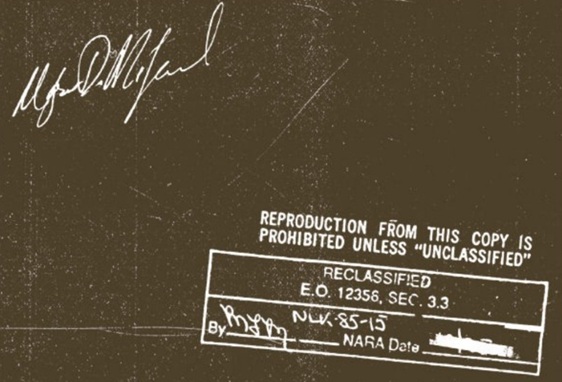
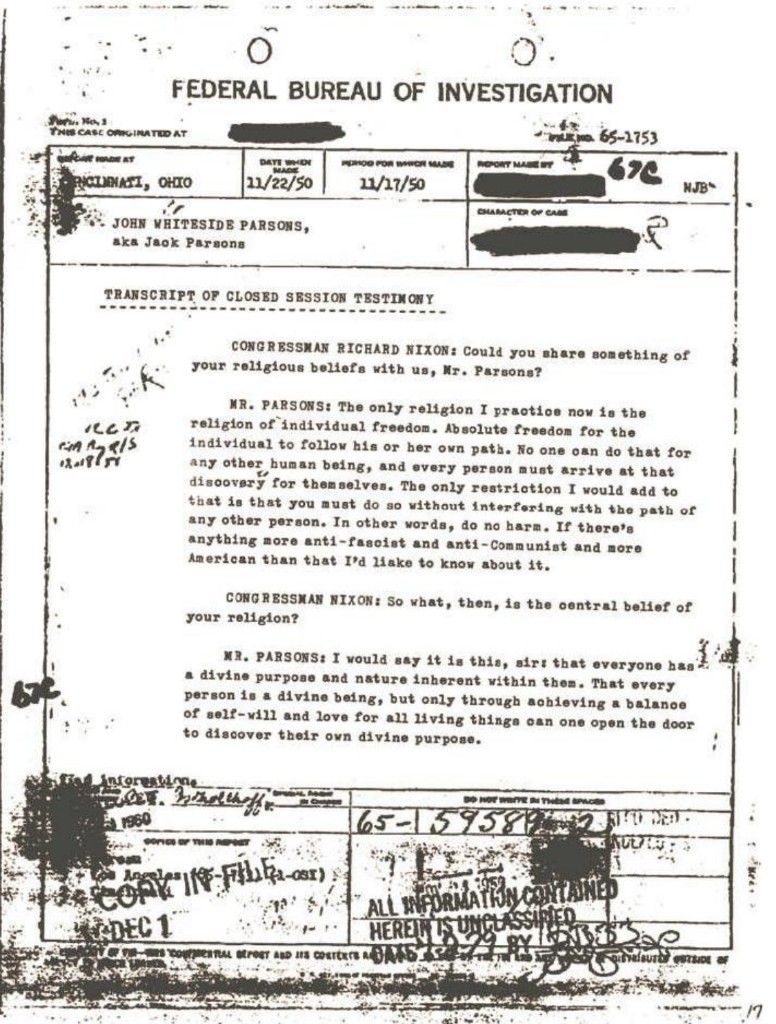
Milford’s 1949 conclusion: Parsons is not “evil,” only dangerously unfiltered — deny security clearance; sever all military/government association with Marvel John “Jack” Whiteside Parsons. The leaf closes under his own hand — Major D. Milford — with the reproduction ban and later NARA reclassification stamps (E.O. 12356) still riding the copy. HUAC then puts Parsons in closed session: an FBI Cincinnati sheet (11/22/50, file 65-1753) keeps Nixon asking about religion; Parsons answers with “individual freedom,” do-no-harm, and every person a divine being — Thelema without the name, sold as anti-fascist American creed. A fat FBI file finishes the public destruction; clearance stays dead.
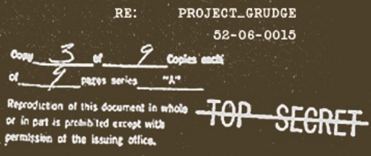
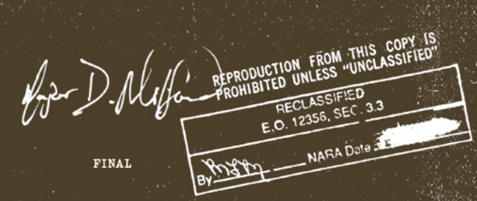
Parsons’s downward spiral continues — mechanic, orderly, bootleg pyrotechnics for war pictures — until another perceived security threat sends Major Milford back to Pasadena in 1952. The revisit opens under a Grudge header: RE: PROJECT_GRUDGE · 52-06-0015 · Copy 3 of 9 · series A · TOP SECRET struck through on the surviving plate. He finds a carriage-house lab of explosives, Thelema pamphlets, a pink room with a painted devil’s head — still living with Marjorie. Recommendation hardens toward containment: perhaps house arrest, lest he flee the country. The leaf closes FINAL under Major Douglas Milford.
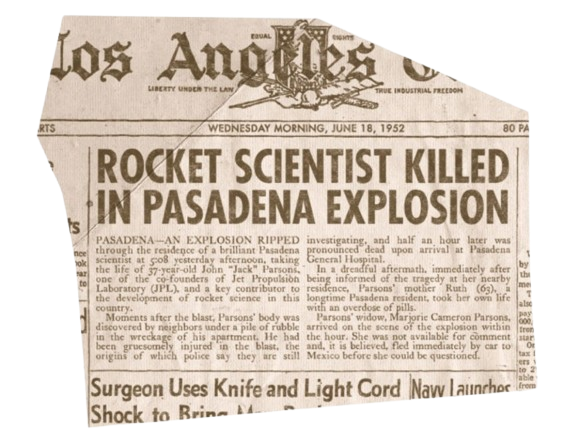
Days later the public sheet lands: Los Angeles Times, Wednesday morning, 18 June 1952 — “ROCKET SCIENTIST KILLED IN PASADENA EXPLOSION.” Blast at 5:08 the afternoon before; Jack Parsons, 37, JPL cofounder, found under rubble; dead at Pasadena General. Mother Ruth (63) takes her own life with pills on hearing the news. Widow Marjorie Cameron Parsons reaches the scene within the hour, gives no comment, and — the paper believes — flees by car toward Mexico before questioning. The dossier’s private weather stays uglier: fulminate of mercury, arm and face gone, “fire demon” gossip. JPL writes him out; decades later a crater on the moon’s dark side carries his name. For Milford the Parsons case is the polar shift — occult gate-talk and aerospace now share one file.
Field-report substance, signature blocks (1949 denial + 1952 FINAL), HUAC/FBI leaf, 1952 Grudge header, Times death plate, and death particulars HELD as dossier (TP on JPL/Parsons facts). Murder vs accident vs “demon” stays OPEN gossip. Paperclip Germans get the public credit; American occult chemist gets the dark-side crater.
EXHIBIT · Major D. Milford — signature closing the 1949 clearance denial.EXHIBIT · FBI · Cincinnati · 22 Nov 1950 — John Whiteside Parsons; Nixon closed-session exchange on “religion” / individual freedom.EXHIBIT · RE: PROJECT_GRUDGE · 52-06-0015 — header on the 1952 Pasadena revisit file (TOP SECRET struck on the plate).EXHIBIT · Major D. Milford · FINAL — closes the 1952 report (house-arrest suggestion; reproduction prohibited / NARA reclass).EXHIBIT · Los Angeles Times · 18 June 1952 — Parsons dead in the blast; mother Ruth suicides; Marjorie flees toward Mexico.
After three years of media debunking and public fury, Grudge’s “mass hysteria” summation fails. A quieter program replaces it: Project Blue Book. Milford is in the room when General Charles Cabell orders an open mind and “a good answer to the saucers.” Seventeen years of fieldwork follow — and off-books watching of Holloman rumors, “Wise Men,” a contact called M.
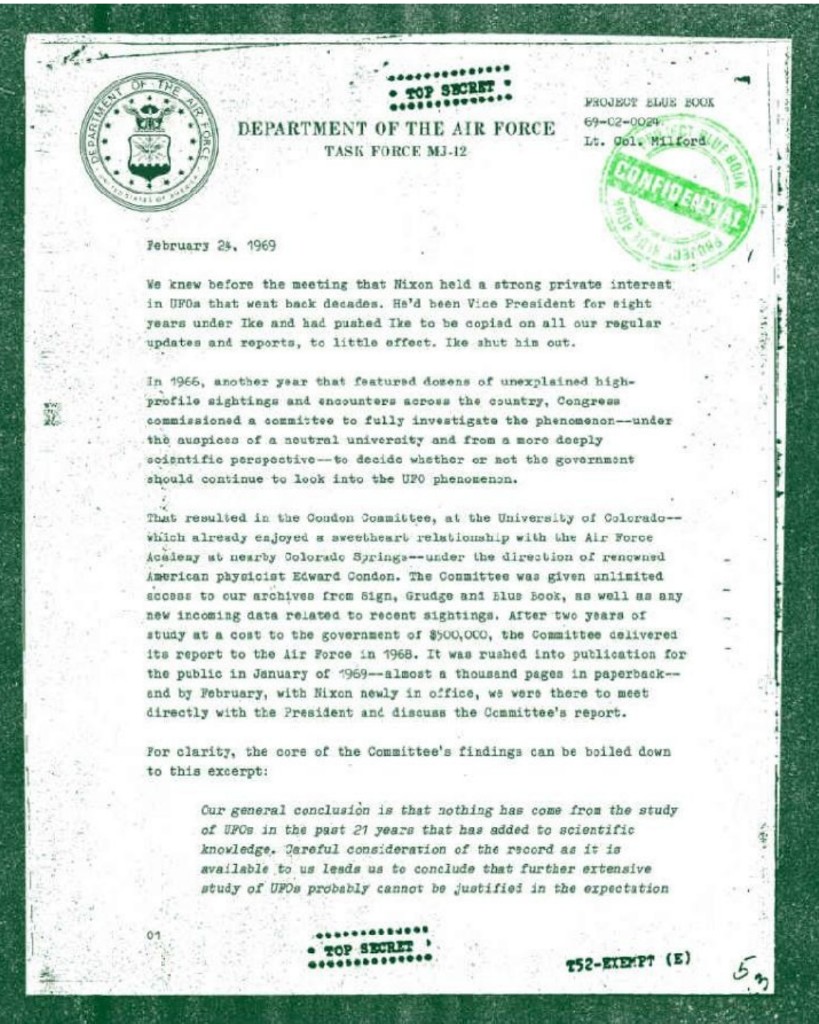
February 1969 closes the public book. Congress’s Condon Committee (University of Colorado) has rifled Sign, Grudge, and Blue Book archives and published a foreword that kills further study — while the body of the report still leaves a third of sampled cases unexplained. Hynek and Lt. Col. Milford brief the newly inaugurated President Nixon. Hynek calls the report slanted; Nixon interrupts with a boiler-room attack on Edward Condon (old HUAC enmity from Manhattan Project days), flings the report against the wall, thanks Hynek, and asks him to leave. Alone with Milford — first face-to-face after years of paper — Nixon pours Cutty Sark: Blue Book will be shuttered in months; moon this year, Mars talk later; keep a roster for a below-radar interagency task force, CIA cut out; find what the Skull and Bones “Wise Men” have sat on since Ike. Milford’s answer to “what are they?”: not nothing; not only extraterrestrial — some may be extradimensional, with us longer than we know, different forms at different times. Directive 200-2 is Catch-22 (disclose only what is already identified). Sighting math: thousands a month worldwide, maybe 3% reported. Handshake at the door: not a word. Outside, Hynek asks what they discussed. Milford says fishing.
Cabell opening HELD. Condon/Nixon/Hynek sequence HELD as Milford’s Blue Book journal (MJ-12 letterhead CONTAMINATED chrome — do not promote the header to held conspiracy). Extradimensional answer and Wise Men tasking stay LEAD inside that private room. Full multi-page facsimile set not mounted — substance carried in prose; one cover leaf shown.
EXHIBIT · Blue Book / 69-02-0024 · 24 Feb 1969 — cover leaf of Milford’s Nixon-room journal (full transcript held in prose).
Blue Book mothballed · moon landing week · Twin Peaks
Nixon’s prediction lands: 1969 kills Blue Book funding. The week after Armstrong and Aldrin walk, Douglas — sixty — “retires” to Twin Peaks (fly-fishing, oil painting) — the cover story he already used on Hynek. Within weeks Robert Jacoby dies; Doug buys controlling interest in the Gazette, modernizes it, renames it the Twin Peaks Post. That fall older brother Dwayne Milford — lifelong pharmacist who never left — wins his fifth term as mayor. Douglas’s front-page endorsement is the last kind word he ever speaks or prints about Dwayne. The old scoutmaster is now the town’s perpetual mayor; the younger brother who chased saucers now owns the paper.
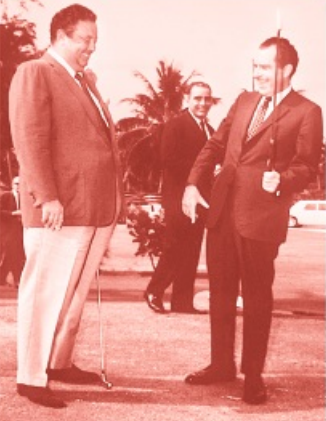
One stone left unturned from Nixon’s five and a half years: what Air Force Colonel Doug Milford, soon to be retired, did with the job Nixon had given him. Despite mounting legal trouble, Nixon makes good on the promise — an untraceable intelligence “carve-out” so Milford can carry a deeper UFO investigation with no official military or political oversight. Four decades of discreet interagency work let him pull a small trusted circle from different backgrounds. The last known direct contact: night of 24 July 1974, Nixon on a secure line from the Oval Office to Milford’s Twin Peaks residence — days before the presidency ends. Milford’s personal journal reconstructs the call.
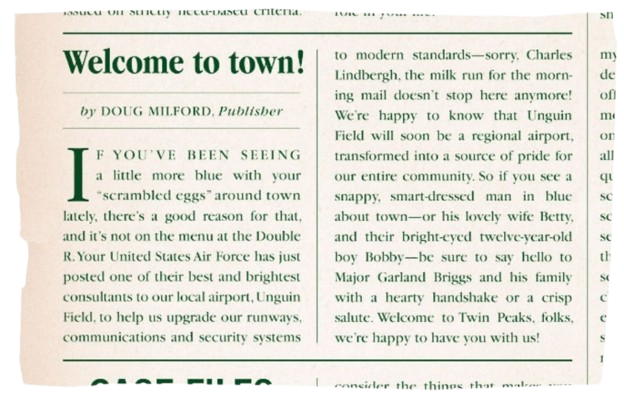
That same stretch of the calendar, a young officer from Fairchild AFB near Spokane moves to Twin Peaks on special assignment. Milford’s editorial in the Post, 15 July: “Welcome to town!” — scrambled eggs not on the Double R menu; Unguin Field upgrading to regional airport; say hello to Major Garland Briggs, wife Betty, twelve-year-old Bobby. Public weather for a private recruitment. The Listening Post years begin under a handshake the paper sells as civic pride.
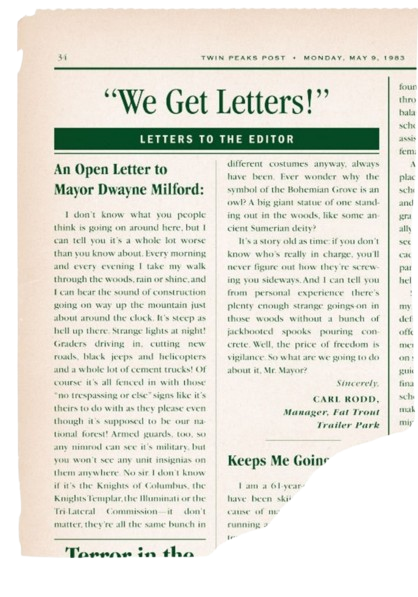
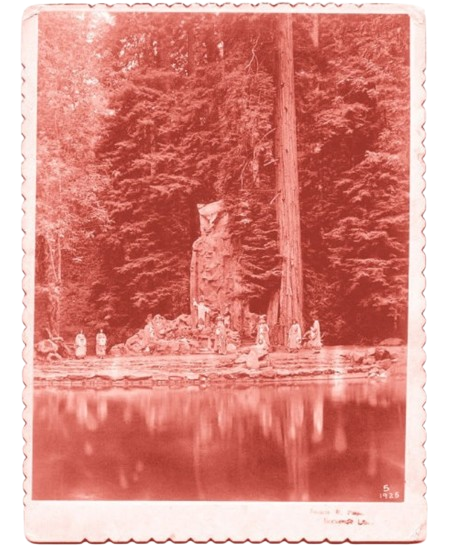
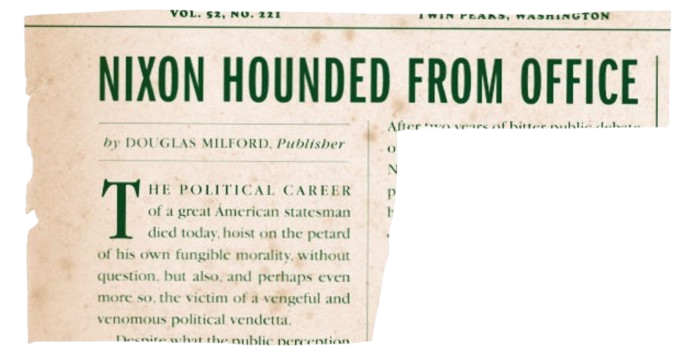
By 9 May 1983 the mountain has a civilian complaint on the letters page. Carl Rodd — Fat Trout Trailer Park, one of the Pearl Lake three — writes an open letter to Mayor Dwayne Milford: construction around the clock up the steep national forest, strange lights, graders, black jeeps, helicopters, cement trucks, “no trespassing” fence, armed guards with no unit insignia. Bohemian Grove owl talk; Knights Templar / Illuminati costume parade. “There’s plenty enough strange goings-on in those woods without a bunch of jackbooted spooks pouring concrete.” The price of freedom is vigilance — what will the Mayor do? The paper prints the letter under Doug’s masthead — without telling him. First act when he returns from a business trip: fire the assistant editor who put the edition to bed. Second: pay a visit to his brother, the mayor. Tension has been building since Douglas retired home — or, more precisely, since he was born. An editorial Douglas ran the day after Nixon resigned in 1974 certainly did not help: “NIXON HOUNDED FROM OFFICE” — great statesman hoist on fungible morality, and also victim of vengeful vendetta.
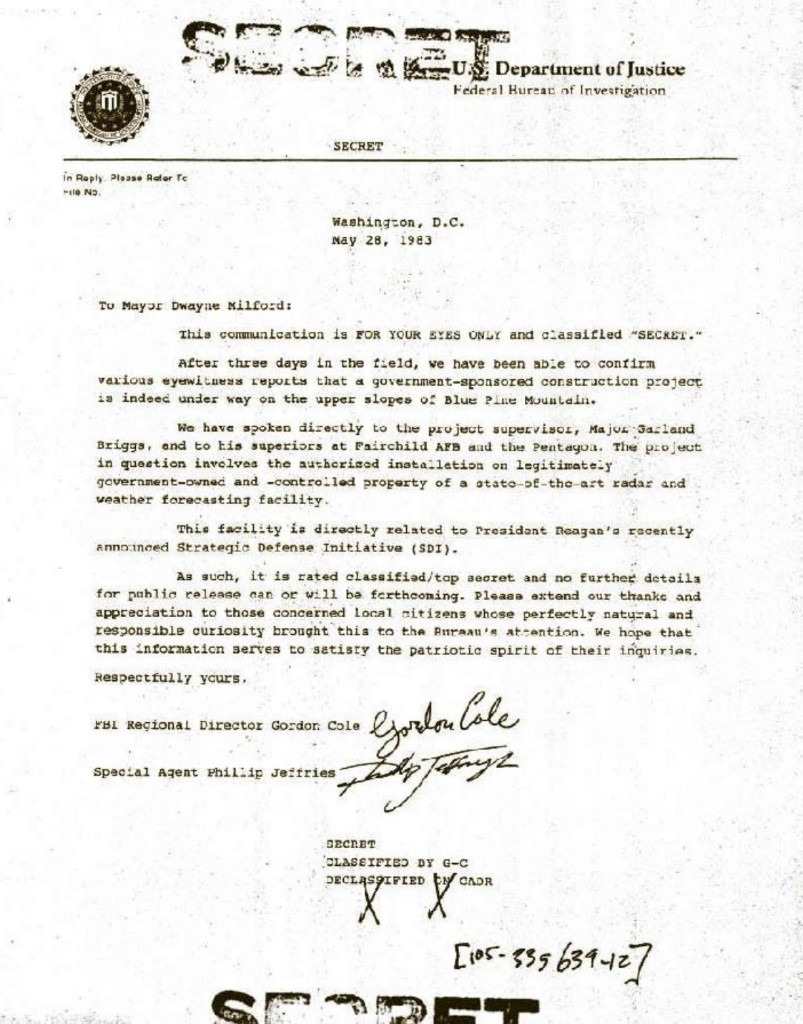
Dwayne takes him up on it. A regional FBI supervisor and a special agent hang around a few days for a “thorough investigation,” then a week later hand the Mayor a SECRET leaf dated 28 May 1983: FOR YOUR EYES ONLY — construction on Blue Pine Mountain confirmed; supervisor Major Garland Briggs (Fairchild / Pentagon); cover story a radar and weather facility for Reagan’s Strategic Defense Initiative; classified — thank the citizens for their patriotic spirit. Signed Gordon Cole, Regional Director, and Special Agent Phillip Jeffries. The Listening Post’s concrete stays in the dirt; the Bureau’s paper sells Star Wars weather.
HELD as the civic hinge between the Oval Office shutdown and the Listening Post years. Carve-out and July ’74 call HELD as dossier claim. Briggs welcome, Rodd letter, Bohemian Grove owl, Nixon editorial, and Cole/Jeffries SDI cover letter HELD. Brother rupture is dossier fact.
EXHIBIT · Nixon and Colonel Doug Milford — private weather of the carve-out years; last direct contact is the secure Oval call of 24 July 1974.EXHIBIT · Twin Peaks Post · Doug Milford, Publisher — “Welcome to town!” · Major Garland Briggs, Betty, Bobby · Unguin Field.EXHIBIT · Post · 9 May 1983 — Carl Rodd → Mayor Dwayne Milford: lights, cement, unmarked military on the mountain.EXHIBIT · Bohemian Grove owl, circa 1930s — TP plate; the owl Rodd names in the same letter weather.EXHIBIT · Post · day after resignation, 1974 — “NIXON HOUNDED FROM OFFICE,” by Douglas Milford, Publisher — ink that worsens the brothers’ war.EXHIBIT · FBI · 28 May 1983 — Cole & Jeffries → Mayor Milford: Blue Pine Mountain = SDI radar/weather; Briggs named; eyes only.
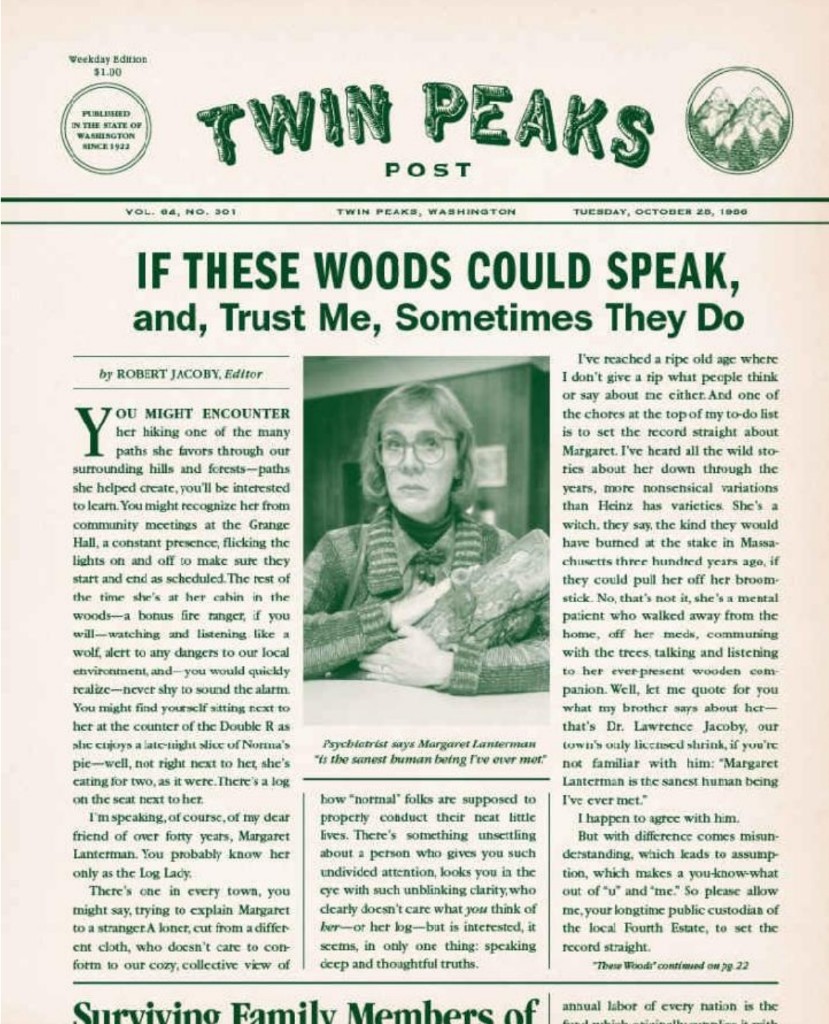
Robert Jacoby’s last Post column — Maggie Coulson grown into the Log Lady — three weeks before he dies.
05.1HELDFrost dossier
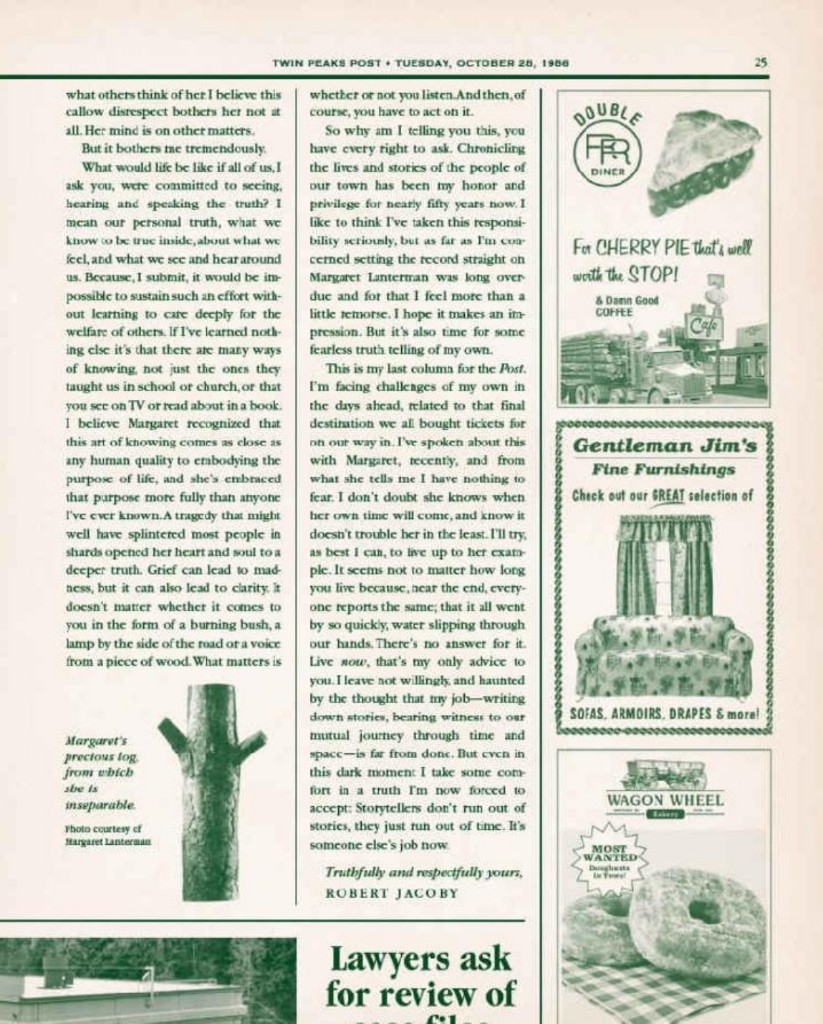
Twin Peaks Post — 28 Oct 1986
Robert Jacoby, Editor · “If These Woods Could Speak…”
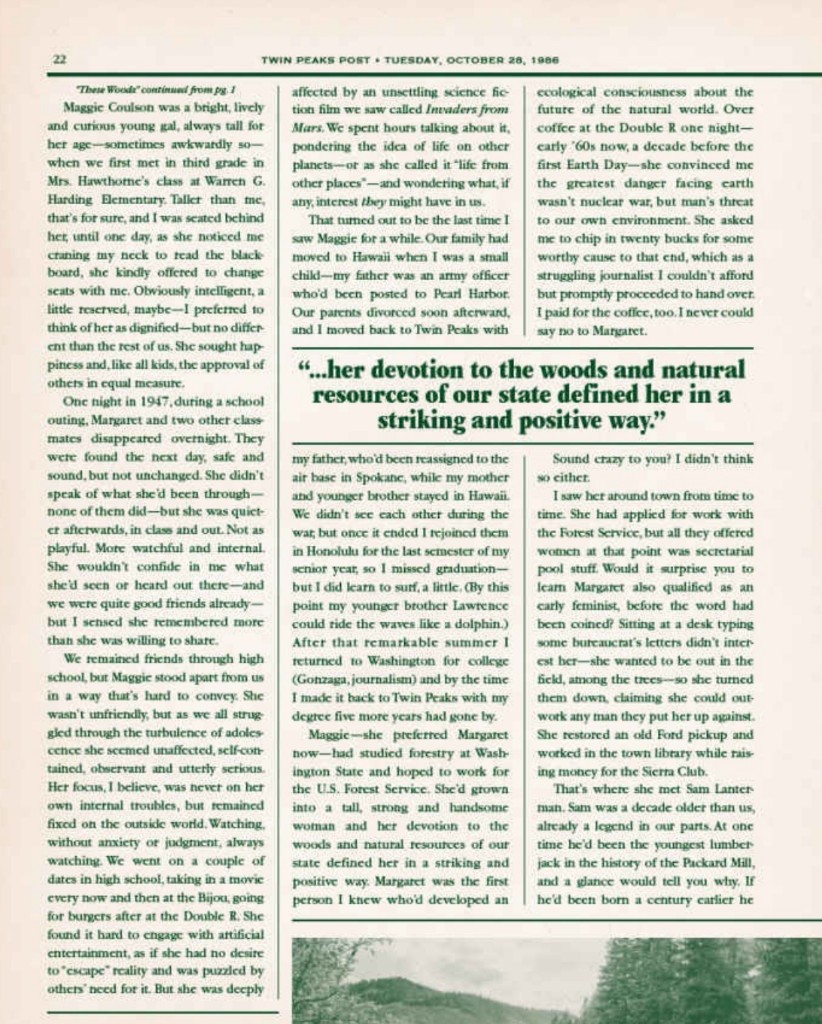
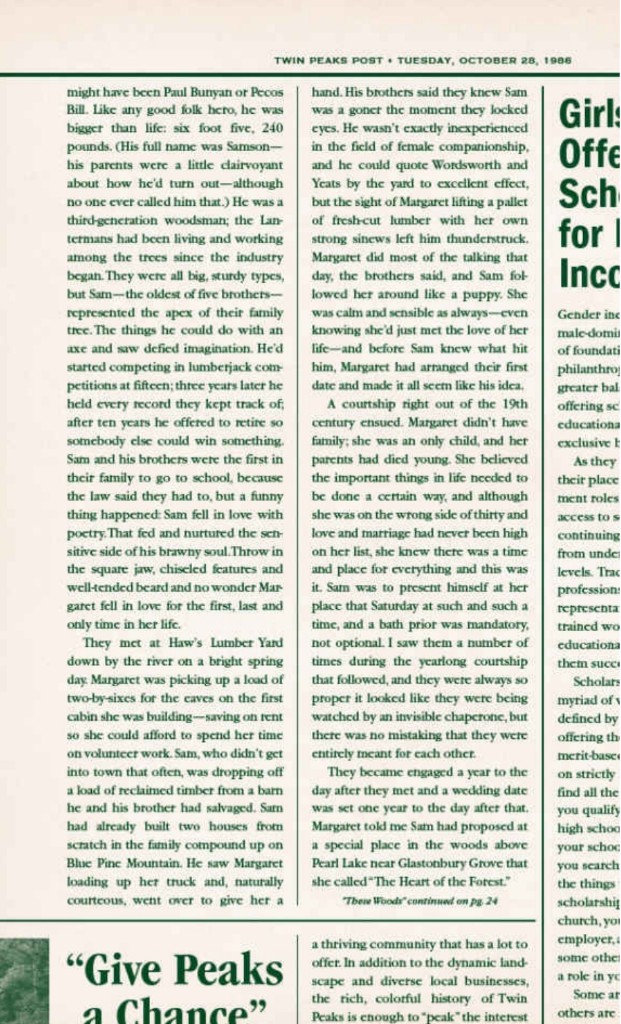
Jacoby defends his friend Margaret Lanterman — the Log Lady of Grange Hall and the Double R counter, log on the next stool — against witch and mental-patient gossip. Brother Dr. Lawrence Jacoby is quoted: she is “the sanest human being I’ve ever met.” The column walks her life: Maggie Coulson of Warren G. Harding, overnight woods of ’47 with two classmates (safe, not unchanged); forestry at Washington State, Forest Service door shut because she was a woman; library work, Sierra Club; then Sam Lanterman — Packard Mill legend, 6′5″ poetry-reading woodsman — met at Haw’s Lumber Yard, courtship like the nineteenth century, proposal at the Heart of the Forest above Pearl Lake near Glastonbury Grove.
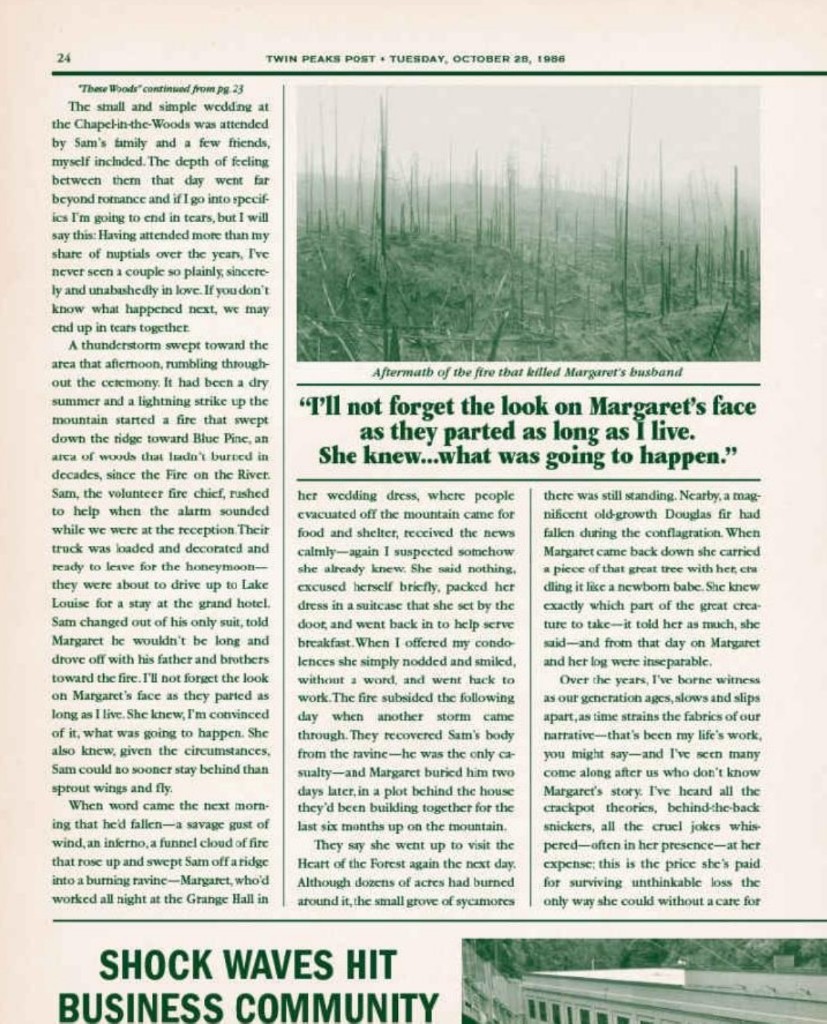
Wedding at Chapel-in-the-Woods; Sam volunteer fire chief. Reception night: lightning fire toward Blue Pine; Sam leaves to fight it; a funnel cloud of fire sweeps him into a burning ravine. Margaret returns from the woods with a piece of old-growth Douglas fir that “told her” which part to take — log and woman inseparable from that day. Jacoby signs off: this is his last column; challenges ahead, final destination; Margaret’s example of seeing, hearing, speaking truth.
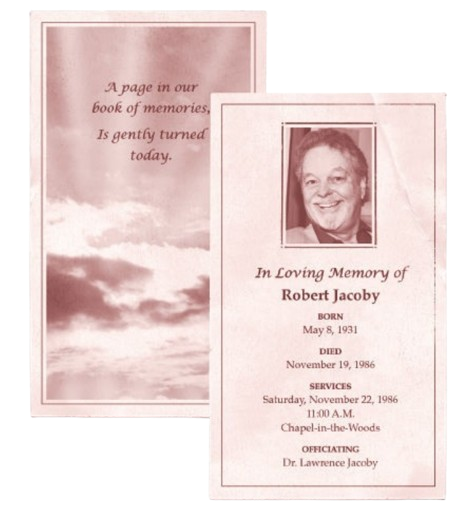
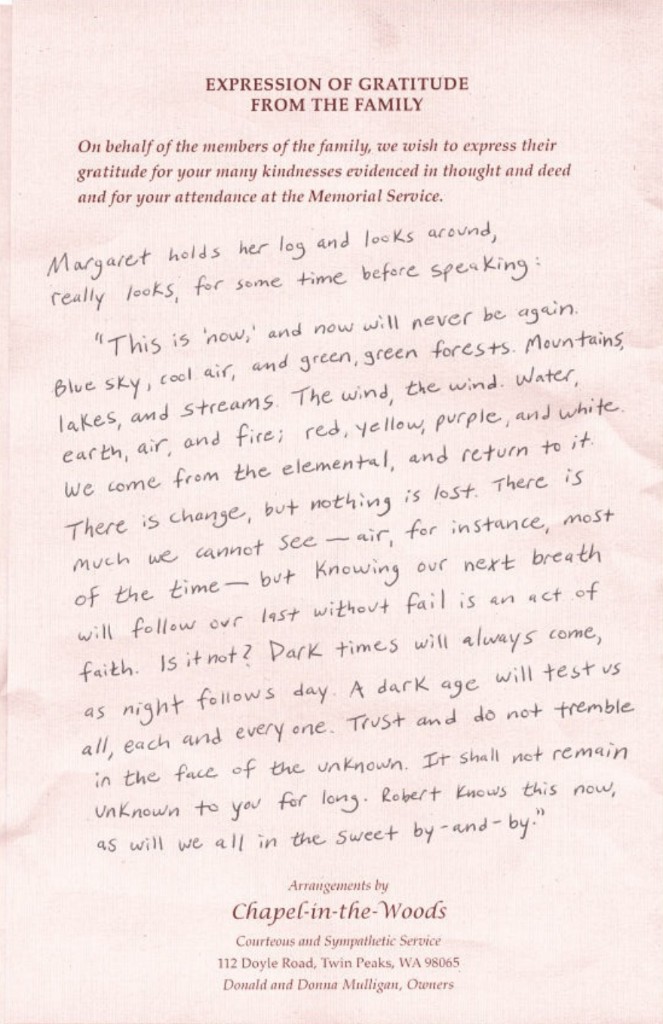
Three weeks later he dies of MS — 19 Nov 1986 (born 8 May 1931). Services Saturday 22 Nov, Chapel-in-the-Woods; Lawrence officiates; over two hundred; ashes on Pearl Lake’s steel blue. On the shore Margaret asks to speak — log in her arms — “now will never be again”; elemental return; a dark age will test us; trust the unknown; “Robert knows this now.” The Archivist is in the congregation; TP hunts the guest register for his name and hand.
HELD as dossier facsimile of Jacoby’s farewell column, funeral card, and Margaret’s shore words + Archivist funeral note. Childhood Pearl Lake night cross-links 03 Local.
p.1 · woods that speakp.22 · Maggie / ’47Sam · Heart of Forestp.24 · fire / the logp.25 · last column
EXHIBIT · funeral card — Robert Jacoby · Chapel-in-the-Woods · Lawrence officiating.EXHIBIT · Margaret at the shore — “a dark age will test us all”; Archivist’s remembered hand.
EXHIBIT · Dr. Lawrence Jacoby — letterhead weather of the brother who officiates.
Bureau language for the unclassifiable — story year 1975, before Listening Post succession.
06.1HELDScreenFrost dossier
Blue Rose origin — Lois Duffy / doubles (1975)
Story year 1975 · spoken on screen in The Return Parts 12 + 14
Albert calls it case number one. In 1975, young field agents Gordon Cole and Phillip Jeffries investigate a murder in Olympia and approach a motel room to arrest suspect Lois Duffy. A gunshot sounds. They kick in the door and find two identical women: one on the floor with a bullet wound to the abdomen, the other backing away with the gun. The wounded woman is Lois Duffy. She says, “I’m like the blue rose,” smiles, dies, and disappears before their eyes. The armed woman is also Lois Duffy; Lois had no twin sister. Awaiting trial for a murder she insists she did not commit, the surviving Duffy hangs herself. Tammy supplies the working key: a blue rose does not occur in nature; the dying woman was likewise unnatural — conjured, a tulpa. The scene certifies an impossible double and a Bureau phrase, not which Lois was primary or what made either one.
Part 12 supplies the institutional frame: after the Air Force closes Project Blue Book, the military and FBI form a top-secret task force to pursue the “troubling abstractions” its ordinary answers left behind. The dying woman’s phrase becomes Blue Rose; Gordon recommends Jeffries to head the squad, and Jeffries recruits Albert, Chester Desmond, and Dale Cooper. Frost’s dossier lays parallel weather already carried in 04.6–04.7: Nixon tasks Milford with a below-radar interagency continuation, leaves him an untraceable carve-out, and points him toward FBI allies before the presidency ends; by 1983 Cole and Jeffries are signing the SDI cover letter that protects Listening Post Alpha. The lines converge, but they do not produce a clean published org chart. Frost is not the source of Lois Duffy’s story, and alignment does not prove that every off-books program was one formally named unit.
HELD as screen dialogue: Part 12 for the task-force frame, Part 14 for Lois Duffy and the 1975 case. Tammy identifies the dying Duffy as conjured — a tulpa — but that remains her deduction; whether the diagnosis is complete, which Duffy was original, who made the double, and how this event relates to other doubles stay OPEN. Frost’s Milford / Cole alignment is HELD as dossier weather, not as the source of the name. The classification does not automatically rename every earlier Sign, Grudge, or Blue Book paper “Blue Rose.”
Late-eighties civic Doug first — then the handoff to Garland Briggs (after 1975 Blue Rose naming; after Briggs’s 1979 sighting).
07.1HELDFrost dossier
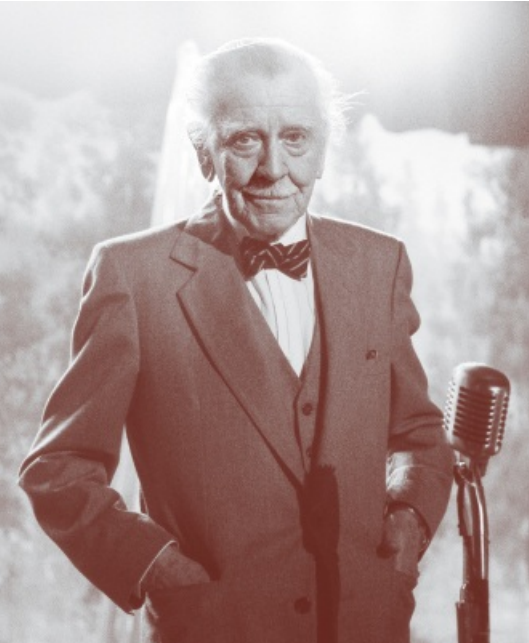
*4* Colonel Douglas Milford — late 1980s face
Twin Peaks · publisher of the local paper · before the handoff named
Every man has his weakness. By the late 1980s, as members of their generation began exiting the planet in greater numbers, few citizens were left in town who remembered Doug Milford’s early troubled years or even his decades-long military career away from Twin Peaks. Most knew him now only as the friendly, avuncular and somewhat eccentric owner and publisher of their local newspaper. He was often spotted driving around town in a forest-green two-seat convertible Morgan, an antique British racing car, wearing scarf, goggles, racing cap and gloves. As he aged Doug lost his hair, wore a bad toupee for a time, then lost his vanity, ditched the rug and settled on a jaunty beret. His conservative politics, particularly during the Reagan years, had moved slowly closer to the middle, or rather the middle had moved closer to him.
His long, deep undercover career as a key figure throughout the shadowy history of Air Force intelligence and UFO investigation, or his even stranger later years as an independent operative supervising an undercover mission assigned to him by a disgraced former president, remained a secret he kept from every single soul he encountered. Except one. More on that in a moment.
By all appearances, Doug Milford had money. He lived in a big house on a five-acre spread outside of town. He owned a small fleet of luxury automobiles — including the Morgan — which he stored in a custom garage. An urbane, sophisticated figure, he wore fashionable bespoke clothes and left sizable tips at local restaurants. No one knew where his fortune came from — well beyond what one would expect for a retired colonel living on an Air Force pension — or, even more mysteriously, how he’d managed to hang on to it through four divorces. (As I said, every man has his weakness.) By the late 1980s, Douglas had become a pillar of the community, and the curiosity aroused by his apparent fortune subsided.
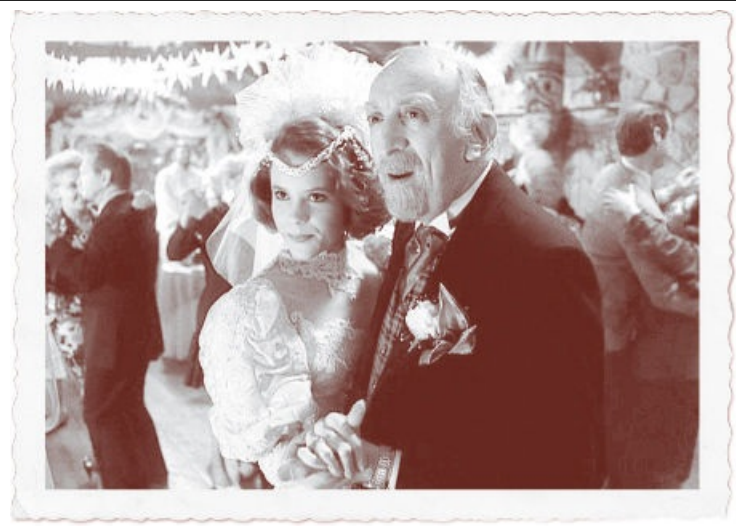
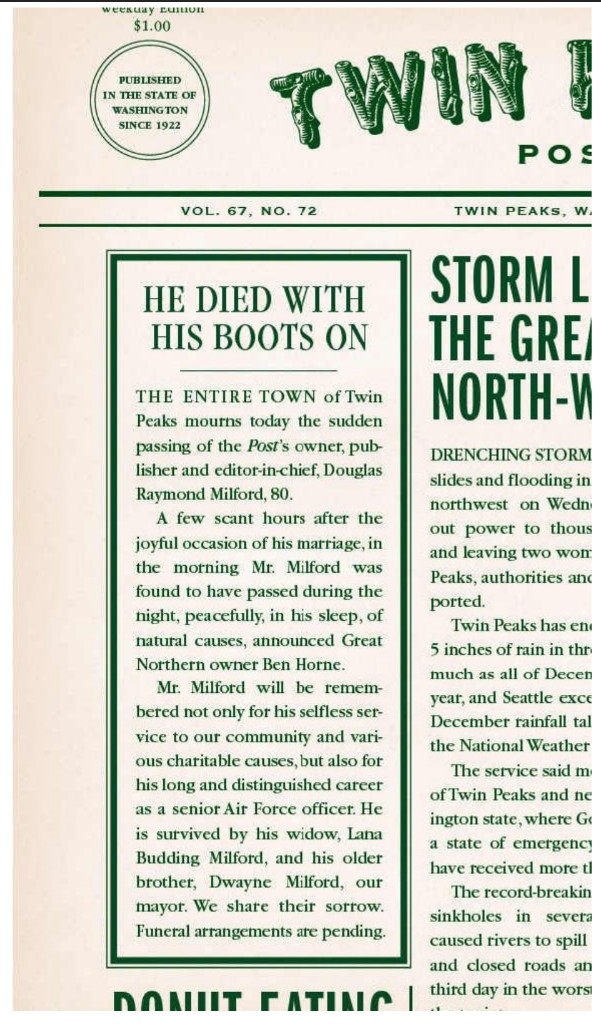
HELD as dossier civic portrait (*4* Colonel Douglas Milford) after the Kauai / Laura leaf in book order. Toupee → beret, Morgan, four divorces, Nixon-era independent mission — all in the leaf. Wedding plate with Lana Budding; then the Post itself mourning its publisher — “He Died With His Boots On,” natural causes hours after the marriage, Ben Horne announcing, survivors Lana and brother Mayor Dwayne. “Except one” = Briggs; handoff cards follow. Do not collapse this public face into Feb 24 Case 89 procedure.
EXHIBIT · Colonel Douglas Milford — late face the town knew.EXHIBIT · Doug’s and Lana’s wedding.
EXHIBIT · Twin Peaks Post — “He Died With His Boots On.” Click to enlarge.EXHIBIT · The widow Milford — Lana Budding Milford.
Pearl Lakes · concrete patio outside the control room · after the work was finished
Briggs’s closing leaf fixes the evidence chain before it releases the dialogue. On May 17, 1985, not long after the work at Listening Post Alpha was finished, he and Milford sit on the concrete patio outside the control room overlooking Pearl Lakes. Milford has brought Cuban cigars and fine red Bordeaux to mark the occasion. Briggs believes they are talking privately; Milford is recording them without his knowledge. Nearly four years later, the day after Milford dies, Briggs finds the tape waiting on his desk, apparently left there by Doug. He transcribes the surviving conversation from that point forward on “my faithful Corona.” The artifact therefore carries distinct layers: Milford and Briggs speaking in 1985, Briggs framing and typing the exchange after the 1989 death, and TP later reading the dossier. It is not an official meeting minute or an omniscient flashback. It is Briggs’s first-person account of a covert recording, and the tape is the hinge that preserves both the threshold test and the handoff that follow.
HELD as Briggs’s frame for the Corona transcript that follows. Date and setting (patio / Pearl Lakes / control room) HELD in the leaf; the secret recording and posthumous desk delivery HELD as dossier claim. Transcript substance: 07.3.
EXHIBIT · My faithful Corona — the machine that types the patio tape into the ledger.
Milford recruits Briggs · Corona transcript of the May 17, 1985 tape · includes Briggs’s Aug 1979 sighting
Milford does not begin with a clearance packet. He presses Briggs to respect the unknown long enough to cross a threshold, and the conversation turns to a secret Briggs has already carried across one. In August 1979, while co-piloting an F-4 Phantom over western Montana’s Bitterroot country, Briggs and his pilot see a silvery, crescent-shaped craft. The pilot argues against an official report — too much paperwork, too many questions — and Briggs initially agrees. He later sends an anonymous account to the Mutual UFO Network rather than let the sighting disappear completely. Within the transcript’s recruitment logic, that choice is evidence of fit: a disciplined officer obeys in the cockpit, then quietly preserves the anomaly when procedure demands silence. It is not objective proof of what flew over Montana. Milford uses the disclosure to move Briggs from the Strategic Defense cover toward the older hidden inquiry; Briggs realizes the colonel is not the man he thought he knew. The next beats reveal Milford as witness as well as recruiter: the “white rabbit,” the promised replacement, and the marks under his sleeve.
Dialogue and sighting claim held inside the Archivist’s first-person succession narrative. Object identity OPEN. The “one” soul who knew Doug’s shadow work — and who found the tape.
Briggs · after the woods encounter · Betty notices
Throbbing pain on the back of my neck. Betty noticed there were marks, symbols really, carved, burned or branded there. Interlocking triangles. I’d seen these marks before. On the bodies of other “abductees” — the three children who’d been lost in these woods: Margaret Lanterman, Carl Rodd and another boy who’d moved away and since passed on. And Doug Milford. Now whatever force or thing this was had placed its mark on me. Yes, I thought, as resolve flooded back to me…
HELD as Briggs’s first-person claim in the succession leaf. Sketch plate sits with the sentence. Cross-link Pearl Lake kids (03 Local) — marking trail already noted on Margaret / Rodd plates; neck triangles are the shared brand language here. Ontology of the force OPEN.
EXHIBIT · Interlocking triangles — the mark Betty found on Briggs’s neck; the same brand on Milford and the Pearl Lake three.
Writing in the dossier after Milford’s death, Major Garland Briggs discloses that the transfer itself began years earlier. Milford had handpicked him, arranged his move from Fairchild, and let him build, develop, and run Listening Post Alpha under the belief that the Blue Pine Mountain facility belonged to the Strategic Defense Initiative. On the May 17, 1985 tape, the cover drops. “You’re not who I thought you were,” Briggs tells him. Milford answers as the white rabbit leading him toward the hole: Briggs is his replacement, the coming “Watcher in the Woods.” He then opens the buried chain “from Roswell to Nixon” and names the station’s actual brief — monitor for intelligent nonhuman life not only in deep space but in the immediate surroundings of Twin Peaks. Finally he turns over the dossier already assembled across his long career: “This is your job now.” Briggs inherits a mission and an existing, layered archive, not a blank binder. Milford supplied much of the historical file; Briggs types Archivist notes, adds local and contemporary material, and becomes its custodian and co-author. The disclosure identifies the Archivist without granting him omniscience, and it keeps the later arrival of another “control” as an unresolved operational question.
Succession and LPA mission as spoken by Briggs held as Frost first-person (Secret History). Cover story (SDI) vs. True intent is part of the same held confession. Later Final Dossier language that calls LPA a “Blue Rose station” is 2017 annotation — not a date on this arc. Mayday terminus: Arc 04 · 08.3.
Letter to Garland — the full truth as I’ve come to view it
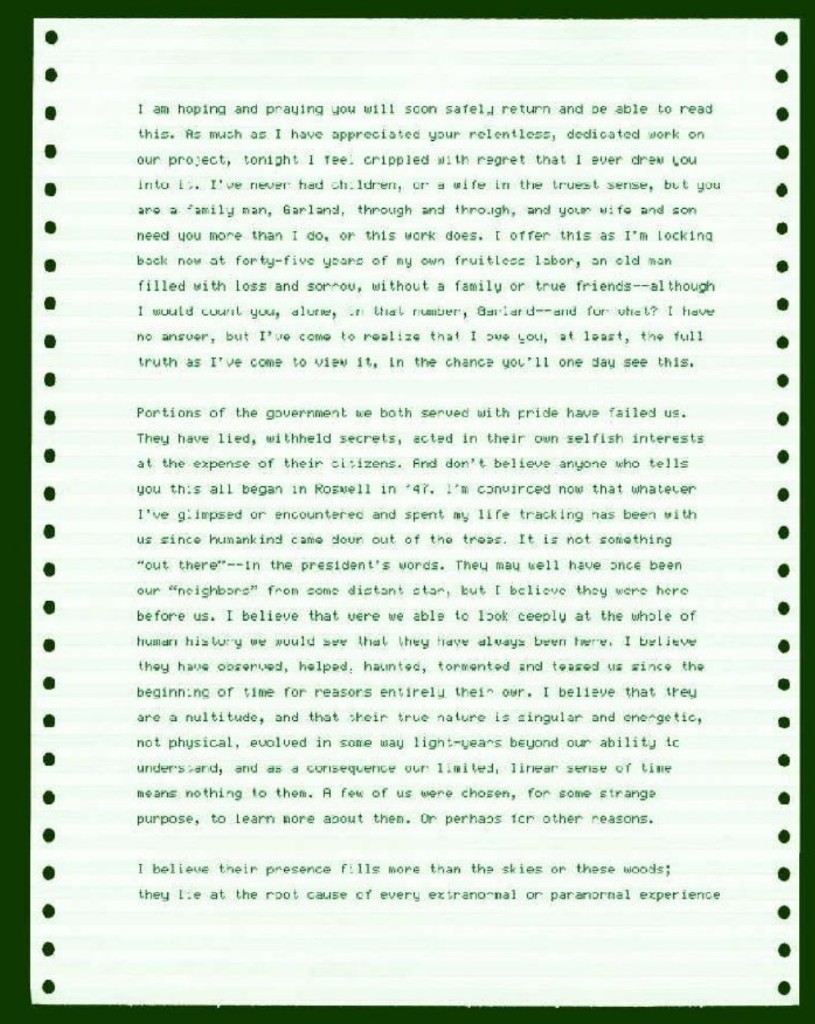
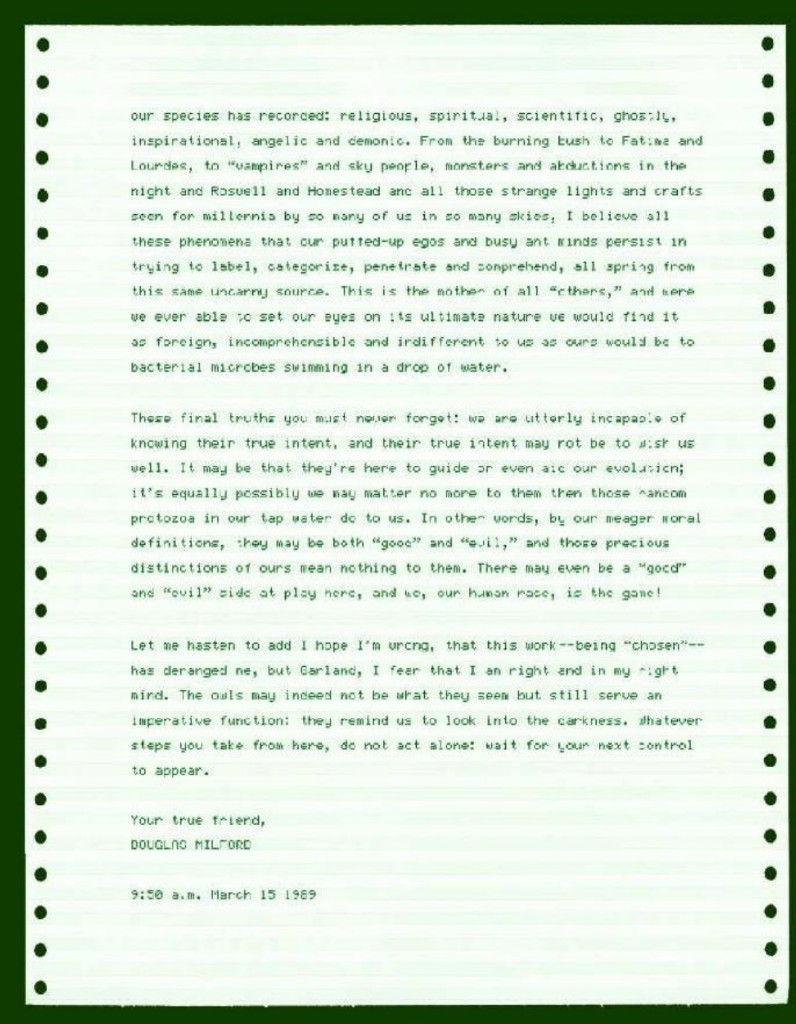
Douglas Milford → Major Garland Briggs · tractor-feed print · dated 15 Mar 1989, 9:50 a.m. on the closing leaf
Dot-matrix pages left for Briggs: regret for drawing a family man into the work; government failure and lies that did not begin at Roswell ’47; presence older than humankind — not merely “out there,” but here before us, singular and energetic, beyond linear time. Burning bush, Fatima, Lourdes, sky people — one uncanny source, “mother of all others.” Good and evil may mean nothing to them; the race may be a game. “The owls may indeed not be what they seem but still serve an imperative function: they remind us to look into the darkness.” Wait for the next control. Signed: Your true friend, Douglas Milford.
HELD as dossier facsimile (not on the Dale Cooper character page — lives here with LPA succession). Ontology of the entities stays OPEN; the letter is Milford’s late confession, not certified cosmology. Date sits days before Case 89’s Mayday weather — do not merge into Feb 24 procedure.
EXHIBIT · p.1 — “I owe you, at least, the full truth…”EXHIBIT · p.2 — owls / darkness; wait for the next control. 15 Mar 1989.
The Secret History of Twin Peaks (Mark Frost, 2016) — PDF ~pp. 83–91 (Milford WWII → Roswell → Sign); ~92–132 (Lights in the Sky / Maury Island / Milford’s shadow); ~133–161 (Twin Peaks sightings; Project Sign; Estimate / Grudge); ~233–262 (The Coming of What? — Parsons, Crowley, Devil’s Gate, clearance & death); ~263–295 (Blue Book; home 1969; Post; Mayor Dwayne; Briggs welcome; Rodd / SDI cover); ~296–303 (Margaret Lanterman / Jacoby farewell column); ~304–312 (Jacoby Kauai — Laura / Madeleine / Jacques; see Arc 04); ~313–318 (*4* Colonel Douglas Milford — late civic face; Lana; Post obituary); ~319–325 (May 17 1985 patio tape / Corona; interlocking triangles; LPA handoff; Milford→Briggs letter 15 Mar 1989); dossier terminus / Tamara Preston seal — see Arc 04 Mayday. Page numbers = PDF reader order.
Twin Peaks: The Return Part 12 — Albert’s Blue Rose task-force history; Part 14 — Albert’s Lois Duffy origin account and Tammy’s tulpa deduction (Screen; story year 1975).
The Final Dossier (Mark Frost, 2017) — cited only as later annotation (e.g. LPA called a Blue Rose station); not placed as a 2017 chronological node in this arc.